Saturday, 27 July 2024

A Critical Ethnography of Social Media: The Strange Case of Missing Canadian Content on YouTube


There have been a number of, in my opinion, excellent Canadian television shows over the years including the innovative and influential Degrassi trilogy of The Kids of Degrassi Street, (CBC, 1979-1986) Degrassi Junior High (CBC, 1987-1989) and Degrassi High (CBC, 1989-1991),  Degrassi before Californication, Anne of Green Gables (CBC, 1985, 1987), Due South (CTV, 1994-1999), Slings and Arrows (The Movie Network/Movie Central 2003-2006), a show turned down by the CBC for perhaps being too much of a satire of a Canadian cultural institution, Stratford, Being Erica (CBC, 2009-2011), the long running Murdoch Mysteries (City, 2008-2012, CBC, 2013-), and the long running Heartland (CBC, 2007-), to name a few. None of them, however, get either the attention they deserve or the props they deserve from the seemingly omnipresent but certainly not omniscient “reactors" on YouTube, whether Canadian or not, whether scholars, who are a vast minority on social media, or not.

There are, as anyone who has browsed YouTube for a period of time knows, a number of Canadians who do music, film, and television “reactions” on that social media site. They, like the English Canadian duo CineBinge, Popcorn in Bed (who is sometimes joined by her sister) and darcie’s watching stuff, both of whom hail from Alberta, the most Americanised of Americanised Canada, the Torontonian shadowcat, or the Canadian francophones Vic, and Verdy, however, largely react to American stuff though Popcorn does occasionally, very occasionally branch out into British stuff. A few, like the Hanier Family and Bars and Barbells do have Canadian content rules and periodically “react” to music by English Canadian bands like Rush, Triumph, and April Wine but not generally to lesser known English Canadian bands such as Great Big Sea, Figgy Duff, The Northern Pikes, Frozen Ghost, lesser known French Canadian bands like The Box and Men Without Hats, or very English Canadian Canadian bands such as The Tragically Hip or Sloan.

There is one Canadian “reactor”, however, an expatriate Canadian actor living in London in the United Kingdom named Megan Ruth who generally “reacts” to British television shows like the innovative and influential Monty Python’s Flying Circus (BBC, 1969-1976), Fawlty Towers (BBC, 1975-1979), Blackadder (BBC, 1983-1999), Inbetweeners (E4, 2008-2010), and The League of Gentlemen (BBC, 1999-2002, 2017), all TV shows worthy or “reactions” and all British TV shows largely ignored by the majority of “reactors” on YouTube in favour of the much more mediocre American programmes that dominate “reaction" videos on YouTube. That makes Ms. Ruth somewhat of an anomaly amongst “reactors” on YouTube. 

In many ways Ms. Ruth, CineBinge, Popcorn in Bed, darcie’s watching stuff, Vic, and Verdy are allegories for Canada itself past and present. Ms. Ruth symbolises the English Canada of yore, an English Canada proud to be part of the British Empire, an empire that is more of a memory than a reality these days. CineBinge, Vic, and Verdy symbolise the Canada of today, a Canada that is a client state of Imperial America and in thrall to Californicated American culture. All of them ignore Canadian content generally. Ms. Ruth ignores Canadian television programmes that are similar to the British television shows she does “react” to such as the fascinating Twitch City (CBC, 1998, 2000), the brainchild of Canadian art director Don McKellar. CineBinge ignores the films of the brilliant Canadian artist, Guy Maddin while Vic and Verdy ignore the work of English and French Canadian artists. 

Of course, this state of affairs—the strange case of missing Canadian content on YouTube—is not surprising given that “reactors” have made themselves into commodities whose goal it is to make monies off of advertising revenue on YouTube. And the best way to make money off advertising revenue on YouTube is by “reacting" to American stuff given that American Californicated culture is one of the dominant imperial cultures on the planet and the dominant English language culture on the planet. Perhaps the strange case of missing Canadian “reaction” content on YouTube is not so strange after all. 

Canadians, by the way, are not the only “reactors” to ignore their own media history in favour of American television and movies. Most of the Brits on YouTube largely ignore great British television and movies like Inspector Morse (ITV, 1987-2000), Lewis (ITV, 2006-2015), Broadchurch (ITV, 2013, 2015, 2017), and Happy Valley (BBC, 2014, 2016, 2023), all of which are all far superior artistically speaking to almost anything and everything on US TV, in favour of American content just as Canadians largely ignore Canadian content and gravitate toward American media. But then like Canada once Imperial Britain is now a client state of the Imperial United States. By the way, the same state of affairs can also be found among Australian and Kiwi “reactors” to television and movies on YouTube, citizens of two other English and British settler societies that are now client states of the US who focus most of their "reactions" on American content.

One last word about Ms. Ruth, I have occasionally imagine that her show must be brought to us by CSIS, the Canadian Security Intelligence Service, Canada’s version of MI5, MI6, the CIA, and the FBI. Why? Because she apparently deleted a post of mine noting her exclusive focus on British media and her exclusion of Canadian content. Whether she did delete this comment or not I don’t know. I have no empirical data to verify that she did or didn’t do this. Still I like to imagine that she did. After all, it would make so much sense in the wider world of politically and culturally correct YouTube “reaction” videos.


A Critical Ethnography of Social Media: We Are Team Socialised for Media Reading Conformity


Most humans across time and across space have been and continue to be socialised for manichean conformity. They, thanks to cultural socialisation, come to embody a knee jerk manichean ideology that automatically makes them read “us”, whoever us is—ones family, ones kin, ones tribe, ones nation, ones state, or ones clique, to note a few examples of how ethnocentrism works in everyday life—as good and “them”, whoever them is—the them category is dynamic and changes as times change as when the Soviets replaced Nazis as the comic bookish evil in the American and Western Cold War universe—as bad. For many Americans past and present, for example, America the Good, America the Kind, America the Gentle, America the Compassionate, America the Leader of the “Free World”, America God’s Country, America the Land of the Free and the Home of the Brave, is the essence of good in the universe. For many Americans the Russkies are bad, the essence of evil in the universe because they, at least in part, are the very essence of not us, the antithesis of us. For many Americans Israelis are good even though they are, at the moment, engaged in actions and behaviours that are not that different from the Russkies in the Ukraine (or the US everywhere for that matter) because they are our friends and we like them so they must be good just like us.

This culture of manicheanism is present in all realms of human life whether the economic, the political, the geographic, or the demographic, something that points up the fact that it is ultimately culture rather than economics, politics, geography, or demography that makes the human world go round. Many Americans, who are socialised for manichean conformity, for instance, believe that the economic system of the US is the best because it is the economic system of the US (culture and ideology as tautological), that the political system of the US and its foreign policy is the best because it is the political system and the foreign policy of the US, believe that American geographic space is best because it has been blessed by god or by a teleological nature, and believe that Americans are god or nature’s chosen few because they are Americans and Americans are by “definition” good. Culture, meaning, faith, and belief are thus at the heart of Americans self-image of their nation and of themselves. Culture, in other words, undergirds and provides the scaffolding for the comic book like American religion of Americanism, a religion in which America and all that it stands for is the essence of goodness in the universe. America as a comic book.

This is not to say that there are not cultural contradictions in American society and other societies where the same cultural forces and ideologies operate as well. There are. However, those who can see through the socialisation for conformity curtain that hides the wizard of ideology behind it and see reality in the process are few and peer pressure and a host of other pressures (see the work of Emile Durkheim and Howard Becker on deviance and the social and cultural construction of conformity which is always in operation in everyday life) from a variety of cultural, economic, and political forces, including the media, the cultural institution and industry that melds them all together, are a major factor in why conformist humans always wear that happy we are the best face in their public and private lives.

One can readily see this culture of manicheanism at work in reaction videos on social media sites like YouTube. Looking at “reaction” videos on YouTube lifts the curtain to show the critical observer how the culture of human manicheanism works and how it generally leads to misreadings and misinterpretations of texts that operate and work outside of the manichean box to some degree. 

I have been, as I have noted before in these blogs, doing ethnography on YouTube. I have specifically been exploring “reactors” reacting to the television shows Buffy the Vampire Slayer, Firefly, and Doctor Who in order to explore how this manichean culture of ideology permeates most readings of these television shows and how it works and functions to maintain manichean conformity.

The work of manichean culture in Buffy is apparent in how many, actually most, reactors read Buffy’s theodicy, interpret Buffy’s notion of evil. Buffy begins with a manichean notion of evil. Us humans good. Them demons bad. Very early on, however, Buffy complicates and makes messier its conception of evil. In the season one episode "The Pack”, for instance, Xander, one of the good guys goes bad thanks to demon possession, something that despite the fact that Xander is possessed by evil raises questions about the blanket good and evil binary ideology that Buffy begins at in its very first episode "Welcome to the Hellmouth/The Harvest” given that Xander is supposed to be one of the good guys, one of the Slayerettes. In the season one episode “Nightmares” Buffy’s Dad says some harsh and nasty things to our heroine, a heroine most viewers, one assumes, identity with because she is our heroine, because he is a manifestation of her nightmares, nightmares in which Buffy, who is coded as the good guy, believes she may the cause of why he and her mother split up. The episode “Out of Mind, Out of Sight” begins to turn the mean girl viewers love to hate, Cordelia, into the sometime Scooby viewers hate to love, something that continues in the next episode, the season finale, and in seasons two and three. 

The second season episode “Lie to Me” furthers deconstructs Buffy’s there is good and there is evil and the twain doth not meet ideology in the character of Ford, who wants to become a vampire because he has an incurable fatal disease, and thanks to Giles, Buffy’s mentor. In the final scene of the episode Buffy asks Giles to lie to her about the nature of evil in the Buffyverse. He tells her that you can always tell the good guys from the bad guys by their varying characters and by their different appearances to which Buffy responds, and rightly so given Buffy’s world building up to this point, “liar”.

Season three of Buffy even further complicates the theodicy of Buffy. Season three is full of doubles of the shows main characters, all coded as white hats (a coding some “reactors” don’t grasp thanks, perhaps, to the decline of the Western, the genre that often recapitulated America’s good guy image of itself) or good guys revealing the similarities and differences between them and pointing up, in the process, how but for the grace of god goes I in all of them. Buffy, who earlier had the buy the book Kendra as a doppelgänger, now has the not by the book doppelgänger Faith. In the episode “Bad Girls/Consequences” the similarities between Buffy and Faith are foregrounded. Faith, who has long felt like an outsider due to a host of circumstances including being made to feel like an outsider by Buffy and her Scooby comrades in arms. Under the influence of her Faith side, however, Buffy's bad girl and Nietschean side begins to come to the fore only to be submerged again as a consequence of Faith’s killing of a human being and her lack of remorse about it. Xander and Willow have their dark and skanky VampXander or AltXander and VampWillow or AltWillow. Xander has his literal double who is sometimes played by his actual double in the fifth season episode The Replacement". Giles has his Richard Wilkins III (who is actually Richard Wilkins I and II too), the mayor of Sunnydale, someone who is “good enough to be concerned about potential gas leaks in the Sunnydale sewers but who is evil enough to want to become a demon who devours the youth of Sunnydale. When Faith becomes the mayor's enforcer he becomes a father figure to her just as Giles is a father figure to Buffy.

Despite this clear complexification of evil in the Buffyverse many viewers miss the increasing complexity of Buffy’s theodicy. Most “reactors” knee jerkingly interpret the relationship between Faith and the mayor as one of evil Svengali to innocent slayer. They can’t comprehend, at first at least, that the mayor actually cares about Faith—how can he, they knee jerkingly assume, since he is evil, and Faith is pure, or so many want to believe. Some even—cognitive dissonance at work?—try to turn Faith into a spy who is collecting information on what the mayor is up to so she can report it to the Scooby Gang. Others miss the fact that Buffy tells Faith that the demon Skyler, who wants to sell them the Books of Ascension which are essential to the mayor’s plans, does not fall in the dangerous category and so does not have to be killed, something Faith has a problem comprehending, pointing up, in the process, the fact that she has not had the experience with the complexity surrounding demons Buffy has

Season four of Buffy continues to deconstruct the good and evil binary that is so much a part of human socialised for conformity culture. Buffy and the gang ultimately refuse to kill the ostensibly evil vampire Spike who has been neutered thanks to a trip to the Initiative vet. The Initiative, the big bad of season four, whose manichean militaristic view of evil—evil is evil and always bad including Willow’s werewolf boyfriend Oz—is contrasted with and counterpointed to the Scooby Gang, something foregrounded in Buffy’s speech to Riley about the complexity of evil and the problems associated with a manichean world view in the episode “Goodbye Iowa”. Magic, which some have historically seen as evil, becomes central to the triumph of the Scoobies over Adam, the Initiative’s one man scientific killing machine.

Despite this complication of Buffy’s theodicy many continue to tow the manichean good is good and evil is evil line. It is only in the fifth season, a season in which Dracula reveals pertinent information to Buffy about who she, the slayer is, Vic and cass reacts, for instance, finally grasp the fact that Buffy’s theodicy is as complicated and messy as that of Buffy’s companion show Angel. In fact, the complexity of Buffy’s theodicy set the table for the complex nature of evil in Angel. Is this misreading due to culture and Ideology at work? It is the function of Attention Deficit and Hyperactivity Disorder? Empirical Deficit Disorder at work? Or is it the consequence of all of the above at work? Given that ADHD and EDD are social and cultural constructions just like manicheanism I am going to go with the last, with the caveat that I suspect ADHD and EDD along with Historical Deficit Disorder and Research Deficit Disorder, are largely social and cultural constructs as well.

Friday, 26 July 2024

A Critical Ethnography of Social Media: The Movie Night with Jacqui Reaction Show


Attention Deficit Hyperactivity Disorder or ADHD and its closely related companion Empirical Deficit Disorder or EDD aren’t the only related disorders prevalent and noticeable on social media sites like YouTube. One can also readily observe two other closely related disorders, Research Deficit Disorder or RDD and History Deficit Disorder or HDD, on social media as well.

Like ADHD and EDD, RDD and HDD have likely been around for some time. They are not recently discoveries maladies by Psychologists newly appended to the Diagnostic and Statistical Manual, the Bible of the psychological set. Rather they have likely been around for some time, well at least since humans organised themselves into small scale and large scale agricultural societies.

One can see contemporary examples of both RDD and HDD on many if not all "reaction videos" posted by the latest in postmodern media commodities or wanna be commodities on the social media site YouTube. Take Movie Night with Jacqui, for instance. On the Movie Night with Jacqui Show the commodity known as Jacqui, who like other “reactors” on social media seems more interested in making a buck than in enlightening the masses, claims to be or to have been a film student perhaps at USC, if the graduation certificate that appears in the background of at least one of her “reaction” videos is a guide. 

What is fascinating about film student Jacqui is that she appears, at least on the evidence of her reactions to the first two episodes of the Joss Whedon created television show Firefly, to be plagued by both RDD and HDD. Firefly, as those who have done some historical research know, is clearly a hybrid of John Ford’s Stagecoach (an adaptation of Guy De Maupassant’s famous short story "Boule de Suif"), Howard Hawk’s cinema of professionalism and stoicism, Shakespearean and Hitchcockian multi-tonality, and Hitchcockian suspense. Jacqui, however, is either unaware of all this or doesn’t think it is worth commenting on—too heady for the masses for our money conscious “reactor”?—something I find odd for a self-proclaimed student of cinema. Even if Jacqui is, as the evidence suggests—her remarks on shots and staging, for instance—in the filmmaking track rather than the Film Studies and Film History track, one would nevertheless expect, given that she studies or studies film and film making, as Wesleyan Film Studies student Joss Whedon knows well, is learned, at least in part, by watching, paying attention to, and learning from the masters of cinema in the same way that one can learn how to write, paint, and research by studying the great masters of the past, I would not expect commodity Jacqui to either miss or ignore such critical information about Firefly. But then this is the postmodernist world where research and history are passé, the Reithian remit is kaput, and emotionally grounded reactions are the name of the social media moneymaking game just as they have been the name of the manipulate humanity game at least since the Ancient Greeks.

A Critical Ethnography of Social Media: The Cass Reacts GobFest, 2024


Many commentators have made much of attention deficit hyperactivity disorder, which was first diagnosed in 1902,  since the rise of the modern media like the telegraph, the telephone, and the wireless and postmodern or new digital media like social media since the middle and late 19th century. Some have even attributed what they see as a rise in ADHD to these new media and particularly to these new digital media.

Several studies, in fact, have attributed a variety of problematic symptoms to one of these brave new digital media forms, smart phones. San Diego State Social Psychologist Jean Twenge, for instance, notes that there has been a decline among iGens, those born between 1995 and 2012, in face-to face interactions including hanging out with friends, driving around, dating, sex, and engaging with family, an increase in loneliness and the fear of missing out or FOMO, one of the reasons many now have their smart phones with them at all time, engage in dangerous walking by looking at their smart phones while walking, and an increase in suicide amongst those with greater smart phone screen staring and sharing times compared to those who use smart phones less. Other studies have found that those who use smart phones more have trouble sleeping. Thanks to all this many social scientists  have pondered whether smart phone use and its consequences is leading to the de-socialisation and feralisation of those addicted to smart phones.

I, for one, am not sure that there has been a rise in ADHD since the rise of modern and postmodern media. Most humans, I suspect, have long had limited attention spans for a variety of reasons including television viewings of things like commercials, Sesame Street, and Music Television or MTV, which some contemporaries believed, because of their fast jump cut structure, were contributing to ADHD and its closely related Empirical Deficit Disorder or EDD. I don’t doubt that each of these media and others of their ilk, media and non-media, have impacted human culture and human psychology, particularly in the rich and media drenched nations of the core nation world. I don’t think, however, that ADHD or EDD has increased—assuming that the former has been present across historical time and cultural space, the latter almost certainly has—nor would I argue that one can at this point put the digital genie back in the bottle thereby changing humans for the better and bringing about heaven on earth, something many social engineers of all political stripes have been trying to do for centuries. What I do suspect or hypothesise is that with the advent of the new digital media like computers, smart phones, and the internet, ADHD and EDD, which I would argue are primarily a cultural and social psychological phenomena rather than, at least initially, biological ones, have become more noticeable because of the omnipresence of smart phones, computers, and social media sites like YouTube. 

As I have noted in these blogs before, I have been studying and doing the ethnography of the social media site YouTube for two years now. One of the things I have noticed in YouTube reaction videos is both ADHD and EDD amongst “reactors" Nowhere are both of these more prominent and more obvious than in the reaction videos of cass reacts to Buffy the Vampire Slayer. No one that I have observed on YouTube reaction videos gabs the gob more than cass reacts while watching videos, pointing up, in the process, the problems associated with multi-tasking that scholars have noted for some time. Studies, like that done at Stanford, for instance, have shown that multi-media multi-tasking reduces the quality of a student's writing. It also appears to reduce viewer comprehension of what he or she are viewing. In a recent “reaction” to the seventh episode of the fifth season of Buffy titled “Fool for Love, for instance, cass reacts as a consequence of her cocktail of hyperactive gabbing and empirical deficit disorder, missed the fact that Spike, a vampire character in Buffy who has killed two slayers, got lucky when he killed his first slayer, a Chinese slayer during the Boxer Rebellion, in that episode. She apparently missed the fact that an explosion occurred while the slayer was about to slay spike and this explosion presumably of artillery origin, led her to drop her weapon, her wooden stake, one of the weapons that kills vampires in BtVS. And she missed the fact that Spike told us before the flashback that vampires have one advantage over slayers—they have their weapon on. them—while slayers have to reach for theirs, something the Chinese slayer was doing when Spike, thanks to the explosion, got the upper hand and killed, because the slayer had dropped her stake, his first slayer. Luck and skill.

Not all, by the way, is gob boom, gloom, and doom on cass reacts “reactions”. Cass reacts can be quite insightful about the relationships (not surprising given the prominence of emotion and emotional attachment in Western culture, a culture in which, generally speaking, emotions trump analysis) in Buffy after each episode she “reacts” to ends. See, for example, her reactions to the fifth season episode “Shadow” on YouTube. It is unfortunate that there is such a contrast to cass reacts' running “reactions” to each episode and her analysis after each episode is over because cass reacts has some interesting things to say once the gobfest ends and the analysis begins.


Tuesday, 23 July 2024

We Are Special: Musings on Human Self-Centredness


One of the things humans are is ethnocentric in some way, shape, or form. They have believed and they continue to believe that they are special, that their family is special, that their clan is special, that their clique is special, that their tribe is special, that their identity group is special, that their religion is special, and that their state or nation is special. They continue to replicate, in other words, in a self-centred culture in which they are the centre of and measure of everything, a culture of human narcissism.

Well humans are indeed special. They are especially special at brutalising, terrorising, and mass murdering their own species. They are especially special at producing and circulating bullshit, at creating all sorts of manufactured fictional “realities” that continue to produce lowest common denominator humans on a mass scale particularly in the modern and postmodern ages. They are especially special when it comes to gullibility, at buying snake oil from the demagogic salesmen and saleswomen who sell it and pied piper it, something again increasingly common in the mass modern and mass postmodern periods. They are especially special at destroying the planet they live on and which gave them and gives them life, something that has been particularly prevalent since the rise of modern and postmodern social formations. They are especially special at greed, a greed they use to justify human cruelty toward other humans. They are especially special at commodifying their own bodies for a host of economic, political, and cultural gazes. They are especially special when it comes to banality, mundanity, and triviality. They are especially special in conjoining blissful ignorance with blissful arrogance. They are especially special at emotionally driven jealousies, jealousies that far often lead to brutality and murder. They are especially special at emotionally driven abuse, abuse that far too often leads to brutality and murder. They are especially special, particularly in their modern and postmodern ages, at creating autocratic and authoritarian police states which herd the masses like sheep and cattle into little socialised for conformity pens. They are especially special at creating weapons of mass destruction which can now wipe most of them off the planet, something that many might see as a small mercy since the planet is plagued by a biblical like plague of human locusts. They are especially special at creating fictional “realities” which, in turn, produce neurotic,  psychopathic, and sociopathic versions of themselves, something which again has become more prominent in the modern and postmodern eras. They are especially special at lying to themselves and deluding themselves, They are especially special at hypocrisy, one of humanities oldest “professions". Humans, in other words, are especially special at mass moronicity, mass skankiness, and unconscious and semi-conscious mass suicide.

Monday, 15 July 2024

Let He Who is Without Sin Cast the First Stone: Musings on Human Hyporcrisy


I first heard the story orally when I was in college. It is a story, however, or so I am told, that is as old as the stone age. It is a story that may be so old it was spoken before it was written down.

The story that I heard that day in class goes something like this. One day the Christian god-man Jesus was in Jerusalem drawing figures in the sand. All of a sudden a crowd appeared within Jesus’s eye and ear sight. They were physically pushing and pulling a woman along in front of them. Soon the crowd formed a circle around the frightened and disheveled woman each member of the mob picking up a stone to throw at the woman who, it turns out, was caught in adultery, adultery, well female adultery being a capital crime at the time. The adulterer, of course, was no where to be found. Before the members of the crowd cast the first stone, however, one of those who was part of the mob noticed Jesus and went over to him. “Rabbi", he said to Jesus, "we caught this woman in adultery. What should we do with this criminal". Jesus quickly responded to his inquisitor, “Let he who is without sin cast the first stone". The mob heard the rabbi’s word and they stopped and contemplated what Jesus said. Suddenly, however, an elderly woman that was part of the mob let a stone fly at the adulteress hitting her squarely in the chest in the process. As mobs always do after someone does something they too began casting stones at the poor woman. Soon the adultress was dead. After most of the crowd left Jesus went over to the woman who had cast the first stone and said "mother, sometimes you make me so angry.”

This story, a story with a message that is ignored by most including those who consider themselves right thinking Christians, are like many stories and tales of this ilk. This tale, like those others, is a wonderful existentialist allegory of the human condition. The crowd represents most humans since no human is a saint and all humans are, in some way, shape, or form, sinners. Jesus represents that rarity in human life, the voice of sympathetic, empathetic, and compassionate reason. The adulteress symbolises not only human hypocrisies but human double standards. Mother symbolises holier than thou human beings who can’t see the mote in their own eyes and, for those in on the parody and satire of the story, the Christian Orthodox and Roman Catholic Mary who both have turned into a saintly virgin without sin and without children despite the fact that Mary was human and Jesus had siblings, or so the New Testament claims.

Those of us alive and living with a functioning critical brain are aware of the hypocrisies of the human species every hour of every day. Some of us revel in the absurdity of pots calling kettles black, of Republicans whinging and whining about liberal violence while ignoring the violence and violent discourse in their own midst, of sinners casting stones at Joss Whedon, or Alice Munro, or Robert F. Kennedy Jnr.. while ignoring the fact that other sinners would be, in this course of ideological affairs, fully justified at casting stones at them, of Donald Trump and Joe Biden whinging and whining about violence when they engage in selective violence, mental and physical, everyday, of whinging and whining out of both sides of their mouths US Supreme Court theocratic authoritarians claiming to be republicans, of political and ideological correcties whinging and whining about the political and ideological correctness of others. There are so many human hypocrisies out there in humanland that it would take more than two hundred lifetimes to list them. As I only have one lifetime I will simply point out that humans are and forever will be hypocrites. Isn’s that pathetic and ain’t that a shame?

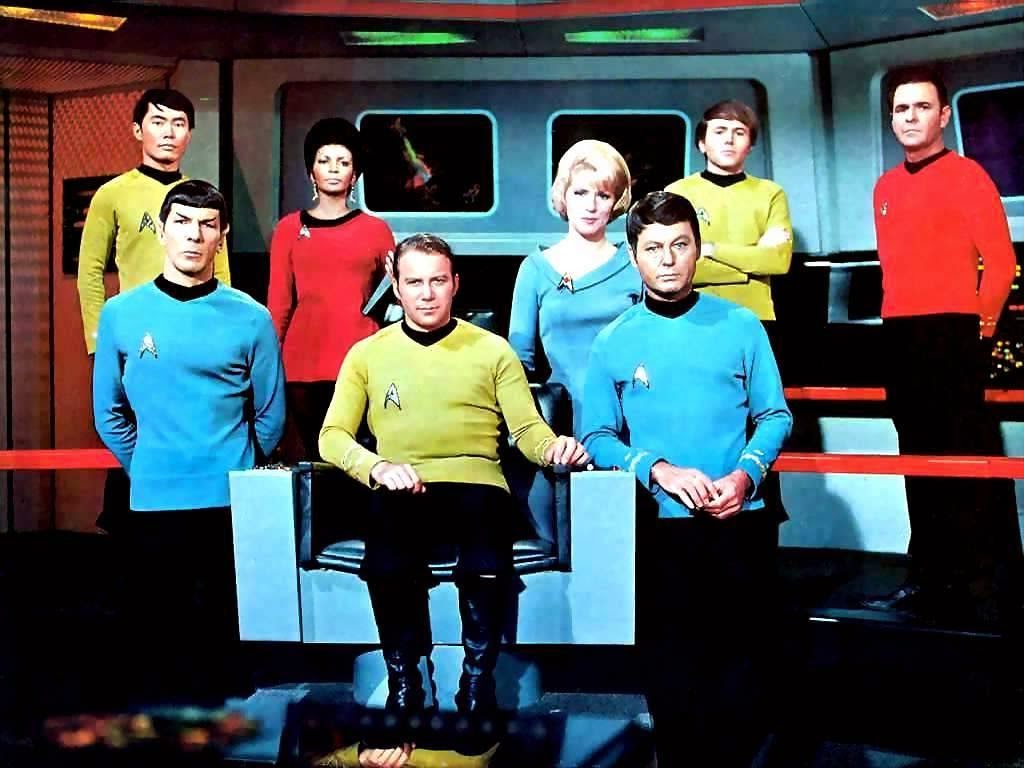
The Adventures of the Starship Enterprise: Musings on Star Trek and its Contexts


Several scholars and critics have argued for years that the short lived US television series Star Trek (NBC, 1966-1969), a series that has spawned a host of successors and fanboys and fangirls, was a reflection of an America in transition from the presidency of that aged, conservative and grandfatherly Dwight D. Eisenhower (1952-1960) and his administration, an administration that seemed to mirror him at least in the popular imagination, to the presidency of the young, vibrant, active, optimistic, liberal,  and Hollywood celebrity like John F. Kennedy (1960-1963) and his administration, which seemed to mirror him at least in the popular imagination. 

Many of those who propound this hypothesis see JFK as the logos that enters into the young, vibrant, and optimistic Captain James T. Kirk, the leader of the Starship Enterprise which is on a five year mission to go where no man has gone before, into the new frontier that is now the ever moving universe instead of the moving American western frontier. One can argue, however, that the parallels between the Kennedy administration and the crew of the Starship Enterprise is even broader than the Kennedy-Kirk connection and parallels. You have vice-president Lyndon Baines Johnson leading the medical operations of the Star Trek Enterprise in the form of the drawling and emotional Southerner Leonard “Bones” McCoy. You have Bobby Kennedy, one of JFK’s closest advisors, kind of inhabiting the body of the half-human half-alien Mr. Spock. You have the best and brightest Ivy Leaguers who served in the Kennedy administration represented in the engineers who keep the Starship Enterprise functioning particularly when it is under pressure from a variety of varying forces many of them from alien forces outside the ship. You have crew members who are representative of what passed for liberal diversity in the early and mid-1960s. There is the Black communications officer Lieutenant Uhuru whose name is supposedly Swahili for freedom and whose character is presumably a shout out to the civil rights movement then afoot in the United States. There is the Russian ensign Pavel Chekhov, whose last name is that of a famous Russian literary figure making it easy for viewer to make the connection. There is the Japanese Lieutenant Sulu who along with Chekhov often helms the Enterprise. Uhuru, Chekhov, and Sulu embody in the series Africa, the evil other of 1960s America, and Asia respectively. All three are played by American actors and all serve under the command of he who some would see as the ultimate American action hero and gunslinger of the era, Captain James T. Kirk. You have a host of glamorous young women in auxiliary female roles such as Nurse Chapel and Yeoman Janice Rand all whom, as is Uhuru, are garbed in not so futuristic mini-skirts presumably, at least in part, for the young nerd boy male gaze that those who made the show presumed would watch the show.

Characters are not the only reflections of Kennedy America in Star Trek. There are also the many contradictions in the show that reflect the contradictions of America in an era where the counterculture was becoming prominent. You have, for example, the ethnographic episodes where Kirk and Company learn about and learn something from the aliens they encounter on the new frontier such as in the 1967 episode “Errand of Mercy”, an episode in which Kirk and the Enterprise come up against the Klingons, Star Trek’s Russkies, both of whom are shown up by a planet full of powerful pacifists. You have the episodes that mirror the playing chicken games of the Cold War such as 1966’s “The Corbomite Maneuver”, an episode that ultimately asks why can’t we just get along and answers we can with a little understanding, understanding that will help the great powers avoid nuclear annihilation. And you have the too many to list imperial episodes in which Kirk and the Enterprise do what they are not supposed to do, violate the prime directive of the cultural anthropology episodes to leave native cultures alone so they can develop on their own, episodes that are slyly commented on and critiqued in “Errand of Mercy”, episodes all which show the primitives on the frontier how they can progress by simply “adapting” to the United Federation of Planets, the utopian liberal American way. 

The ethnographic, cold war, and imperial episodes are not the only generic episodes one finds in Star Trek. There are also the many episodes, too many to list, where Kirk not only gets his man but gets, well almost gets, his woman. It is as if those making Star Trek were coyly commenting on John's and Bobby’s many extra marital sexual affairs or the sexual power of those in power. But then again, affairs are close to the Hollywood heart and many of those who tune in to Hollywood television shows and watch Hollywood movies do so to see fairy tale romances amidst the western action adventure. Sex, as Hollywood has known for some time sells and selling is central to the Hollywood capitalist enterprise. There are the episodes where history in space parallels American history in time, the episodes where the Enterprise finds Romans, Chicago like mobsters, and Third Reich like Nazis in outer space, episodes undoubtedly impacted by the budgetary constraints of the show. There are the alternative history episodes of the show, most famously 1967’s “City on the Edge of Forever”. There are the episodes where the Star Trek crew go back to the era in which the show was made such as 1967’s “Tomorrow is Yesterday” There are the megalomaniac episodes of the show, episodes in which Kirk and the Enterprise come up against more powerful forces in the form, for example, of Greek gods and characters who have lived the lives of many illustrious humans but who, by episodes end, are outsmarted and out manoeuvred in classic Hollywood fashion by Kirk and the crew of the Starship Enterprise such as 1969’s “Requiem for Methuselah". The show must go on after all and in Hollywood genres go on and on and on in repetitive fashion, something viewers of Hollywood television and film love and love and love.