Mass capitalism is an economic system, a system of exchange, with its own theology, a theology propagated by the high priests of mainstream economic theory who postulate—though they don’t see it as postulation hence the use of the term theology here--that humans are rational and that human greed is ultimately good for all. It is an economic system that dominates western and increasingly global politics because modernity and its mass capitalism are bureaucratic and the higher in the bureaucracy one is the more monies one makes and the more power and authority one has. This allows those in the higher realms of the bureaucracy to use their power and authority, to leverage their status, in a multitude of political, cultural, geographical, and demographic ways. They lobby, for instance, the American government and have a greater ability to lobby successfully compared to those with middling power and authority and those with low levels of power and authority because in capitalist societies money, as the proverb goes, talks. It allows those with money, power, and authority to use these monies and this power and authority for cultural purposes. When they buy art they impact the “value” of the art they buy. When they contribute monies to symphony orchestras they impact the type of music that will be programmed. When they engage in risky behaviours that come back to haunt them the world has to listen because, as happened as recently as 2008, their “coughs” wreak havoc on the increasingly integrated global economy. Those with monies typically live longer, have less deaths in childbirth, and have less child deaths than those with moderate or limited monies who live in poverty.
The noted Swiss film maker Jean-Luc Godard, a director who has been categorised as part of the French nouvelle vague or New Wave by critics and historians, often used the “profession” of prostitution, as a metaphor for mass capitalism in his many films. In his 1980 film Suive qui peut (la vie), [English title Every Man for Himself], for example, Godard stages a scene—I hope I am remembering this right as I have not seen the film since it was released--in which a businessman, sitting at a desk choreographs a scene for his entertainment in which one of his cronies has sex, including anal sex, with a prostitute while another character in the film voyeuristically looks on. The message of this film, of course, is that workers are exploited by their bosses and their sycophantic flunkies in the lower upper levels and middle levels of capitalist bureaucracies, something that makes the English title of Godard’s film not quite accurate given the realities of power and authority imbalances within economic bureaucracies.Where I, Ron, blog on a variety of different subjects--social theoretical, historical, cultural, political, social ethical, the media, and so on (I got the Max Weber, the Mark Twain, and the Stephen Leacock in me)--in a sometimes Niebuhrian or ironic way all with an attitude. Enjoy. Disagree. Be very afraid particularly if you have a socially and culturally constructed irrational fear of anything over 140 characters.
Thursday, 14 March 2024
A Critical Ethnography of Social Media: Why the Brave New Postmodern Digital Media World is Much Like the Brave Old Modern Media World
Sunday, 1 January 2023
The Books of My Life: One Nation, Two Cultures
Polemics and apologetics are, of course, two sides of the same demagogic coin. Demagoguery itself has a long history both inside of and outside of academia. The Athenian leader Perikles, for instance, warned of the potential influence of demagogues during Athens's war with Sparta. Many of the early Christian fathers proudly identified themselves as polemicists and apologists as they argued for the falsity of other faiths or meaning systems and proclaimed the truth of their own. Many true believer monotheists have engaged in polemics and apologetics ever since, though many have not acknowledged the fact that that is what they do. Polemics and apologetics have been central to American, Canadian, and Australian political culture almost since the "birth" of those British settler societies.
The academy, at least since the late 19th century, thanks to the impact of positivism on the hard and soft sciences in the ivory tower, have, at least in their official rhetoric, abjured polemics and apologetics in favour of empiricism, though some might argue and several have that empiricists have proclaimed their value freeness way too often for as Max Weber noted in the early twentieth century what academics choose to study reflects, on some level, the values of the researcher.
Despite their proclamation of value neutrality academics have, on occasion self consciously and almost messianically waded into polemical and apologetic waters. Historian Jack Granatstein's Who Killed Canadian History (1998 and 2007) and historian Keith Windschuttle's Who Killed History (2000), for instance, are, respectively, apologias for "traditional" Canadian and "traditional" Australian history as they define it--an emphasis on "traditional" political history and the great men who helped make it--and polemics against Canadian and Australian social and cultural histories, which they see as arising out of the cultural ferment of the countercultural 1960s, an era they generally bemoan and see emblematic of the decline of America, Canada, Australia, New Zealand, and so on. An American variant of this argument can be found in historian Gertrude Himmelfarb's One Nation, Two Cultures: A Searching Examination of American Society in the Aftermath of the Cultural Revolution (New York, Vintage, 1999, edition with a new afterword, 2001).
While Himmelfarb trods terrain similar to that of Granatstein and Windschuttle, her polemic and apologetic is more broadly focused than either those two, who focus their gaze on education and more particularly on higher education. Himmelfarb, like Granatstein and Windschuttle, sees academia as impacted by post-1960s social and cultural historical fads. She traces these, as has become common among intellectual conservatives in Canada, Australia, and the United States to the situational pluralism, multiculturalism, and relativism of the sixties counterculture, which, she argues, has now become the dominant cultural strain in late twentieth and early twenty-first century America.
While Himmelfarb claims that the cultural ideologies of 1960s counterculturalists have become the dominant paradigm in the United States since the 1970s, a claim some might dispute given the fact that the US seems evenly divided between Democrats and Republicans, exemplars of liberalism and conservatism (really "traditional" liberals) and right wingism respectively in fin-de-siecle and early twenty-first century America and little in the way of bipartisanship in the American federal legislature. Himmelfarb argues that there is also an oppositional culture of dissent from this pluralist, multicultural, and relativist hegemony, an oppositional culture that remains prominent and significant in the United States, the dissident culture of traditionalists, by which Himmelfarb seems to mean those who continue to promote the Victorian values of self-discipline, self-help, family, civil society, sexual morality, patriotism, and religion or morality. She counterpoints these values to the values of the counterculturalists which, she argues, have given rise in late twentieth and early twentieth century America to increased divorce rates, increased crime rates, increased drug abuse rates, increased female headed families living in poverty rates, increased cohabitation rates, increased narcissism, and increases in a host of other immoralities.
As I noted, Himmelfarb's polemics and apologetics have become standard jeremiad fare among intellectual conservatives like Himmelfarb and fellow travellers like Lynne Cheney, William Bennett, and Robert Bork. This world of late twentieth century and early twenty-first century polemics and apologetics, however, seems rather quaint, dainty, and passe in the age of that right wing demagogue who has dominated so much discourse in the early 21st century, Donald Trump. Trump, of course, is someone who has been married multiple times, committed adultery on several occasions, brags of his sexual strategies and conquests to friends and media celebrities, makes fun of the disabled, proffers crazy and delusional conspiracy theories, rages at hallucinated un-American traitors in his midst, fellow travels with racists and Nazis, and who is the supreme example of a flim flam capitalist narcissist. Trump, who is hardly the paragon of Victorian ethical and moral and virtue Himmelfarb preaches, surprised many of the punditariat by winning the presidency of the United States in 2016 and who has become, since his run for the presidency in 2016, the totem figure of a purification cult grounded in a variant of the American nationalist faith, a cult centred on Trump and which has, as one of its major statements of faith, the belief that their great leader is a man called by god or nature to "make America great again". Himmelfarb's polemics and apologetics, in other words, echo an intellectual world that has, at least for the moment, passed just like the age of Victoria has passed.
There are a number of other problems with Himmelfarb's declensional polemic and apologetic. On the theoretical level she argues for a cultural determinism or reductionism that is ultimately similar to and as problematic as the economic determinism of vulgar Marxists. And while culture, which Himmelfarb emphasises, is important, so are economics (class, poverty, we have to eat), politics (status, humans, who have always lived in groups, have to live together), geography, and demography (age, cohort). Additionally, Himmelfarb fails to distinguish descriptive or empirical relativism from normative or ethical and moral relativism, a common demonising strategy used by many conservative and right wing polemicists and apologists or demagogues.
On the methodological level Himmelfarb seems to argue, on the one hand, that the hegemonic postmodernist culture of situational tolerance and its heirs and the dissident culture of "traditionalists", with which she identifies, are Weberian ideal types and that they intersect and interact in a variety of ways in practise. At the same time, Himmelfarb seems to view these two cultures (a riff on C.P. Snow's two cultures of science and the humanities?) as distinct or binary movements engaged in a manichean culture war for the very soul of America. Additionally, Himmelfarb utilises and mixes and matches both quantitative and qualitative anecdotal data, which sometimes makes her argument less compelling and convincing.
On the cultural level Himmelfarb conflates intellectual and popular culture. While the United States does have intellectual cultures, which take a variety of forms in their culture, their politics, and their economics, the US also has a long tradition of anti-intellectualism and anti-academicism particularly on the right, a movement distinct from traditional liberalism or conservatism. Additionally, Himmelfarb, who sees religion as a bulwark of Victorian values, misses the increasing age, cohort, and cultural tensions within American intellectual evangelicalism at places like Calvin and Wheaton (Illinois) these days.
Speaking of the religious culture, Himmelfarb finds greater cultural and ideological coherence in right wing religion than there is. She fails, for example, to distinguish between conservative intellectual Christianity, such as that found at Calvin College, Wheaton College (Illinois), Brigham Young University, and the University of Notre Dame, separatist Protestantism, such as that at Bob Jones University, and mainstream right wing anti-intellectual Christianity, which preaches the anti-intellectual gospel of everyman a Bible scholar regardless of whether they know Hebrew, Aramaic, koine Greek, and Near Eastern history or not, the gospel of free market capitalism, something non-existent in biblical times, the gospel of Anglo-Saxonism, and the gospel of theocratic we are OK you are not OK intolerance.
On the geographic level HImmelfarb's claim that the US is one nation and two cultures is problematic. Joel Garreau (The Nine Nations of North America, 1981), for instance, argues that there are nine nations with varying cultures in North America while Edward Crabb and James Curtis (Regions Apart, 2005) argue that the United States and Canada are really four nations or societies with different cultures: the francophone and the anglophone in Canada and the North and the South in the United States. I would argue that there are at least two nations in the United States, the Northeast and Pacific Coast and the South, and that one can find elements of each in other parts of the US. Austin, for instance, is more Northeast and Pacific Coast than rural Texas. Salt Lake City is more Northeast and Pacific Coast than most of the other parts of Mormon Utah and the Mormon culture region save perhaps for St. George. The South continues to be characterised by strong elements of theocratic Christianity and White identity superiority while the Intermountain West, save for Mormondom, continues to be characterised, in part, by European post-imperialist racism and rebellion against the federal government, which owns substantial amount of real estate in the West, despite the fact that without government intervention, interventions in the form of things like the Boulder Dam, the West would be a very different place.
Personally, I think one can make a compelling argument that there may be more than only two Americas. The American sports world, which can serve as an excellent transparent mirror into American culture and society, is tribal. It's the Dallas Cowboys and their worshipful fans versus the New York Giants and their devoted fans, the New York Yankees and their devoted fans versus the Boston Red Sox and their worshipful fans, the Chicago Bulls and their worshipful fans versus the Los Angeles Lakers and their devoted fans. The US, this sports tribalism suggests, is a land of tribes where national teams, like the US men's and women's soccer teams, are barely a blip on the national radar. It is, of course, different in other parts of the world. New Zealand, for instance, worships its national rugby team, which is central to Kiwi civic religion. Canada worships its national hockey team, a sport central to its public religion. Brasil worships its national football or soccer team, which is central to its civil religion. Generally speaking, one finds, in nations where a national sport is prominent and central, a greater sense of national identity, though there are interesting caveats here. In the US, for instance, the coding of the military and the police as sacred and the myths associated with them play an important role in the conceptualisation of national identity among right wing groups.
On the educational level Himmelfarb treats academia as too consensual. As several surveys have shown over the years there are a number of significant cultural and ideological differences between academics in the hard sciences, the social sciences, humanities, those who teach law, those who teach the medical sciences, and those who teach in other of the applied sciences. Social scientists and those in the humanities seem to best fit Himmerfarb's caricature and stereotype of the "typical" academic.
On the political level Himmelfarb makes the common mistake that the United States is a democracy. Even if one accepts the notion that the US is a republic the reality is that America is, like all core modern and postmodern societies, bureaucratic. As Weber and Michels noted in the early twentieth century, all modern and postmodern bureaucracies are pyramidal in form with structured and inherent inequalities of power, authority, and wealth embedded and institutionalised in them (See GE, Apple, Kroger's, the government of the American state of Indiana). And while one might argue that these structured inequalities are grounded in merit, one of the central myths of British settler societies, the realities of nepotism and structured inequalities related to social and cultural capital, suggest that merit is, at best, only partially at play in American economics, politics, and culture. So, if one is going to argue that the US is a democracy the person or persons making this argument need to provide empirical evidence as to why a society characterised by bureaucracies with embedded structural inequalities and impacted by favouritism are democratic. Personally, I don't think anyone can do this because the US is, by definition and as a consequence of its bureaucracies, an oligarchy and always has been.
Another political level problem one finds in One Nation, Two Cultures is Himmelfarb's failure to distinguish, as I noted earlier, intellectual conservatism from right wing political culture. These two cultures, and subcultural and countercultural variants within each, are different and distinct though there is overlap on some issues. Conservatives, historically speaking, have their origins in the intellectual opposition to the Enlightenment and particularly the French Revolution though one might argue that foreshadowings of it appear in the defenders of the monarchical faith. The right, on the other hand, has its origins in religion, anti-intellectualism, and a culture of white superiority. Both may preach the gospel of the free market but that doesn't mean that they have the same historical origins and that they are the same culturally and ideologically. As for Himmelfarb's conservatism, it is actually old Enlightenment liberalism, the liberalism of Adam Smith, the liberalism, if somewhat tensely, of John Stuart Mill, and the liberalism that was shocked by the French Revolution.
On the social ethical level Himmelfarb is a bit confusing. Is Himmelfab arguing that counterculturalists have a situational morality, or does she maintain that the counterculturalists have no real ethics or morality at all? Can Himmelfarb admit that some elements of the "counterculture" have as ethically valid and thought out conception of the public sphere and of virtue, a virtue tied to human rights, as conservatives and right wingers? It seems to me that Himmelfarb wants to have it both ways, that she wants to have her cake--yes they do have an ethics and a morality--and not eat it too--no they don't have a social ethics and morality beyond a selective situational ethics and morality, which may be no ethics or morality at all.
Postscript: I am proud to say that this review was banned by Amazon for possibly violating "community standards" though how it violated I don't know because whoever categorised it as such--amateur suits, fundamentalist bots, politically correct ideologues--don't tell you how said review may, and they do use the word may, violates community standards. Whatever the reason it was banned and a censored version was requested, it is clear that autocratic and despotic Amazon is not committed to real freedom of speech and that says it all.
Thursday, 1 December 2022
The Books of My Life: Who Killed Canadian History?
The historically oriented books of the Tanakh, for instance, and particularly the historically oriented books of the Torah, tell the inherently polemical and apologetic story of god's chosen people and their trials and travails as they tried to live up to the covenant they made with Yahweh at Mount Sinai, the site of the covenant in the Yahwist and Priestly versions of the tale of the chosen people in the Torah, or Mount Horeb, the site of the covenant in Elohist and Deuteronomist retellings of the sacred story. Israel's prophets, the nevi'im offered polemical and apologetic commentary, a kind of midrash before midrash, on these sacred texts pointing out the failures of the chosen to live up to the covenant they made with Yahweh or Elohim and the punishment the lord or god brought to bear on his chosen as a consequence of their failures to live up to the covenant. Ancient Egyptian texts polemicised about the greatness of their civilisation, a greatness that demanded that battles lost to the Hittites be rewritten as victories. The "histories" of the Ancient Greeks and Ancient Romans are filled with examples of polemics and apologetics over hubris, barbarians, Socrates, Alkibiades, particular emperors, such as Nero or Justinian, or particular empresses, such as Theodora.
Polemics and apologetics didn't end with the advent of professionalised history and professional historians in the late nineteenth and early twentieth centuries. Both can still be found on the surfaces and in the deep structures of contemporary historical writing despite claims by many professional historians that history has become, with them, empirical and objective or, at least, dispassionate. Professional historians of American Christianity, for instance, wrote empirically grounded histories of particular Christian denominations grounded in primary source material that were undergirded with polemical and apologetic assumptions and presumptions that Christianity, particularly Protestant Christianity, and even more particularly American Protestant Christianity, was god's one true religion and that the denomination they wrote their histories on and about was god's true Christianity.
Professional historians have, over the years, fought a variety of polemical and apologetic battles. They have battled over whether history should be--note the normative phrasing here--narrative in form, whether it ought to be methodologically sensitive incorporating quantitative methods into what has largely been a qualitatively oriented discipline, and whether historians should be theoretically literate. Many professional historians, for instance, reacted negatively to Charles Beard's Economic Interpretation of the Constitution of the United States when it was published in 1913 finding it too theoretically oriented and too reductionist. One invariably wonders if some of this unease with Beard's book was due to the fact that Beard's book de-mythologised an American sacred text and, in the process, demythologised American sacred history. Some have reacted negatively to the theoretical and methodological approach of the French Annales school of history, a historical school that goes back at least to the late 1920s. Several of the Annales historians argue that history should be quantitative, qualitative, and theoretical, contending that history must be understood as made or caused by both long term economic, political, cultural, demographic, and geographic forces, such as the great power struggles that led up to the Great War, great power struggles that go back hundreds of years, and short term economic, political, cultural, demographic, and geographic events. such as the assassination of an Austrian-Hungarian archduke by a Serbian nationalist
in 1914. Many historians find the Annales approach too theoretical, far too focused on economic events, far too quantitative in orientation, and too far removed from the traditional great events and great men approach, arguably a somewhat secularised version of the Christian lives of saints and the mode of history writing that has dominated history in both its "amateur" and "professional" forms for some time.
Others, a minority of historians like myself, a historian deeply impacted by cultural anthropology and sociology, have long found the Annales approach to history quite compelling. In fact I would argue that the Annales approach to human history best helps us understand and comprehend the culture wars and the battles over history that have often reared their heads throughout human history and have been particularly prominent since the 1960s. When we apply the Annales approach to the culture wars it is clear that the culture wars and the culture wars over history have been going on in the West, as I noted earlier, for centuries, the longue duree, and we can see that the culture wars are also stimulated simultaneously by specific events, such as the impact of renewed social and cultural history on the historical profession after the 1960s. Recently, there has been a lot of ink spilled over the history battles that erupted out of the countercultural 1960s. At the heart of these battles over history are the same questions that have troubled historians for years. Should history be mythic-empirical? Should it be objective-empirical? Should it be hermeneutic-empirical? Should it be narrative in form or quantitatively grounded?
One of the most prominent polemicists and apologists fighting the post-1960s culture war over Canadian history has been the retired York University historian, former member of the Royal Military College Board of Governors, former Chair of the Council for Canadian Security in the 21st Century, and former head of the Canadian War Museum J.L. Granatstein (sometimes aided and abetted in his culture war by fellow historian David Bercuson and others of a cult of militarism that seems aristocratic in nature). Granatstein, who has written extensively on the Canadian military and Canadian foreign policy has engaged in polemics and apologetics on at least two different levels. On one polemical and apologetic level Granatstein has advocated for the transformation of Canada from a peacekeeper nation to, what Ian McKay and Jamie Strong call, in a nice turn of phrase, a warrior nation in order to protect Canada's interests. That this Canadian warrior nation is likely to be little more than a player sitting on the American junior varsity imperial bench along with England and Australia seems to be acceptable to Granatstein. How a Canadian nation that is small in population and next door to the, by far, dominant superpower of the post-Cold War world, an imperial power that dominates Canada economically, politically, and culturally and hence doomed to be, in the foreseeable future, a junior partner on the American imperial team is going to protect its "national interests" (read elite interests) which are intimately tied to American interests (read elite interests) is beyond me, however. Perhaps they don't have a problem with Canada taking care of the gatorade and the dirty laundry for the Team America.
On another polemical and apologetic level Granatstein has waded into the polemics and apologetics surrounding the rise of a "new" Canadian history, a "new" Canadian history dominated, he claims, by social and cultural history and by quantitative and hermeneutic methodologies and approaches. In his provocatively titled monograph Who Killed Canadian History (Toronto: Harper Collins, 1999 and Toronto: Harper Perennial, revised and expanded edition, 2007) Granatstein argues, much as did Australian historian Keith Windschuttle before him in his equally provocatively titled The Killing of History: How a Discipline is Being Murdered by Literary Critics and Social Theorists (Sydney: Macleay, 1994), that the counterculture of the 1960s gave rise to a social and cultural history that is killing, murdering, and savaging traditional and national Canadian (or in Windschuttle's case Australian) traditional great man and great events political history. The social and cultural historians who came of age in the economic, political, cultural, and demographic ferment of the 1960s in Western Europe, the United States, Australia, Canada, and New Zealand, have, Granatstein argues, replaced the history of the state, politics, foreign policy, and wars with the history of common men, women, and ethnics, a history that is, Granatstein claims, far too focused on historical trivialities, something that has often been a problem in a discipline that has often avoided and demonised theory and methodology and hence, questions related to historical significance.
Granatstein also argues that this "new" once countercultural and now dominant history has negatively impacted Canada beyond the academy. These "new" histories, Granatstein argues, have linked up with progressive educational reforms afoot throughout Canada in the late 20th and early 21st centuries, educational reforms that emphasised the need for education for individual and identity group self esteem. This has resulted, Granatstein argues, in a history that celebrates the achievements of identity groups like women and selective ethnic groups. Combined with the limited mandates for history courses in Canada's primary, secondary, and higher educational institutions, the "new" histories and the "new" historians, Granatstein contends, are undermining Canadian national identity, something that is essential if the Canadian nation is, claims Granatstein, to survive and thrive as a common culture.
Granatstein's argument that the lack of a common history resulting from acids associated with the "new" social and cultural histories along with post-World War II battles between the Canadian federal government and the provinces over power and authority (as I write Alberta is set to institute a policy which would allow the political elites of that province to effectively check what comes out of Ottawa and check any challenges to that power in the courts), is grounded, whether consciously or unconsciously, in theoretical perspectives that go back at least to the European Enlightenment and the Romantic era and to the Enlightenment philosophe and romantic social and cultural theorist Jean-Jacques Rousseau and the founding father of sociology and ethnology, Emile Durkheim. Rousseau and Durkheim, more analytically, argued, as does Granatstein and others before and after him, that for a nation to effectively function as a nation and survive as a nation, it must have a common culture and a common set of values and norms. There is, of course, a lot of truth to this perspective though this approach raises a question Granatstein barely if at all addresses, namely whether Canada with its two and perhaps now three, four, five, or ten solitudes, has ever been a single nation and has ever had a common national culture, questions that can equally be posed about the United States with its at least two founding solitudes, that of the North and that of the South.
There are a number of other empirical, methodological, and theoretical issues one could bring to bear on Granatstein's polemic against the "new" social history and cultural history and their postmodernist impact on modernist history. Granatstein, for instance, does not, in his rather too broad brushstrokes, distinguish between various types of academics inside Canada's ivory towers. As numerous surveys have shown over the years, those who teach in the professions, in the hard sciences, and in the applied sciences are not the same culturally as those who teach in the social sciences and humanities. Those who teach in the social sciences and humanities are closer to the caricatures and stereotypes Granatstein plays in in Who Killed Canadian History. Additionally, Granatstein ignores, to some extent, the impact the old analogue media and the new digital media have had on academic history textbooks. When I was an undergraduate, for instance, I had to read thirteen books for an introductory class on Greek history, texts that would not be considered textbooks today. Today a teacher is lucky if she or he can get her or his students to read the one brief textbook generally assigned for introductory courses today. Publishers, of course, have tried to sex up textbooks to get professors to assign them for classes and that, they hope, will move students to read them. They have added a host of colour photos, a host of topical elements, a host of anecdotal introductions that mimic film and television narratives, and a host of graphs, maps, and charts that they hope will stimulate and generate student engagement with the textbook. I have, however, have seen no evidence that this publishing strategy is working. What this strategy has done is to raise the cost of textbooks to astronomical levels, price levels that not all students can afford.
Some of the elements added to modern postmodern textbooks, of course, are related to gender, ethnicity, and class, all phenomena that have been prominent and significant factors in the making of history over the centuries and all things the "new" historians focus on and should--yes I am going normative here--focus on. Granatstein and his colleagues have qualms about this increasing focus on gender, ethnicity, and class, because, as I noted, they think they are pushing much needed political, diplomatic, legal, and military history out of history textbooks and out of history classes alienating students from history courses in the process. According to Granatstein students are still interested in these "traditional" subareas of the historical profession. He cites somewhat anecdotal data--student interest and attendance in courses in these areas--to make his case. But is this really the case? Is this anecdotal evidence sufficient to prove the point? Shouldn't historians (not to mention publishers) be engaging in ethnography to find out what really interests students? Beyond these, hasn't the old great men and great events history proven to be as if not more "boring" to many contemporary history students?
Speaking of university textbooks, I perused several introductory texts on Canadian history chosen somewhat randomly while reading through Who Killed Canadian History in order to test them against Granatstein's hypotheses. What I have found suggests that Granatstein overstates his case about the decline of traditional history and its replacement by trivial history and vanity history, both things that history has long been anyway and something that should not be surprising given that Granatstein is, after all, engaging in polemics and apologetics. In the 529 page Canada: Unity in Disunity by Paul Cornell, Jean Hamelin, Fernand Ouellet, and Marcel Trudel, a textbook that early on tried to deal with the realities of Canadian multiculturalism and pluralism, there are 19 references to John Macdonald, 10 pages on World War I, and 21 pages on World War II. In the 537 page second edition of the introductory textbook Destinies: Canadian History Since Confederation written by R. Douglas Francis, Richard Jones, and Donald Smith and published in 1996, three years before the first edition of Who Killed Canadian History, 23 pages are devoted to the Great War while there are 50 references to John Macdonald. The 568 page 2003 edition of the single volume Canada: a National History by Margaret Conrad and Alvin Finkel, both of whom Granatstein brands as killers of Canadian history, devotes 19 pages to World War II, including brief sections on the air and sea war between 1939 and 1944, while Pierre Trudeau garners 5 references and the Charter 1. By way of comparison, the 567 page Nation: Canada Since Confederation, the 1990 textbook written by Granatstein himself along with Irving Abella, T.W. Acheson, David Bercuson, R. Craig Brown, and H. Blair Neatby, a textbook that is no longer in print, devotes 67 pages to the period from 1911 to 1919, 54 pages to the period from 1939 to 1957, references Macdonald 10 times, Trudeau 21 times, and the Charter once. While Nation has chapters on industrialisation, labour radicalism, and immigration, the bulk of the textbook is devoted to political history raising the question of how serious "traditional" historians like Granatstein are in advocating for an integrated political and social and cultural history in introductory classes and texts, particularly since the Francis, Jones, and Smith and Conrad and Finkel do integrate "traditional" and "new" histories.
I found Who Killed Canadian History in both of its editions--they do differ from each other as the revised and expanded edition adds a couple of chapters and some parts of the text have been deleted and other material added to the text in the second edition--an interesting if not fully compelling polemic on how Canadian history and history in general should be done. I agree with some aspects of Who Killed Canadian History, such as the need for politics to be a central part of introductory courses and introductory textbooks on Canadian history. But so should historical approaches that emphasise economics, culture (gender, ethnicity, class), demography, and geography, all significant and important forces that impact human beings and the worlds humans have created and all of which are essential frames through which we can understand the human species from prehistory to today. As for who might be interested in Grantstein's polemic, it is likely to be of interest to those interested in polemics and apologetics over how to do history and to those interested in cultural divisions within the humanities and the social sciences in contemporary Canadian universities, itself an iteration of the broader Western culture wars that have long impacted human history and human culture, particularly in the core nation world.
Saturday, 2 April 2022
Musings on Historical Explanation
The contention, thought out or parroted, that great power struggles, the US's attempt to demonise, delegitimise, and isolate Russia, the Ukrainian civil war, US covert and overt actions in the Ukraine since the 1990s, and US backtracking on promises had nothing to do with the current crisis in the Ukraine seems to me to be problematic. It seems to me to be an attempt by some, mostly apologists and polemicists for the American civil religion and the devotees of that American national faith, to negate what should be obvious to anyone with an empirical and contextual mind, namely that long term and short term economic, political, cultural, demographic, and geographic factors structure human history.
Such an assertion seems to me akin to arguing that great power struggles between the French and the British in the "new world", the French and Indian War, and the British attempt to make the Colonials pay for at least some of the cost the expensive French and Indian War, to get the Colonials to pay for their own protection, in other words, were not factors in the coming of the American Revolution. That assertion seems to me as equally causally problematic as the similar argument about the Ukrainian war and a prime example of "intellectual" boot scoot boogieing.
It is, of course, another matter to note the fact that the Colonials seemed to, by opposing taxes to pay for the French and Indian War, want something for nothing, a rather common human and American cultural trait at least since the coming of the modern world.
Sunday, 10 May 2020
How to Read History: Musings on the Tara Reade Controversy
So,
we can look analytically at the controversies swirling around Tara Reade's accusations of sexual harassment by Democratic former senator and vice-president on several levels: the exegetical or
textual level, the hermeneutic level, and the homiletic level.The exegetical, textual, or evidentiary level. On the exegetical level Reade's claims of sexual harassment and of Biden as the sexual harasser, go back to 1993 according to reputable sources. If one wants to challenge this data trail one has to show, for instance, that the interviews, the testimony of others, and the Larry King phone call were all actually produced in 2019 and 2010. Good luck with that. By the way, eight women have now accused Biden of sexual misconduct with them.
Layer 1: Neoliberal Democrats, generally speaking, are circling the wagons around Biden and attacking Reade, sometimes in a classic demagogic ad hominem fashion.
Layer 2: Progressive Democrats tend to argue that Reade's claims need to be taken seriously and thus should be investigated seriously.
Layer 3: Trumpians assume Reade's claims are accurate and are using her claims as demagogic propagandistic talking points against Biden hoping to manipulate the listening masses and get the faithful to echo them in the process.
Layer 4: the legal level. Reade's claims have not yet resulted in a settlement or a court room trial so...
Obviously most of the discourse surrounding Reade's allegations are operating on this level and are avoiding and eliding the factual or exegetical level in part or entirely.
Layer 5: Academic discourse about the above discourses.
The homiletic level:
Here we can look at how some draw morals from the Reade tale. Some are using Reade's experience to preach about the dangers of Biden, Washington DC, or patriarchy in general. This level interacts with and interpenetrates with the other levels. It is quite clear, of course, that on the exegetical or factual level patriarchy and male political and economic power have led to large number of real sexual harassment cases. See Clinton; See Weinstein; See Epstein...There have also, factually speaking, been claims of sexual harassment that are more the product of revenge, anger, wanting celebrity, wanting money, etc. To adjudicate between real and falsified claims requires an attention to the evidence, the exegetical level. The exegetical level, however, is often overdetermined by and read through the hermeneutic level. Additionally we have to remember that it is sometimes the case that some of the wealthy and powerful have, historically speaking, bought off their victims. See Jackson.
Playing this typology out...
Exegesis: A 1993 newspaper report from San Luis Obispo notes Reade's claim of sexual harassment by Biden. Additionally, Reade's mother called into the Larry King show claiming her daughter had been sexually harassed while working for Biden. Finally, in the 1990s, two neighbours of Reade said she told them that she had been sexually harassed while working for Biden and her ex-husband stated that Reade said she had been harassed during her tenure with Biden in a court document. All of this is evidence. These are empirical facts.
Hermeneutics: When we move to the hermeneutic level or interpretive level, beliefs, beliefs impacted by culture and ideology, often, tragically for the facts, play an important and determining role in what we humans see and how we humans see it. In a perfect world beliefs would be grounded solely in the facts. We don't live in a perfect or rational world, however. Oftentimes, instead, ideologically driven beliefs rewrite the facts even, in many cases, eliding or eliminating them in the process. You see this happening a lot among the devotees of the Orange One. You also see it in the attempt by some demagogues in the Democratic Party to deny that Reade's claims go back to 1993, a clear (and pathetic) attempt by demagogic polemicists to diffuse an ideologically correct and fictional narrative on their true believers hoping they will repeat this fictitious narrative in the process and overlook the facts, in large part, because they imbibe this fictional narrative.
Conclusions: As I have said repeatedly, sometimes to no avail since the ideologically correct generally put their own words into other peoples mouths in a sometimes manichean fashion (you are either for Trump or agin him), none of this proves Biden's guilt. Biden denies Reade's claims just as Trump denies the claims of the legions of women who have accused him of sexual harassment. What the exegesis above does prove is that the Reade claims are not recent fabrications by Republican polemicists and apologists.
Moving beyond Reade's specific claims we do have to recognise several other facts that are relevant to Reade's sexual harassment claims and case. We must note, factually speaking, for instance, that more than eight women have accused Biden of sexual harassment. This alone should make those of us who are not apologists or polemicists, who are not demagogues, in other words, and who are simply trying to look at the facts first, wonder, first, about what all these accusations may tell us about Biden's behaviour. Second, we need to take note of the fact that the rich and powerful, who are often men, far too often engage in such behaviours because they are rich and powerful (Harvey Weinstein) and far too often are able to delay recognition of their predatory behaviour because they are rich and powerful. Finally, we need ask ourselves why demagogues and their fellow travellers in the press are focusing on Reade and not also on the eight other women who have accused Biden of too much touchy feely.
I had forgotten, by the way, that while in law school at Syracuse Biden had engaged in plagiarism and gotten caught. He explained his infraction by claiming that he was unfamiliar with the rules of attribution, which is pretty impressive for a guy who took a bachelor's degree from the University of Delaware (or perhaps it isn't). I guess Biden was still blissfully ignorant of the rules of attribution in 1987 when he borrowed from the speeches of British politician Neil Kinnock. All of this, of course, goes directly to questions about Biden's honesty and honourableness.
Friday, 10 January 2020
The Right Wing Bullshite Machine and the Australian Bush Fires
By the way, according to reputable sources, namely Australian police and fire services, while there have been arrests for arsons (as well as for looting) arsonists are only responsible for 1% of the 5.2 million hectares of New South Wales and 0.03% of the 1.2 million hectares burned in Victoria during the 2019 and 2020 bushfires. According to the New South Wales Rural Fire Services it is lightning that has been the cause of the majority of the fires in Australia. Perhaps right wing nuts will argue at some point that lighting is part of the great left-liberal-commie-nazi conspiracy to take over the world. But then they are truly delusional.
Saturday, 30 November 2019
In the Land of the Gobshitters...
There, staring me in the face, was Boris Epshteyn, chief demagogue, chief ideologue, chief Republican polemicist and apologiest, and chief gobhsitter of the Sinclair Broadcasting Group. Epshteyn was going on about how socialist elitists in the form of Bernie Sanders and Elizabeth Warren were trying to and turn the US into the USSR of Epstheyn's youth.
Leaving aside the fact, that this USSRing of the US is an old refrain in the radical right and goes back at least to the popular New Deal of Franklin Delano Roosevelt, there was so much delusional fiction in Epshteyn's rant and in Epshteyn's person that one cannot help but remark on it. Take in the idiocy of elite Epshteyn himself. This populist raving about American elites went to the elite Georgetown University where he took an elite bachelor's degree in Foreign Affairs and an elite postgraduate degree in law. Take in the fact that the populist anti-elitist demagogue Epshteyn works for an elite and wealthy media firm that exerts much political influence on the Trump administration. Take in the fact that demagogue Epshteyn is calling Sanders and Warren propagandists when he is one of the chief ideologues and propagandists for a network that offers no, as far as I can see, opposing, and more empirically grounded, voices, something once mandated by the fairness doctrine of the FCC until Republicans eliminated it, a reflection of right wing self righteousness and intolerance of opposing American voices. Take in the bizarity of a media elitist calling out the media for its supposed "liberal bias" when in reality the commercial media's one god is mammon and its way of getting more and more mammon is to sensationalise, emphasising, or better over emphasising in the process, as the modern mass media always has, murder, celebrity, fires, cruelty to animals, and the lowest common denominator.
Take some time to take in the lunacy at the heart of contemporary America, a land where elitists whinge and whine about elitism, where demagogues whinge and whine about demagoguery, and where propagandists whinge and whine about propaganda. In closing let me note that the bullshite such as that uttered by gobshite Epshteyn is akin to yelling fire in a crowded theatre where there is no fire. Let me also note that such bs is eaten up by true believing groupie masses as if it were the best Russian caviar. Ain't that delusional right wing America?
Saturday, 1 June 2019
The Books of My Life: Power and the Idealists
There were, for me, a number of problems with Berman's analysis and his polemics and apologetics. On the historical and apologetics level Berman, though he comes close to doing this at times, fails to explore precedents for the liberal interventionism for the 1990s and after. Reinhold Niebuhr, for example, was, like the 68ers Berman explores, a radical in the 1930s who became a liberal interventionist in the years that led to World War II. Niebuhr's one has to chose the best of bad options, by the way, had, thanks to its manicheanisation by his more naïve followers, an immense impact on official American policy during the Cold War, another thing that parallels the trajectory of the 68ers.
Berman plays, historically speaking, fast and loose with the concept "totalitarian". Berman seems to divide the world up into totalitarian and non-totalitarian regimes and urges intervention when the former engage in the mass violation of human rights. "Totalitarian", however, is simply the modern and perhaps postmodern variant of autocracy or authoritarianism. Berman seems to argue that "totalitarian" regimes are fundamentally different from autocratic and authoritarian ones but he doesn't tell us why. Are autocracies and authoritarian regimes distinct economically, culturally, and politically from "totalitarian ones? If not why the need for a new term? Or is the term "totalitarian" one invented in the 20th century to scare the masses (propaganda) into submission (for a history of the term see Abbot Gleason's Totalitarianism: The Inner History of the Cold War)?
The Guardian, contrary to Berman's claim, is not, and I assume he is speaking of the British newspaper here, is not a marxist or communist rag. The Guardian is one of the great newspapers of the world.
Finally, Berman, though he mentions the Quakers at one point, elides the role Quakers have played in the pursuit of an internationalist human rights over the years. Quakers played major roles in the prisoner rights movement, the Indian rights movement, the women's rights movement, the anti-slavery movement, the saving refugees movement, and the anti-war movement. Quakers played such an important role in the pursuit of global human rights that the Friends Service Council and the American Friends Service Committee won the Nobel Prize in 1947, itself an acknowledgement of the roles Quakers played in the human rights movement. It is likely, by the way, that Quaker pacifism is one of the reasons for Berman's ignoring of the Quaker historical precedent. Berman, you see, like the 68ers he turns into heroes, sees war as a means to protect human rights while most Quakers did not and do not.
Speaking of heroes, heroes and villains are at the heart of Berman's manichean apologetics and polemics. Berman's heroes are 68ers like Joshka Fischer, Daniel Cohn-Bendit, Bernard Kouchner, and Andre Glucksmann who, according to Berman, were nutted by reality, particularly the anti-Semitism of those terrorising Israel and Jews that many on the left, because of their anti-imperialist mentality, allied with, and, as a result, whether in government service or as founders or supporters of international human rights organisations, became involved in and supported international intervention in support of human rights whether in Vietnam, the former Jugoslavija, or, more problematically for the 68ers, Iraq. The villains in Berman's not fully interconnected essays are factions within the left, Berman, by the way, is more historically and empirically accurate when he notes that the left has factions than the right and extreme right.
It is this manicheanism, a manicheanism that seems to trap Berman into a corner in which reflexivity is unnecessary and unwanted, that is a key factor in the problems at the heart of Berman's book. For instance, Berman seems to assert that war in general and war in the age of indiscriminate total war is a viable last option to protect human rights. The obvious problem with this argument, however, is that war is and always has been indiscriminate in its victims and hence is itself something that violates human rights. How many civilians were killed in the "good war" of the 1940s? In the end, the strong pacifist position that argues that something that violates human rights cannot be a weapon for the protection of human rights seems a stronger and more empirically grounded perspective. I suppose one could counter with Niebuhr's argument that sometimes one has to choose between less bad and more bad alternatives, but if one is going to make this argument one has to recognise that war is something that violates human rights and live with it. Berman, however, doesn't seem to have the sense of irony and tragedy, Niebuhr had.
Nor does Berman explore the contradictions inherent in the notion that the US or any other nation can and should be an instrument of pursuing human rights. The US, like the USSR and every other great power present and past, is a bureaucratic oligarchy (see Max Weber and Robert Michels on bureaucracies and inequalities of power and authority) that at both home and abroad has been and will continue to be a violator of human rights. How can the great powers with their economic, political, cultural, and geographic imperialisms be the protectors of human rights around the globe? Again, I suppose one could follow the Niebuhr strategy and argue that we must chose the least worst of bad alternatives but again one has to be conscious, as was Niebuhr who remained critical of oligarchy, capitalism, and imperialism all of his life, that one is choosing the least worst of alternatives and live with it. Berman once again seems to want to have his cake and eat it too.
In the end Berman's book was far too limitedly historical and far too polemical and manichean for my taste. In many ways I found Berman's book, because it engaged in far too much ahistorical polemics and apologetics, that which he ironically rails against in the book, utopian. So reader beware, while Berman's book offers an interesting exploration of the political and ideological "evolution" of the 68ers, it does so in a far too limitedly historical way and in a far too manichean and utopian way for my taste. The more things change?
Thursday, 16 May 2019
The Books of My Life: Film as Film
In Film as Film Perkins challenges both the image oriented and realist oriented approaches to cinema that dominated film theory between the 1920s and early 1970s. Perkins instead argues that, descriptively speaking, films are both grounded in the realism of the camera eye and the magic of film images. In chapters three though eight Perkins notes that film is a technological phenomenon, an economic phenomenon, and a meaning generating phenomenon that works or functions on both the narrative, photographic, and image levels. Perkins also explores how, in the films produced during the Hollywood studio era, it was the director who bought together the various contributions of narrative, image, sound, music, set design, and lighting and the important roles spectators play in the filmmaking process and the film interpretation process.
Perkins, as I noted, is not only interested in understanding films but in judging them. Perkins argues that good films must be credible, coherent, and balanced and that they must fuse narrative, concept, and emotion. For Perkins, the critic analysing Hollywood studio films--as Perkins notes this approach cannot be applied to many of Jean-Luc Godard's films which don't strive for credibility--can judge individual films and the films of certain directors on the basis of how credible they are, how coherent they are, how balanced the various elements that go in to the making of films are, and how more or less they integrate narrative, concept, and emotion.
I very much liked Perkins's approach of grounding an analysis of film value in an understanding of the nature of Hollywood films. That said, I am a bit more skeptical than Perkins of the ability to judge the quality of films given that value is in the social and cultural eyes of the beholder. Perkins, however, allayed some of my concerns my noting that a film criticism grounded in empirical phenomena still remains an open ended enterprise.
Anyone and everyone interested in the contextual nature of film and how films create meaning should read Perkins's groundbreaking and well written Film as Film. Additionally, those critical of auteurist approaches to Hollywood cinema should take note of Perkins's contextualised and nuanced approach to the issue of authorship in Hollywood cinema. I doubt that they will, however, given that contemporary critics of auteurism seem to prefer their auteurists to be romantic straw men or caricatures and stereotypes rather than real flesh and bone auteurists.
Tuesday, 7 May 2019
The Books of My Life: Mormonism
Bushman's Mormonism: A Very Short Introduction (Very Short Introductions, New York: Oxford University Press, 2008) concisely explores, in 130 pages, Mormon history, Mormon culture, and Mormon political forms. As Bushman notes, Mormon culture was, at its heart, a Jewish form of Christian restorationism that was biblical, prophetic, apostolic, and apocalyptic in orientation. Its power structure was and is patriarchal, centred, as it is around the male priesthood, and it is a religion that is, like Judaism, Anabaptism, and Quakerism, both a religious faith and an identity marker for its adherents. As Bushman notes, the central symbol of Mormonism, the eternal plan of salvation, is important in that, thanks to its linking of Mormon identity to the Mormon life cycle from pre-existence to post-existence, a very effective means of creating and recreating a sense of being Mormon in some way, shape, and form.
Bushman takes a largely functionalist and consensus approach to Mormon history and Mormon culture. While Bushman, for instance, sees continuity, if somewhat contradictorily, between primitive Mormonism, the Mormonism of Joseph Smith, 19th century post-Joseph Mormonism, and post-manifesto Mormonism, those of a more conflict bent see significant cultural change between 19th century and post-manifesto Mormon culture thanks to the demise of polygamy and theocratism, two things at the heart of Mormon culture and the plan of salvation, brought about, in part, because of WASP dominance and activism and American governmental intervention. Mormons, White outsiders in 19th and pre-World War II WASP America became, over the course of the mid and late 20th century, closer to the establishment mainstream as Whiteness broadened out in 20th century America to include Jews, Italians, Greeks, and Mormons, to chose four examples of groups made White in 20th century America. In the process, as conflict theorists note, Mormons became more American than their former American critics. Where Bushman sees Mormonism as a kind of prophetic hierarchical democracy, others, of a more conflict Weberian bent, see a bureaucracy that is both hierarchical and spherarchical and dominated, if not entirely, by the male powers that be in Salt Lake City. Mormonism, in this theoretical frame, is seen as more autocratic than "democratic", whatever that means, is seen as an autocracy that, like all autocracies, is characterised by varying degrees of mainstream conformity and, at the same time, by varying forms of outside the mainstream dissent.
If you are looking for a good apologetic and polemical oriented brief introduction to Mormonism, and yet another entry in the Mormon apologetics and polemics sweepstakes by the OUP, by a cosmopolitan believer, Bushman is your man, particularly if you are already a believer. If, however, you are looking for a more critical introduction to Mormonism, you might want to look elsewhere. I have long been fond of "gentile" Jan Shipp's Mormonism: The Story of a New Religious Tradition, which focuses on pre-manifesto Mormonism.
Wednesday, 1 May 2019
The Books of My Life: The Book of Mormon
Givens is probably the leading believing Mormon polemicist and apologist of the new generation in early 21st century America. As historian Daniel Walker Howe notes in the blurb on the back of this 140 page book, Givens's very brief introduction to the Book of Mormon is a "reverent" one. Givens's short book is a "reverent" or apologetic and polemical exploration of the origins, structure, themes, tales, characters, teachings, use by the Mormon faith community, and controversies associated with the Book of Mormon since it was first published in 1830.
One has to wonder who the target audience of Givens's very short introduction is. I can't imagine many non-Mormons picking it up to read given its apologetic and polemical character and tone. It is far too brief for academics and academics interested in Mormonism who are more likely to turn to Givens's equally apologetic and polemical but fuller introduction to the apologetics and polemics associated with the Book of Mormon, By the Hand of Mormon (2002). Believing Mormons and perhaps introductory classes in Book of Mormon Studies at one of the church owned colleges and believing Mormons who see an acknowledgement of their faith in Oxford University Press publishing a book on the Book of Mormon, seem more likely target markets to me. For these last, it seems to me, a good if too brief state of the Mormon intellectual apologetic and polemical art to the Book of Mormon that can be read very quickly.
Monday, 1 April 2019
The Books of My Life: The Opening of the American Mind
This culture war, Levine argues, is not new and like culture wars over American history and American identity in the past, it is grounded in different approaches to the past in late 20th and 21st century American academic and intellectual culture. On one side, argues Levine, is the polemicist camp. The polemicists, Levine argues, are characterised by a selectively remembered past grounded in romantic and nostalgic ideologies. On the other side, argues Levine, are those academics in the humanities and social sciences who utilise the latest in theoretical and methodological tools to understand more accurately the American past and, by extension, the American present.
Both of these approaches, Levine argues, are not simply about the past. They are also about the present. For the polemicists America was, is, and forever should be, Western. For the polemicists Americans were, are, and forever should be, culturally Western. For the new academics, on the other hand, America was, at its birth, diverse culturally and ethnically, and is even more culturally and ethnically diverse today. As a result of this difference, both camps do history in general and American history in particular, differently. The polemical camp, Levine rightly notes, are more ahistorical (and hysterical for that matter) than historical in approach. They defend, for example, what they see as a long academic tradition, the Western civilisation core curriculum in its American variant, without apparently grasping--or perhaps they are simply using this rhetoric for Machiavellian and manichean ideological and political advantage--that the tradition they are defending was actually an early twentieth century innovation in American higher education. The new academics, on the other hand, are historical and utilise the latest in historical methodologies to try to get at, as best as they can, the political, economic, cultural, and demographic realities of American history. While both camps are polemical, the polemical camp believes America and Americans should be Western while the new academics believe Americans should recognise the positives of cultural and ethnic diversity, the new academic approach is grounded in sound historical exegesis and hermeneutics while that of the polemicists is not. This difference, to me, is important since, norms and values, if we want to pursue them, must be grounded in historical reality rather than in selective romantic and universalist ideologies.
While I found Levine's book an excellent introduction to the contemporary culture war over American history, culture, and identity, one has to wonder who the target audience of the book is. Though The Opening of the American Mind seems ostensibly, at least, to be aimed at the polemicists in the book reading audience, the fact that they are largely uninterested in historical accuracy and more interested in winning the latest political and cultural battle in the post-1960s culture war, would, seem to make this book, grounded as it is in primary research and call and response academic practise, irrelevant to them. Those who are more likely to pick up this book and read it, it seems to me, are those already convinced of the superiority of an inductive and descriptive rather than a deductive and normative approach to American history and American identity. And that, dear reader, seems to encapsulate in microcosm the reality of a divided contemporary America that is rent through with anti-intellectualism, anti-academicism, ahistoricism, and the ideological construction of an emotionally grounded mythic "reality".
Thursday, 14 February 2019
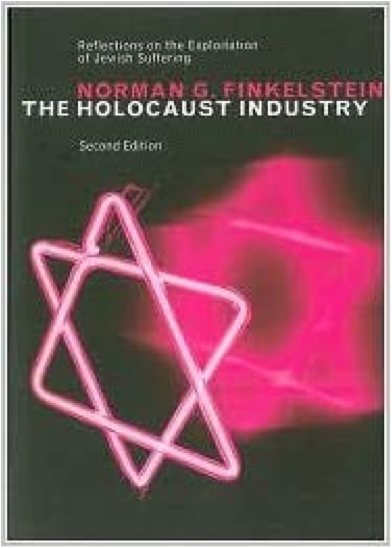
The Books of My Life: The Holocaust Industry
Finkelstein argues that the ideological use of the Holocaust by the holocaust industry is grounded in the teleological notions that the Holocaust is unique and that Jews have been the unique and only victims of this singular Holocaust. Given that the Holocaust is a species of murder, in this instance mass murder or genocide, Finkelstein argues, both cultural and ideological assumptions are problematic since there have been and will certainly be more instances of planned and intentional mass murders beyond the Armenian Genocide, the genocide aimed at Jews, the Romany, communists, and the disabled in Nazi Germany, the Indonesian Genocide, the genocide of Native Americans, and the genocide associated with American slavery. Murder, in other words, must be seen as on a continuum ranging from murder, intentional or not, to mass murder and genocide rather than as a binary of holocaust/not holocaust.
After reading Finkelstein's expose I couldn't help but wonder whether it is the the pursuit of power and the pursuit of plunder rather than prostitution or spying that is the real oldest profession of the world. After all, holocaust industry organisations come off, in Finkelstein's book, as working less for the benefit of holocaust survivors, who seem to get both smaller in number and larger in number in holocaust industry rhetoric, than for its own benefit, and holocaust industry lawyers come off as interested more in big payoffs than in helping those who survived the horrors of the actual Holocaust. Ironically, argues Finkelstein, this holocaust industry has ended up aiding and abetting that which one would hope it would try to undermine, anti-Semitism and Holocaust denial. Welcome to the rabbit hole.
Wednesday, 6 June 2018
The Books of My Life: Beyond Chutzpah
There are a number of things I liked about Beyond Chutzpah. Finkelstein clearly shows that the "new Anti-Semitism" is, in its attempt to link any kind of criticism of Israel to anti-Semitism, a "new" kind of apologetic and polemic aimed at demonising Israel's "enemies" in order to win the discourse war. One has to distinguish anti-Semitism from criticism of Israel. Finkelstein nicely shows how Dershowitz's The Case for Israel is an apologetic and polemic that is generally at odds with the reports of Israeli and international human rights organisations. But then Dershowitz is a lawyer, a "profession" that is inherently apologetic and polemical. Finkelstein nicely shows that Dershowitz's book is full of citation problems. Finkelstein nicely notes that the "empty land" and "primitive inhabitant" discourses of Israel's apologists and polemicists are the same ones used by European settlers in the US, Canada, Australia, and New Zealand to dispossess the First Peoples, the First Nations, the aboriginals, and the Maori.
All this said, I found Beyond Chutzpah somewhat disjointed. Finkelstein's focus on the new anti-Semitism doesn't always sit well with his often devastating take down of Dershowitz's claims that Israel, which seems the saintliest of nations in Dershowitz's apologetics and polemics, is following international law when it demolishes the houses of Palestinians, targets Palestinians for assassination, "tortures" Palestinian prisoners it holds in its gaols and detention centres, and "annexes" Palestinian land. I also found the book somewhat repetitive. Still Finkelstein's book is definitely worth a read if you have any interest in apologetics and polemics, how ideology constructs reality, conservatism, and the Palestinian-Israeli conflict in the modern and post-modern world.
Monday, 21 May 2018
The Books of My Life: Public Access
Bérubé's Public Access is one part post-World War II cultural studies and literary studies, one part post-1960s cultural studies and literary theory, one part post-1960s cultural studies and literary studies history, one part post-1960s cultural studies and literary studies in action (including a compelling reading of Stanley Kubrick's 2001: A Space Odyssey), one part exploration of post-1960s right wing attacks on post-1960s cultural studies and literary studies, and one part call for liberal-left political activism. It is the critique of right wing apologetics and polemics part of Bérubé's book that I want to concentrate on in the rest of this essay.
Bérubé's book does a good job of enlightening its readers about the contemporary American culture war right. Most of the right wing culture war right, as Bérubé notes and documents, are remarkably ignorant of post-1960s cultural studies and literary studies despite their claims that they are the vanguard of manning the barricades to protect America and America's young from its postmodern acids raising the question of how one can critique something one doesn't really comprehend and, in some cases, haven't even taken the time to read. This is, by the way, hardly the first time demagogues have claimed to be protecting someone from something they know very little if anything about. Think of all those anti-Marx folks who never read one sentence of Karl Marx's many writings. Most of the right wing culture war right, as Bérubé notes, really do have a tenuous relationship with empirical facts and empirical reality. The culture war right has consciously manipulated and lied about the writings or conference presentations of those they oppose as a strategy in the contemporary culture war knowing that few of those they aim their screed at will bother to ascertain whether the claims the culture right demagogues make about the "egghead left" are accurate or not. Most of the right wing culture war right, as Bérubé recognises, may claim to be warriors for free speech but the only free speech they vow to protect is their own politically correct right wing speech. Most of the right wing culture right, in other words, are more then willing to limit and ban the speech of those they disagree with and banish those who speak it to a kind of Foucauldian hell. Many in the culture war right, as Bérubé notes, have no interest in partaking of the rational back and forth of scholarly argument or the be fair to arguments you disagree with aspects of scholarly work. Jürgen Habermas we hardly knew ye.
None of this, by the way, is a surprise to me. I have personally seen again and again ignorance, flat out lies, and manipulations from the culture war right along with attacks on the speech of the "egghead left" on social media sites like Facebook. To state the obvious, one shouldn't expect anything else from a group of apologetic and polemical demagogues who self-righteously, arrogantly, and calculatingly see ignorance, a lack of empiricism, and demonisation as the means to the end of the right wing conquest and domination of America.