Showing posts with label Julian Fellowes. Show all posts

Wednesday, 18 April 2012

Happy Anniversary Titanic...

15 April was yet another one of these hundred year anniversaries that so fascinates the public and the media who want to sell product to a fascinated public. 15 April 2012, of course, was the hundredth year anniversary of the sinking of the RMS Titanic in the Atlantic Ocean and the Western media have been full of stories about the ship, its tragic fate, and fictional representations of the ship, its crew, and its passengers and their fate as it sailed toward its tragic fate.

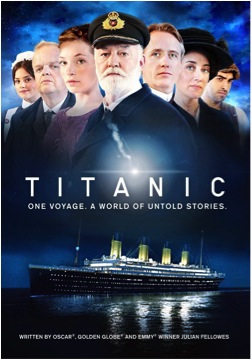
One of the fictional representations of the Titanic that debuted this April and which has gotten a lot of attention, is Julian Fellowes', yes the Julian Fellowes of "Gosford Park" and "Downton Abbey" fame, "Titanic" miniseries that ran on Global in Canada, ITV in the UK, and ABC in the US. Critical judgement of this "miniseries" has by and large been underwhelming, too many stories attempting to be told, too much focus on class, not as good in comparison to James Cameron's 1997 and recently re-released in 3D Titanic, have been the major complaints of media and internet critics.

I recently started watching Fellowes's "Titanic" on the ABC.com website. And apart from the annoyances of advertisements louder than the audio of the show itself, advertisements that are poorly timed, advertisements breaks that are poorly done, two of the plagues of watching films and TV shows online, Fellowes's "Titanic" actually grew on me. It took me awhile to get into the series but Fellowes's telling of the tale of the Titanic tragedy from the several different vantage points of passengers and members of the crew, all representing different classes, over four episodes proved really fascinating and, in the end, quite compelling to me.

As to Cameron's "Titanic", I never found his $200 million dollar plus play toy version of the Titanic tragedy particularly compelling. Rather I found it representative of everything that is wrong with Hollywood. Cameron's "Titanic" is film making by the demographic numbers. You have Leonardo and Kate for the tweens, the ship for the technonerds, Kathy Bates for the adults who like their Americans boisterous, wild westy, and dismissive of Old Europe's class system, the disaster for the dudes who love their films action adventurery, and lots of money spent (while poverty continues to bring suffering to those without access to big Hollywood budgets) for those who think that special effects are the only aspect of a movie that matters. Yech. Of course, this film making by the demographic numbers and drawing as many demographic groups as possible into the suburban movie less than palaces was presumably the only way Cameron and his big money men could recover and expand on their investments. Commodity aestheticism, the Hollywood way. Yech squared.

In the end I enjoyed Fellowes's "Titanic". I found only the historical and special effects aspects of Cameron's "Titanic" (the reconstruction of the ship and its sinking) interesting. Neither Fellowes's nor Cameron's Titanic dramas, melodramas, and tragedies, however, have made me change my mind that the greatest of the Titanic tales on film is the superb "Night to Remember" from 1958 (now available on DVD and Blue Ray from Criterion). Fellowes's version with its narrative ingenuity, a narrative ingenuity confusing, I think, to many viewers socialised to believe that the only real narrative is a linear narrative, was an honourable if overly romanticised effort. And that is much more than one can say for Cameron's linear manichean tween weepie in which what little characterisation there is, is lost amidst the orgiastic spectacle of special effects.

Thursday, 29 December 2011

Upstairs Downton Revisited...

Recently I began to rewatch, for the first time since the 1970s, the classic London Weekend Television and ITV television programme Upstairs Downstairs. Upstairs Downstairs, as virtually every television historian knows by now, was the brainchild of actors Jean Marsh, who would go on to play Rose the downstairs parlour maid in the show, and Eileen Atkins, who was supposed to play the downstairs cook but was unable to because of other commitments.

Upstairs Downstairs, which ran on ITV from 1971 to 1975 and was recently revived by the BBC, was originally going to centre on two maids in a Victorian country house--remnants of this remain in the show in the relationship between Rose and her parlour maid comrade in arms Sarah in the early episodes of the show--but by the time it aired the shows focus had broadened out to include not only the lives of two servants but also the lives, travails, and times of all the other servants downstairs and the masters, Sir Richard, later Lord, and Lady Bellamy, 165 Easton Place, Belgravia, London, upstairs.

Surprisingly, at least to those involved in the show (commentary on the first episode by actors Jean Marsh and Evin Crowley (Emily) and writer Fay Weldon on the Network and Acorn DVD's), Upstairs Downstairs became a hit not only in the UK but in the US. Upstairs Downstairs was one of the first shows broadcast on PBS's Masterpiece Theatre, in fact, it was one of the shows that put Masterpiece on the television map. It also became popular in Canada, Australia, New Zealand, and some 65 other countries across the globe. As a result the show spawned a number of clones including the short lived Beacon Hill (1975) on the US CBS network and more recently Downton Abbey.

Downton Abbey is the creation of British actor--he played the Scottish aristocrat Kilwillie in the BBC's Monarch of the Glen (2000-2005) and politician Claud Seabrook in the BBC's superb Our Friends from the North (1996)--writer--he wrote Robert Altman's Gosford Park itself heir to Upstairs Downstairs and prequel to Downton Abbey--and director, Julian Fellowes. It premiered on ITV on 26 September 2010 and was broadcast in America on PBS's on Masterpiece in January of 2011.

Even before Downton Abbey premiered a number of critics pointed out that in many ways Julian Fellowes new series was the grandchild of Upstairs Downstairs. After rewatching the first episode of Upstairs Downstairs, "On Trial", it is quite easy to see why. Both Upstairs Downstairs begin with a new downstairs arrival, Sarah (Pauline Collins), the new parlour maid, in Upstairs Downstairs and Bates (Brendon Coyle), Lord Grantham's new valet, in Downton Abbey. The arrival of Sarah and Bates at Eaton Place and Downton Abbey allow the writers of the first episodes of each series, Upstairs Fay Weldon and Downtons Julian Fellows, to introduce viewers in a very elegant way to the main characters and dynamics of both houses. Both Upstairs Downstairs and Downton Abbey have downstairs run by prim and proper yet humane butlers, Mr. Hudson (Gordon Jackson) in Upstairs and (Charles Carson) in Downton. Both Upstairs Downstairs and Downton Abbey have mature and crusty if not nasty cooks, Mrs. Bridges (Angela Baddeley) in Upstairs and Mrs. Patmore (Lesley Nicol) in Downton, and somewhat dim and clumsy kitchen maids, Emily (Evin Crowley) in Upstairs and Rose (Sophia McShera) in Downton. Both Upstairs Downstairs and Downton Abbey have scheming and rather "sinister" footmen, Alfred (George Innes) in Upstairs and Thomas (Rob James-Collier) in Downton, both of whom have homosexual relationships with aristocratic foreign visitors to Eaton Place and Downton Abbey. Both Upstairs Downstairs and Downton Abbey have ladies of the house who involve themselves in contemporary radical causes. In Upstairs Downstairs Miss Elizabeth (Nicola Pagett) gets involved in "radical" causes like the suffragist movement while in Downton Abbey Lady Sybill (Jessica Brown-Findlay) involves herself with "radical" labour and women's rights  movements. And finally in both Upstairs Downstairs and Downton Abbey the sinking of the Titanic has an immense impact on the Bellamy and the Grantham households upstairs. In Upstairs Downstairs Lady Marjorie Bellamy (Rachel Gurney) dies while sailing on the Titanic to New York to visit daughter Elizabeth in America while in Downton Abbey Lord Grantham’s cousin and heir presumptive James Crawley and his son Patrick die when the Titanic sinks in the Atlantic setting in motion the chain of events related to the entail that will dominate the first series.

There are also, of course, differences between the two costume dramas about life upstairs and life downstairs. Upstairs Downstairs was, as was the case with British television in the 1960s, 1970s, and some of the 1980s, a kind of "electronic play" largely shot in the studio and largely recorded on videotape, and is leisurely in pace while Downton, as has been common in British television since the 1990s thanks, in part, to the impact of film, is filmed in the studio and on location at Highclere Castle, has substantially more editing than Upstairs, and is, as a result, much quicker in pace than Upstairs Downstairs. It takes, for example, two series of thirteen episodes each for Upstairs Downstairs to get from the Titanic to World War I while it takes Downton Abbey one series of seven episodes to do it. Additionally, where Upstairs Downstairs was much more critical of the British class system with its masters and servants and the impact of this distanced paternalistic system on the servants, Downton, while engaging in a bit of critical distance, seems to me to romanticise the relationship between upstairs and downstairs, allowing its masters and servants to touch on occasion, wrapping the relationship between master and servant in a kind of nostalgic haze which seems to view the paternalism of the Grantham's (and the aristocracy in general?) in a largely positive light, at least in the first series.

The similarities between the two shows clearly cannot be chalked up purely to genre, purely to the fact that both shows focus on the lives and interrelationships of those upstairs and downstairs and are set in aristocratic homes, one in London, the other in the country, in Edwardian England. Downton Abbey is, as so many critics have pointed out, an Upstairs Downstairs for the new millennium. But while Downton may be an Upstairs clone, at least initially, that doesn't mean that Downton Abbey is any less enjoyable for being an Upstairs Downstairs for the twenty-first century. Personally I love the show and I can't wait for series two of Downton to begin on PBS in January of 2012. It is for me one of the best English language television shows out there along with Sherlock, the new Doctor Who, Outnumbered, The Thick of It (all British), and Being Erica (a Canadian show).

As to re-watching Upstairs Downstairs, it has been a joy. It is great to see one of the finest television shows ever made again after some forty years in an excellent transfer with tonnes of extras from Acorn.

Friday, 4 February 2011

Upstairs Downton

I am really sick of the comparisons in the press of the new revived Upstairs, Downstairs (BBC, 2010-) with Downton Abbey (ITV, 2010-). The revived Upstairs Downstairs is a very different show from Downton Abbey though the latter clearly riffs on, or is paying homage to, the upstairs downstairs and downstairs downstairs relationships of the "original" Upstairs, Downstairs. Where they are similar, in other words, is in the character traits of those downstairs--Downton has its own Mr. Hudson, Mrs. Bridges, and Ruby in Mr. Carson, Mrs. Patmore, and Daisy--the relationships between those downstairs, and the relationships between those downstairs and those upstairs.

Upstairs, Downstairs, of course, is not the only influence on Downton Abbey as several critics have noted. Downton has obviously also been influenced by the Jane Austen industry, the BBC Forsythe Saga (1967), and the film Gosford Park directed by the legendary Robert Altman and written by Downton's creator Julan Fellowes (Fellowes script was based on Altman's and Bob Balaban's original ideas for the film). Fellowes has also been accused of ripping off a host of British film and TV landmarks beyond Upstairs, Downstairs such as Mrs. Miniver (1942), specifically the ripping off of the annual flower competition in Mrs. Miniver in episode three of Downton, Brideshead Revisited (ITV, 1981) with its rural manor house, and the "reality" show the Edwardian Country House/Manor House (Channel 4 and PBS, 2002).

While Downton may have been influenced by the original Upstairs, Downstairs (ITV, 1971-1975) Upstairs, Downstairs and Downton Abbey are also very different shows. Compared to Upstairs, Downstairs Downton Abbey, whose narrative is centred around the impact of the law of entail on the Crawley family, particularly the daughters, and on the Abbey itself, is more formal, more rural, and more apolitical in its narrative than the new Upstairs Downstairs which, like the old Upstairs, Downstairs, is centred on a family, in the case of the revived Upstairs on the Holland family and their servants, and is more intimate, more urban, and more political in its narrative than Downton Abbey. Asserting that both the new Upstairs, Downstairs and Downton Abbey are the same because they both have masters and servants in them is akin to arguing that Degrassi High, a dramedy, and Saved by the Bell, a sitcom, are the same because they are both teen high school shows.

I really liked both Downton Abbey and the revived Upstairs, Downstairs. Admittedly, I was a bit put off by the first episode of the revived Upstairs, Downstairs but once I watched the second episode I was hooked. I find the "new" series very much like the old mixing a bit of fact with the a lot of fiction. I hope I will be able to see a lot more of it in the future.