Where I, Ron, blog on a variety of different subjects--social theoretical, historical, cultural, political, social ethical, the media, and so on (I got the Max Weber, the Mark Twain, and the Stephen Leacock in me)--in a sometimes Niebuhrian or ironic way all with an attitude. Enjoy. Disagree. Be very afraid particularly if you have a socially and culturally constructed irrational fear of anything over 140 characters.
Monday, 1 June 2026
The Books of My Life: Radical Campus
Monday, 2 March 2026
The Books of My Life: Racism, Sexism, and the University
In June of 1992 twelve graduate students in the Political Science Department at the University of British Columbia in Vancouver sent an anonymous letter to the Dean of the Faculty of Graduate Studies at UBC accusing several White male professors in the Department of being racist and sexist. A few months later in November of 1993 six more students joined the chorus of voices claiming that UBC’s Political Science department was sexist and racist.
UBC sociologist Patricia Marchak in her analytical and ethnographic study of this battle in the culture wars being fought all across the English settler society world, finds the conclusions of the McEwen Report less than credible in her book Racism, Sexism, and the University: The Political Science Affair at the University of British Columbia (Montreal and Kingston: McGill-Queen’s University Press, 1996). To Marchak, who was the Dean of Arts in the Faculty of the Arts when the affair began, the evidence, in the McEwen Report was not only anaemic. It was grounded in ideological correctness. In fact, according to Marchak, it was McEwen, who introduced racism and sexism into the report by repeatedly using terms like “white”, “female”, and “Jewish" in her final report, a report that sounds from its description more like a prosecutorial brief than an investigation of the facts of the case.
While racism and sexism seemed to be, on the surface, what the UBC Political Science affair was about Marchak argues that this battle in a long standing culture war was really about power. It was about, Marchak argues, who had the power to determine the Political Science curriculum at UBC, who had the power within the hierarchical Political Science Department at UBC, whether the Political Science Department at UBC would be one in which truth grounded in empirical evidence was pursued or good causes were promoted, and whether academic freedom and Enlightenment rationality (empirical facts and empirical context as evidence) or postmodern relativism (perceptions as facts) would prevail in the UBC Department of Political Science. As Marchak notes, this battle for the soul of the university was hardly singular to UBC or Canada. There were battles like this in other universities across the English settler society world in Canada, Australia, the UK, and the US, where Trump and his comrades are trying to remake universities and colleges in their own political and ideological correct image.
In 1995 the dean of the Faculty of Graduate Studies ended the ban on the admission of graduate students to the Department of Political Science. In 1998 then UBC president Martha Piper apologised for how UBC’s administrative bureaucrats had treated Department of Political Science during the affair (these apologies seem to always come after time has passed and the damage is already done, don't they?). As is so often the case with these after the fact apologies, however, it could not erase memories of the damage caused by vigilante like attacks on the Department between 1992 and 1995.
I enjoyed Racism, Sexism, and the University quite a lot. Marchak was spot on about the impact of consumer capitalism with its mantra that the customer is always right on North American universities (one of the original sins of the modern North American university). I personally experienced this culture of consumer feelings when I received a visit from the college lawyer and the college equity officer at the college in which I worked when one student in a class of 34 complained about a joke i told which apparently offended her or him. She is right about the impact of managerial corporate capitalism with its mantra that professionals, well non-academic professionals, know best how to run the institutions of higher education (another of the original sins of the modern North American university). She is spot on in her contention that the anti-hierarchal attitudes of postmoderns undermines the notion of professionalism and professional training and its accumulated cultural capital and that the cultural war between moderns and postmoderns is a battle for power in the North American university. She is spot on that illiberal intolerance can be found among many postmodernist sects. The radical right hardly has a monopoly on illiberalism. She is right that many varieties of postmodernism have a radical democratic aspect to them. This makes some postmoderns close cousins to religious fundamentalism with its ideology of every man a Bible interpreter regardless of educational level and cultural capital accrued. She is spot on about the need for a middle way, a middle way that respects the seeking after truth, natural justice or due process, and merit (even if this is unequally distributed for class, race, and gender reasons), and respect and equity for all.
Finally, I do agree with Max Weber that value, what someone values, does impact what academics and fan boys and girls study but that does not mean that we have to throw out the scientific method with its dispassion with the everything is about power ideologically correct water. One can and should be trained in the fine art of dispassionate analysis grounded in an understanding that every human thing is grounded in economic, political, cultural, demographic, and geographic realities, even if many of those realities are nothing more than social and cultural constructs.
Thursday, 5 February 2026
Anne of Windy Willows, Anne of Windy Poplars, and the Fine Art of Being Sparing With the Truth
I think I was around five years old when my mother started buying books for me to read. It was strange because neither my mum, who came from a working class English family, nor my dad, who was middle class and came from a Swiss family, really read many books or at least I never saw them read many books.
Saturday, 24 August 2024
A Critical Ethnography of Social Media: The Dangerous CBC Reds Are Under our American Beds
Poor Canada. It is North America’s Poor Edith. Canada, particularly through its public broadcaster the CBC, has, over the years, produced some excellent and stimulating television shows. Hardly anybody within and outside of Canada, however, watches them. When people do watch them in significant numbers it is often a cause for at least some Canadian national celebration.
Well presumably some Canadians were intrigued to learn that someone, namely American diplomats stationed in Canada, were watching CBC commissioned shows. They were watching The Border (2008-2010), a show that reminds me less of 24 (2001-2010, 2014), a connection some commentators have claimed to see, than to the BBC’s spy, crime, and action-adventure show Spooks (2002-2011) with which The Border has a lot in common including an indebtedness to John le Carre. This last, by the way, means that The Border, like Spooks, has a lot of reality in it. They were watching the excellent Intelligence (2005-2007), a show about the messy realities of the cross border drug and crime “trade" between British Columbia and the Pacific Northwest and the American and Canadian intelligence and surveillance agents involved in tracking and trying to stop them, brought to us by the same person who created the superb DaVinci’s Inquest, a show that preceded and parallels much in the very realistic US TV show The Wire. They were watching H2O (2004), a drama about an American plan to steal Canadian water co-written by Paul Gross. And they were watching Little Mosque on the Prairie (2007-2012), a situation comedy with an occasional bite centring on Canadian Muslims living in a fictional town in the prairie province of Saskatchewan.
How do we know American diplomats and American agents stationed in Canada were watching these shows? Well in 2010, during the Barack Obama presidency and the prime ministership of ex Reform and new Tory pro-American Stephen Harper, it came to light, thanks to the Canadian national newspapers the National Post and Globe and Mail, and thanks particularly to Wikileaks, which had gotten hold of thousands of US secret diplomatic “cables”, that some bureaucrats in the US diplomatic corps who had watched these three shows reported in cables dated 2008 that they thought they were “anti-American”. These diplomatic and perhaps not so diplomatic missives accused these four CBC shows of stereotyping Americans via emotion laden “anti-American” melodrama. They claimed that that while these shows, produced with Canadian governmental aid, hardly constituted a diplomatic crisis between the two now close neighbours, they did reveal that the CBC, Canadian pubic television whose remit, in particularly, was to make Canadian television, twisted current events in order to feed Canadians negative images of the United States (ah there is that old saw of Canadian identity being a product of Canada and Canadians marking themselves off against Americans). They asserted that these shows reflected a Canadian nationalism that counterpointed Americans engaged in all sorts of “nefarious" actions while Canadians tried to stop them and even sometimes opposed them, shows that all too often counterpointed American black hats to Canadian white hats.
The controversy that resulted over these cables, some of if gosh this is what American tax dollars are paying for variety, when they were released by the Canadian national press and Wikileaks was such that the American ambassador in Ottawa was forced to confess that while he had never seen any of these shows he doubted that any of them were “anti-American” while a spokesman for the US State Department in Washington emphasised the close friendship between the two countries and claimed that no one knows us, the US, better than Canada, a comment that opens up the Pandora’s box of double edged swords. What he also neglected to note is that these “anti-American” not “anti-American" television shows were also shown in the US on retro channels, if often late at night and in the wee hours of morning. Can US TV be "anti-American" too?
Speaking of being an anti-, The Border one of whose creators was Lindalee Tracey of Not a Love Story fame, also sometimes skewers the Russians, the Chinese, two nations regularly skewered on US TV, the British and the Canadians, the last two often for good reason. MI6, the British not so secret spy and sureveillance agency and the Canadian Security Intelligence Service, CSIS, in particular, come in for criticism, the latter quite regularly, making The Border, perhaps, at least for those Canadian politicians and nationalist Canadian historians—you know, the Canadian politicians and historians who think that only they are the only real Canadian patriots and who seek a more militant Canada with greater military, surveillance, and intelligence ties to the US—a prime candidate for the epithet “anti-Canadian”. Can Canadian TV be “anti-British” and “anti-Canadian” too?
Of course, what is never interrogated and never analysed empirically in this claim that something is “anti-American"is why and how something is “anti” Now I will grant you that comments such as America sucks and Americans are dicks, that Israel sucks and Israelis (not Jews) are pricks, that Iceland sucks and Icelanders are sicks, and that evil Russkies suck and Russkies and dicks, pricks, and sicks (a common ideologically driven malady in the US which is used to great effect by the military, industrial, governmental, and university complex) are ill considered, if intellectually considered at all, lowest common denominator nonsense perhaps not even worthy of a seventh grade or first form mind. What I will not grant is that claims that the US is an imperial power, that it often throws its weight around, including in Canada way too often, that it regards itself as the chief policeman of the “civilised" world, that it has an increasing divide between the haves and have nots, and that it has had and continues to have racial problems, to name a few, is "anti-American". All of those critiques are valid empirical critiques of real America and, save in the minds of manipulating demagogues or polemicists and apologists and the socialised for conformity manipulated masses is not "anti-American". They are simply descriptions of reality.
One can, of course, extend this point to other “antis". The differentiation between emotion grounded lowest common denominator schoolyard criticism versus empirical and analytical criticism can be applied to Israel as well given that Israel, empirically speaking, is a regional imperial power, thanks particularly to the US, with all that entails in terms of policing, surveillance, violence, and power, and where some Jews and many Muslims and Christians are second class citizens and experience segregation and violence. A lot of the same empirical criticism made of the US can also be made of Russia, including the observation that it is an imperial power, with the caveat that Russia is a second or third rate great power compared to the US (and certainly isn’t a threat to world domination and even if they were surely 007 or his American counterpart would be able to stop them single handedly as always) and so one’s empirical criticisms of that state’s power ambitions—all great powers including the US and Israel have power ambitions, of course—have to be adjusted accordingly in order to more accurately fit the Russian case.
That so many of the socialised for conformity masses who are easily and readily manipulated by demagogues, by polemicists and apologists strategising for ideological and hence political advantage through the use of emotional appeals, fall for the spurious rhetoric and discourse that even empirical and empirically verifiable criticisms of the US and Israel and Russia are the same as lowest common denominator “antiism" tells you a lot about the life of the mass mind in the modern and postmodern world and about how cultural and ideological power works in the modern and postmodern world. And who says that human life is not inherently absurd?
Read the cables here…https://archive.nytimes.com/www.nytimes.com/interactive/2010/11/28/world/20101128-cables-viewer.html#report/canada-08OTTAWA136
Monday, 12 August 2024
A Critical Ethnography of Social Media: Reviewing "Reviews” at IMDb
For those of us that have learned over the course of our lives that human life is absurd and hence amusing, the internet and its world wide web provides us with a lot to be amused by. I had this hypothesis verified for me yet again when I visited the social media “information” site IMDb just the other day.
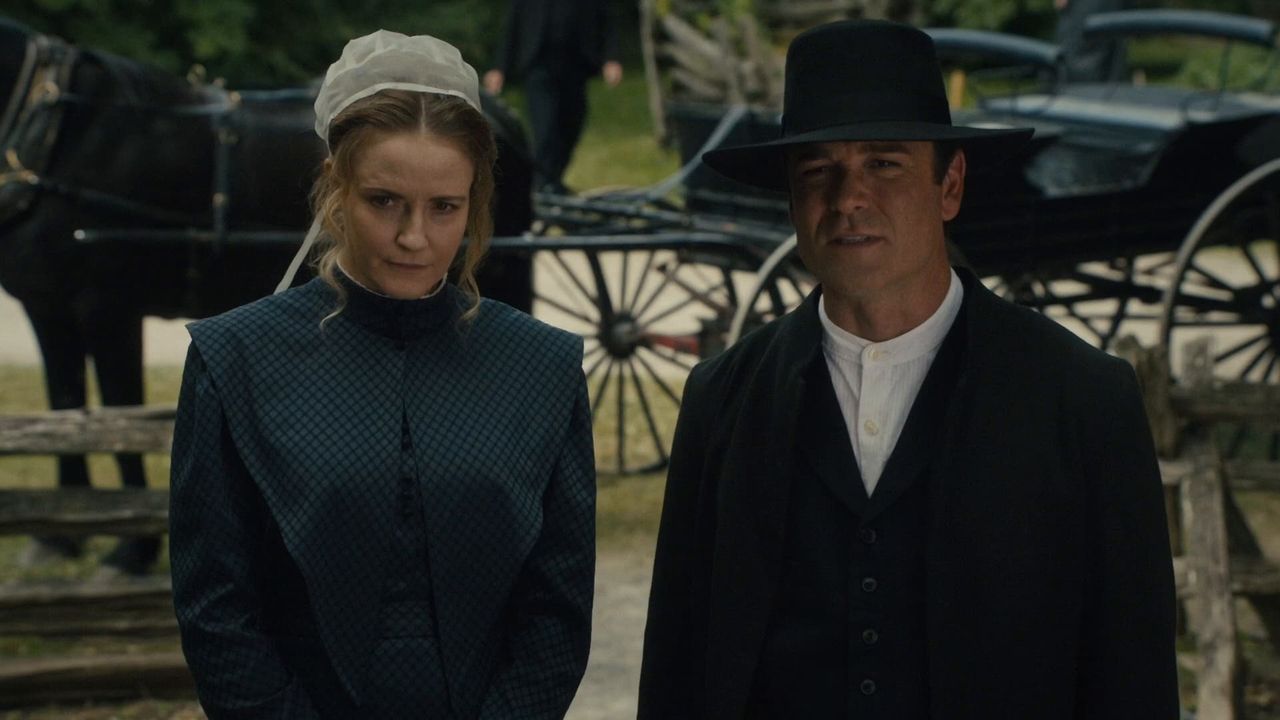
Recently, I watched an episode of the Canadian television show Murdoch Mysteries, which has run on Citytv and the CBC since 2008. The episode was entitled ‘Clean Hands” (CBC, 16:6, 17 October 2023). In that episode two of the central characters in the show, Murdoch himself played by Yannick Bison (once I came across an American “reactor” on YouTube who called him bison after the beast), and Julia, his doctor wife played by Helene Joy, infiltrate two Mennonite communities, one more “liberal” than the other, near Berlin (now Kitchener thanks to English Canadian nationalism during World War I) Ontario. Murdoch and Julia become participant spies in two Mennonite communities in order to find out who murdered a young Mennonite lad who was about to get married and who, because of his more secular ideological bent, was a circle who did not fully fit into the square pegs that were these two old order Mennonite communities.
IMDb is a database founded in 1990 by a British computer engineer. It had its coming out party on the world wide web in 1993. It is a useful if imperfect database that contains information on films, which was its earliest focus, television shows, podcasts, home video, video games, and streaming content. I occasionally go to it to learn more about films and television shows. One of the things I am sometimes interested in which IMDb often contains information on is where films and TV programmes are shot. I wanted to ascertain where the episode of Murdoch I just watched was filmed so I went to the IMDb Murdoch “Clean Hands” page.
I was unfortunately unable able to access the information I was looking for. I did, however, find something else that interested and intrigued me even more. As I wandered around the IMDb Murdoch “Clean Hands" page I happened upon a “review" of the episode—there were five in total at the time—which I found simultaneously interesting, informative, and problematic. This “review” authored by "Steiner-Sam" entitled “Gross Misinformation of early 20th-century Ontario Mennonites” claimed that the CBC, the network that commissioned Murdoch and broadcasts it it in Canada, had done a “pitiful” job in representing Mennonite history and culture in Ontario. He claimed that Ontario Mennonites do not live in “colonies”, that they do not use matchmakers, that they do not avoid the wives of others, that they do not shun for disagreements, and that they do not lock their unwed and pregnant daughters in attics,
There are several empirical problems with this “review”. First, the Canadian public television network CBC does not make Murdoch. The CBC commissions the show and as a consequence does have some say over the show as a result. The show is actually made by Shaftesbury Films—Rogers Sports and Media was also involved in making the show in its first five seasons before it moved to the CBC after Citytv, which is owned by Rogers, cancelled it. Shaftesbury is a private corporation founded by Christine Jenkins, who gets an executive producer credit on the show as a result, in 1987. It is Shaftesbury who hires the actors, hires the writers, and hires the craftspeople associated with the show with, of course, varying amounts of input other interested sources. By the way, Shaftesbury, is aided in their financing of the show thanks to Canadian and Ontario tax credit policies and funds from the Canadian Television Fund.
Second, Mennonites do live in colonies. Russian Mennonites, those Mennonites who migrated to and settled in Russia as a result of persecution in Mitteleuropa, lived in colonies like Chortitza and Molotschna in the Russian Empire. Some of the members of this Old Colony Mennonite community would eventually settle in Canada, Mexico, and Paraguay after leaving Russia in the early 20th century to avoid serving in the military. Mennonites have historically been non-violent. Interestingly, many of the Old Colony Mennonites who settled in Manitoba, Saskatchewan and British Columbia including in urban areas like Winnipeg (now the city with the largest number of Mennonites globally) and Vancouver, later re-migrated to Mexico and Paraguay after receiving state promises to avoid the socialised for conformity practises of English Canadian schools, including the English Canadian British nationalist faith, and, of course, military conscription.
Third, like the term “colony”, which can mean many things including a geographical part of a colonised state under the political control of another, the original thirteen US colonies, a group of people who identify with each other while living in a foreign place, and a settlement in which people live close together—the last two definitions can clearly be used to describe separatist Old Colony Mennonites in the Prairies and separatist (colony) old order Mennonites in Ontario —the term matchmaker, someone who arranges marriages or relationships, can also take different forms. Matchmaker, for instance, can refer to a position, usually a female position, which is institutionalised and hence official in communities or it can refer a role in communities which is not officially institutionalised and which functions on an unofficial level as opposed to official level. Old Colony Mennonites, including those in Canada, like many other if not every other community across the globe, have unofficial matchmakers, unofficial matchmakers who can be recognised by the community as “official” in an unofficial way.
Fourth, Old Colony Mennonites do shun. As is the case in other old order Anabaptist groups, those who “stray” in Old Colony communities are, at least officially, initially reprimanded by a deacon. Those who still refuse to conform can be denied or “set back” from communion. This makes them outside of the fold, people who are shunned. If conformity is not forthcoming after these forms of discipline the offending party can be excommunicated.
Fifth, the episode does not portray all Mennonites as locking their unwed and pregnant daughters in attics. It portrays the hiding of an unwed and pregnant daughter, a daughter who the family hopes will be married off in the future after she gives birth, as the response of one Mennonite family to an unwanted out of wedlock pregnancy.
Finally, let’s not forget that Murdoch Mysteries is a fictional television show that uses a host of strategies, many of them meant to manipulate the emotions of viewers such as tone, genre, drama, tragedy, comedy, satire, parody, music, and editing to manipulate viewers. Murdoch is not by any stretch of the imagination a documentary about early 20th century Old Order Mennonite life in Ontario and does not pretend to be so. It doesn’t even pretend to be a realist text. In fact, no film or TV programme, documentary or otherwise, is ever “real” or ever can be “real” making the notion that films or TV programmes can be or should be “real” an ideology that ultimately cannot be achieved in films and TV shows making the fetish of “realism” the film and television equivalent of the Holy Grail. Given this, if one wants to actually learn more about early 20th century Ontario Mennonites, one can—though most won’t, of course—take advantage of the fact that there are a number of excellent academic studies of North American and Canadian Mennonites out there in scholarly book land that can be read by those interested in Mennonite history, Mennonite society, and Mennonite culture.
IMDb is, of course, not the only social media site on the world wide web that give the reflective a strong sense that human life and its adjuncts—its political, economic, demographic, and geographic cultural ideologies or ways of perceiving—are humorous and at the same time frightening in an enlightening kind of way. There is also YouTube which, I suspect, is even more visited than IMDb, and there are also social media sites like Instagram and TikTok. What all of these social media sites say about human nature, about human gullibility, about the ideologically constructed blindness that impacts the human “race”, and about researching in a digital age that makes research easy, is a question I will leave you to answer if preferably in an empirical way.
For further empirical information on the Old Order Mennonites and Old Order Anabaptists see Harry Loewen and Steven Nolt, Through Fire and Water: An Overview of Mennonite History (Scottdale, PA and Waterloo, Ontario: Herald Press, revised edition, 2010) and Donald Kraybill and Carl Bowman, On the Backroad to Heaven: Old Order Hutterites, Mennonites, Amish, and Brethren (Baltimore, MD: Johns Hopkins University Press, 2001).
Thursday, 1 August 2024
The Books of My Life: Values in Conflict
Colleges and universities, universities and colleges, colleges within universities, colleges as universities, whatever the equation, education and higher education have occasioned much gnashing of teeth over the years in the cultural wars that have come to typify the modern and postmodern worlds. One of the domains where these culture wars have been fought out in the modern and postmodern worlds is in the highly bureaucratised educational sectors of modern core nation societies, sectors that are thought by many to be central to the “proper” functioning of a modern and postmodern society. Talcott Parsons would certainly be fascinated by it all.
The late 1990s and early 2000s saw no less gnashing of teeth about higher education and particularly higher liberal arts education then, well pick almost any date, the 1900s, the 1920s, 1960s. the 1980s, or the early 1990s as York University Canadian historian and social scientist Paul Axelrod reminds us in his Values in Conflict: The University, the Marketplace, and the Trials of Liberal Education (Montreal and Kingston: McGill University Press, 2002). If one can conceptualise the polemics and apologetics over higher education and particularly the polemics and apologetics over a liberal arts education as lying on a continuum with total “traditionalism"—however that is defined since, as Axelrod notes, the notion of what constitutes a liberal education has changed across time and even space—on one end of the spectrum and total innovation—again however that is defined since notions of innovation have changed too across time and space—on the other, Axelrod lies, I think, somewhere in the middle.
Axelrod recognises that things have changed not only educationally but politically, economically, culturally, geographically, and demographically in the modern and postmodern world and he recognises that higher education must adapt to those chances. At the same time Axelrod wants to preserve, in the midst of this change, the core of a what he defines as a liberal education for a postmodern world, a liberal education that encompasses creativity, autonomy restraint, control, intellectual breadth and specialisation, diversity, tolerance, and a liberal education that produces (or potentially produces) well rounded potential employees complete with essential good employee traits. The problem, as Axelrod notes, in making the argument for the contemporary importance and relevance of a liberal arts education is the important role economic elites and politicians with their education for a job “pragmatism” play in contemporary higher education and in higher education bureaucracies.
Axelrod, of course, is not the first polemicist and apologist writing on higher education to defend the value of a liberal arts education in the face of higher educational change and societal change. As Axelrod reminds us the eccentric social scientist Thorstein Veblen in his The Higher Learning in America of 1918 pointed out the dominance of business interests in the rise of the modern research university of the late 19th and early 20th century and the impact this was having on faculty activity, the university curriculum, and the governance of research universities, public or private, with their mania for new educational technologies (in Veblen’s era a mania for the modern Prussian and German higher education model), more students, and higher education public relations spin and decried it. As Veblen notes, by and large the US, and I would add the Canadian universities in the process of becoming research universities, largely chose not to follow the Oxbridge or Camford model of governance, one that gave academics control over their Oxbridge colleges at least until Margaret Thatcher assumed the throne in that green and “blessed" isle, something that says a lot about the cultural meanings and ideologies that dominate both nation-states.
One of the things that became central in the age of university expansion in the age of Veblen and after was branding, something Veblen notes was important to research universities when he was writing in the early part of the twentieth century. Spin doctoring has continued since Veblen’s day and has become central to colleges and universities as a even a brief gander at college and university Facebook pages quite clearly reveals (something that also brings to mind academic discussions of bullshite). One of the pieces of public relations universities particularly relied on after World War II, an era that saw an increase in government expenditures for education and particularly higher educational research, relevant research in particular, of course, and in students, was that education could prove helpful—particularly monetarily helpful—in the job market of the seemingly ever changing post World War II world.
These burgeoning research universities still had a bit of the old amidst the new in the era after World War II. They were characterised by a paternalism, a hangover from the higher education produces gentlemen and, if in a lesser and in a more circumscribed way, genteel ladies ideology, and they limited free speech. These research universities limped on in the early sixties and by the mid and late sixties were conceding some things to student activists during the “revolutionary” era which ended in loco parentis to some extent and only for the moment. They were also helped immensely by the seemingly never ending financial largesse of the government and growing corporations coming their way during the era.
And then the oil crisis hit followed by inflation and stagflation and later a host of capitalist booms and busts. In the wake of the oil crisis governments and corporations, both increasingly caught up by the passionate wet dream that there was money to made in them there gilded hills of economic globalisation. As Axelrod notes, the post oil crisis era was an era characterised by declining public support for colleges and universities. It was also, he notes, an era of increasing grade inflation in universities, increasing college and university reliance on student fees, private gifts, and targeted state support, mostly not for the liberal arts. It was an era characterised by the increasing corporatisation, bureaucratisation, consumerisation, and retailisation of universities, something which gave us, amongst other things, university and college speech codes and calls for universities in particular to remould themselves for the realities of the job market in a world where neo-liberalism with its belief in the market as god had triumphed at least for the moment, the new paternalism. And, perhaps even more importantly, it was an era in which new technologies, thanks to the triumph of the brave new digital world and its shiny new toys, new toys which bred speculation in universities, government, and business about how these shiny new toys might change higher education and how higher education “commodities” are delivered.
In a final coda Axelrod wonders about where universities might go in the wake of the early 21st century. Of course, writing from the vantage point of 2024 one has a little better idea about how to answer this question. Neo-liberalism remains dominant in the political culture of Canada, the United States, and England. Universities and colleges continue to pursue governmental, noblesse oblige, and corporate monies, and social media like FaceBook have simply added to the university and college penchant for pollyannaish spin doctoring or public relations work. Grade inflation continues at liberal arts centred universities where probably too many students with a limited interest in the liberal arts are matriculating given the continuing—and at this time still at least partially correct hypothesis— that more education equals more financial remuneration. Universities and colleges still try to be relevant though the relevance of Women’s Studies, African American Studies, and Latino and Latina Studies (Latinx Studies) has been increasingly overshadowed by “pragmatic” education” for the “new” economy and programmes like computer science, security studies, and data collection. The culture wars over higher education continue and right wing populists continue to maintain and expand their better poker hands thanks to claims that universities and colleges are dens of political correctness (hyperbole grounded in a selective gaze) though those making such polemical claims are themselves politically and ideologically correct (not to mention demagogic and hence skilled at manipulating the masses for political and ideological power ends) though not all of them seem to recognise the rather obvious fact that they are (hypocrisy). Events like the recent Israel-Hamas War have allowed authoritarian if not fascist university and college presidents or chancellors acting not only at their own behest but at the behest of boards of governance dominated by more “traditionalist” business types and rich donors, to increasingly rely on the surveillance and forceful arm of the increasingly militarised and fascist police (when it comes to outsider dissidents not to mention minorities) to maintain "law and order" on campus.
Axelrod’s book is an interesting addition to the culture war polemics and apologetics over education and higher education in a neo-liberal dominated world and a reminder that the culture wars over education seemingly, never stop. This educational theory and practise Sisyphus, like rust and decay, apparently never sleeps. In the end, as I was reading Values in Conflict, I, a child of the sixties for good and bad and a dystopian leaning student of utopianism whether of “left” or “right”, Bolshevik or capitalist, persuasion could’t help but muse about the fact that the more things change the more they seemingly stay the same. Values in Conflict made me even more certain that my scepticism about any form of social engineering, whether heartfelt or cynical, and whether educational or general, was misplaced and that utopian engineering of all stripes is likely doomed to failure in the long run. Additionally, I couldn’t help but muse about whether the liberal arts university and college and the liberal arts themselves will survive the latest utilitarian threats to them. I suspect they will survive in some form or another but likely largely at major high status and wealthy research universities like the University of Toronto and the University of Texas and in research colleges like Amherst, Bryn Mawr, and Vassar. Stay tuned for further episodes in the never ending saga of the Trials and Travails of a Liberal Arts Education coming next year to a theatre near you.
Saturday, 27 July 2024
A Critical Ethnography of Social Media: The Strange Case of Missing Canadian Content on YouTube
There have been a number of, in my opinion, excellent Canadian television shows over the years including the innovative and influential Degrassi trilogy of The Kids of Degrassi Street, (CBC, 1979-1986) Degrassi Junior High (CBC, 1987-1989) and Degrassi High (CBC, 1989-1991), Degrassi before Californication, Anne of Green Gables (CBC, 1985, 1987), Due South (CTV, 1994-1999), Slings and Arrows (The Movie Network/Movie Central 2003-2006), a show turned down by the CBC for perhaps being too much of a satire of a Canadian cultural institution, Stratford, Being Erica (CBC, 2009-2011), the long running Murdoch Mysteries (City, 2008-2012, CBC, 2013-), and the long running Heartland (CBC, 2007-), to name a few. None of them, however, get either the attention they deserve or the props they deserve from the seemingly omnipresent but certainly not omniscient “reactors" on YouTube, whether Canadian or not, whether scholars, who are a vast minority on social media, or not.
There are, as anyone who has browsed YouTube for a period of time knows, a number of Canadians who do music, film, and television “reactions” on that social media site. They, like the English Canadian duo CineBinge, Popcorn in Bed (who is sometimes joined by her sister) and darcie’s watching stuff, both of whom hail from Alberta, the most Americanised of Americanised Canada, the Torontonian shadowcat, or the Canadian francophones Vic, and Verdy, however, largely react to American stuff though Popcorn does occasionally, very occasionally branch out into British stuff. A few, like the Hanier Family and Bars and Barbells do have Canadian content rules and periodically “react” to music by English Canadian bands like Rush, Triumph, and April Wine but not generally to lesser known English Canadian bands such as Great Big Sea, Figgy Duff, The Northern Pikes, Frozen Ghost, lesser known French Canadian bands like The Box and Men Without Hats, or very English Canadian Canadian bands such as The Tragically Hip or Sloan.
There is one Canadian “reactor”, however, an expatriate Canadian actor living in London in the United Kingdom named Megan Ruth who generally “reacts” to British television shows like the innovative and influential Monty Python’s Flying Circus (BBC, 1969-1976), Fawlty Towers (BBC, 1975-1979), Blackadder (BBC, 1983-1999), Inbetweeners (E4, 2008-2010), and The League of Gentlemen (BBC, 1999-2002, 2017), all TV shows worthy or “reactions” and all British TV shows largely ignored by the majority of “reactors” on YouTube in favour of the much more mediocre American programmes that dominate “reaction" videos on YouTube. That makes Ms. Ruth somewhat of an anomaly amongst “reactors” on YouTube.
In many ways Ms. Ruth, CineBinge, Popcorn in Bed, darcie’s watching stuff, Vic, and Verdy are allegories for Canada itself past and present. Ms. Ruth symbolises the English Canada of yore, an English Canada proud to be part of the British Empire, an empire that is more of a memory than a reality these days. CineBinge, Vic, and Verdy symbolise the Canada of today, a Canada that is a client state of Imperial America and in thrall to Californicated American culture. All of them ignore Canadian content generally. Ms. Ruth ignores Canadian television programmes that are similar to the British television shows she does “react” to such as the fascinating Twitch City (CBC, 1998, 2000), the brainchild of Canadian art director Don McKellar. CineBinge ignores the films of the brilliant Canadian artist, Guy Maddin while Vic and Verdy ignore the work of English and French Canadian artists.
Of course, this state of affairs—the strange case of missing Canadian content on YouTube—is not surprising given that “reactors” have made themselves into commodities whose goal it is to make monies off of advertising revenue on YouTube. And the best way to make money off advertising revenue on YouTube is by “reacting" to American stuff given that American Californicated culture is one of the dominant imperial cultures on the planet and the dominant English language culture on the planet. Perhaps the strange case of missing Canadian “reaction” content on YouTube is not so strange after all.
Canadians, by the way, are not the only “reactors” to ignore their own media history in favour of American television and movies. Most of the Brits on YouTube largely ignore great British television and movies like Inspector Morse (ITV, 1987-2000), Lewis (ITV, 2006-2015), Broadchurch (ITV, 2013, 2015, 2017), and Happy Valley (BBC, 2014, 2016, 2023), all of which are all far superior artistically speaking to almost anything and everything on US TV, in favour of American content just as Canadians largely ignore Canadian content and gravitate toward American media. But then like Canada once Imperial Britain is now a client state of the Imperial United States. By the way, the same state of affairs can also be found among Australian and Kiwi “reactors” to television and movies on YouTube, citizens of two other English and British settler societies that are now client states of the US who focus most of their "reactions" on American content.
One last word about Ms. Ruth, I have occasionally imagine that her show must be brought to us by CSIS, the Canadian Security Intelligence Service, Canada’s version of MI5, MI6, the CIA, and the FBI. Why? Because she apparently deleted a post of mine noting her exclusive focus on British media and her exclusion of Canadian content. Whether she did delete this comment or not I don’t know. I have no empirical data to verify that she did or didn’t do this. Still I like to imagine that she did. After all, it would make so much sense in the wider world of politically and culturally correct YouTube “reaction” videos.
Thursday, 4 July 2024
The Books of My Life: The Penguin History of Canada (Bothwell)
Robert Bothwell's The Penguin History of Canada (Toronto: Penguin, 2006), is an excellent introduction to Canadian history from French and English colonisation, with a few details on the indigenous history of Canada thrown in, to the election of the American style Tory government with Stephen Harper as prime minister of Canada in 2006. Bothwell's history of Canada is, one presumes, a replacement or perhaps better a supplement to Bothwell's teacher Kenneth McNaught's much revised classic The Penguin History of Canada (London: Penguin, 1988), first published in 1969.
Bothwell's book is largely traditional in form thanks to its emphasis on great men and great events. While Bothwell emphasises the usual suspects in the political and economic history of Canada he does occasionally throw in some useful social history in the form of demographic history and a bit of cultural history, mostly on ebb and flow and complexity of Canadian identity history, into the mix.
Some may like the fact that Bothwell's book, given that it is authored, by a single historian, is a coherent well-written narrative of Canadian history that virtually anyone with an interest in Canadian, English and British settler societies, and comparative history can read unlike the fragmented multi-authored textbooks that dominate introductory university classes these days. Some may be slightly annoyed with Bothwell's periodic editorial comments about Canadian political history and economic history and his editorial comments of the "great men" of Canadian history. Others may appreciate Bothwell's editorial comments given that it allows readers a peek behind the wizard's curtain and into Bothwell's ideological convictions. For those interested in an excellent and relatively recent history of Canada, I highly recommend Bothwell's The Penguin History of Canada which gives us a history of Canada warts and all.
Thursday, 2 May 2024
The Books of My Life: Rush, Rock Music and the Middle Class
The study of Popular Culture in American universities while present in small doses before 1960 is, like African American Studies, Latino and Latina Studies, and Women’s Studies, largely a product of the culture wars of the 1960s. Still even In the wake of that “bloody” culture war the study of popular film and eventually popular music and popular television in the university has been accepted only grudgingly in many quarters.
The struggle to bring film, television, and popular music into the liberal arts curriculum thus has not been easy given the fact that for many intellectuals and academics in the 1950s and the 1960s the mass media, including film, pop music, and television, were seen as lowest common denominator opiates—which in some cases is true--that were of little interest to those who studied culture, meaning high culture, in the academy. By the time I went to university in the 1970s, however, film was comfortably ensconced in English, Comparative Literature Departments and even Film Programmes and Departments began to appear. Eventually, Popular Culture, if in a more practical and pragmatic key, was added into the curricular mix as those neo-liberals who ran and run the increasingly retail oriented bureaucracies known as universities and colleges discovered that there is students to be matriculated and monies to be made from the teaching of film, television, and pop music as a “profession”, even if they are all professions that, like professional sports, are not easy to break into.
As someone who came of age in the 1960s I grew to love film, popular music, and eventually television, once it, from my perspective, matured. By 1963 I had grown to love the Beatles and could barely wait for the next Beatles single or album release to appear at the record store, department store, or drug store down the street from my Dallas home. By 1967, thanks to the Beatles albums Rubber Soul. Revolver, and Sgt. Pepper’s Lonely Heart Club Band, I had increasingly come to see popular music as an art form. In this I was not alone as William Mann’s famous 1963 review of Beatles songs as art in the Times and the rise of “intelligent” rock magazines like Rolling Stone, NME, and Melody Maker make clear. By 1968 I was listening to what we would now call an alternative FM radio station in Arlington and developing a taste for progressive art rock and progressive psychedelic bands like King Crimson, the Moody Blues and later on Yes, Genesis, Van der Graaf Generator, Spirit, Kansas, Captain Beyond, and, in particular, Gentle Giant. Prog became my popular music of choice—I was already a devotee of classical music--though I continued to enjoy selectively other pop music genres in the increasingly segmented world of popular music including pop, power pop, soul, hard rock, punk, new wave, new romanticism, goth, hard rock, grunge, and even a bit of heavy metal.
Another of the bands I "got into” in those years was Rush. I first heard the Canadian rock trio in 1974 when I bought their eponymous first album. I liked it and still do. Despite this I really didn’t connect with Rush’s subsequent albums until Permanent Waves came out in 1980. I suspect this was because I was never a comic book nerd, a science fiction geek, or a fan of Ayn Rand and her cult. I was more into Hitchcock, Mark Twain, and Max Weber. Permanent Waves, however, with its, what seemed to me at the time, more progressive nature, appealed to me a lot and made me a Rush fan again. I bought every album they released afterwards save for Clockwork Angels, which I will hope to pick up at some point.
Even though I was into rock I was never an inveterate reader of rock magazines. I tended to dismiss rock "critics" because of their, what seemed to me, low level “criticism", a “criticism that seemed to me a hodgepodge of new journalistic narcissism and arrogance a la Pauline Kael blended with an inability to comprehend that beauty and value are in the eye of the beholder. What I valued was what I, for whatever cultural, economic, political, demographic, or geographic reason or reasons, liked. The fact that what I liked was not liked by most “critics” particularly at Rolling Stone, didn’t matter to me. I did not give a crap what they liked for whatever musically correct reason. I liked what I liked and that was good enough for me. After all, I was never someone to wilt before peer pressure.
When I matriculated at university I discovered that there were books on popular culture. I discovered Robin Wood’s book on Hitchcock. I discovered Dick Hebdige’s book on the mods, the punks, and subcultural style. I discovered several of Simon Frith’s many early books on popular music. I discovered John Tulloch’s and Manuel Alverado’s book on Doctor Who, a show I grew up with. I discovered the publications of the University of Birmingham’s Centre for Contemporary Cultural Studies and even thought of applying there for postgraduate work there. I was lucky I didn’t as I did not anticipate the devastation and destruction Margaret Thatcher left in her godzilla like wake. I even began to, if tentatively, write on popular culture when I wrote an essay on Punk Names for an Anthropology seminar on Names and Labels though it was not at the heart of what I studied in university.
Given all this it is not surprising that I would eventually get around to reading Canadian ethnomusicologist Chris McDonald’s Rush, Rock Music and the Middle Class: Dreaming in Middletown (Bloomington: Indiana University Press, 2009). McDonald does an excellent job of bringing together textual analysis, sociology, ethnography, and history in his analysis of Rush. For McDonald Rush and its science fiction and fantasy lyrics, its dispassionate lyrics, its musical virtuosity, its musical inventiveness and experimentation, and its emphasis on hard work and professionalism, is a middle class band whose music particularly appeals to other White middle class male nerds—like myself—including middle class musician nerds—not like myself--who too feel like outsiders in the suburbs they grew up in. McDonald also does a nice job of exploring the different cultures into which White middle class male critics—many of whom act as rock’s tastemakers for many listeners--are inscribed one of which has made Rush and its progressive rock confreres virtually the spawn of a rock and roll Satan.
I did have a few problems with McDonald’s book. McDonald seems to take the position that Canada, from where Rush hails, is either like the US or converging with it while not arguing for either position. Did the US academic publisher balk at too much Canadian content? He does not inform us where those he interviewed are from. Does he think it not matters? But does it matter? Still I found Rush, Rock Music and the Middle Class: Dreaming in Middletown an excellent analysis of Rush and its contexts and recommend it to those with an intellectual interest in popular culture. Those who respond to any scholarly work on popular culture, like the aptly named Xtreme who offers a rather typical knee jerk anti-intellectual “review" of the book and the aptly named Tom Brady, who doesn’t grasp that the formulaic claim that something is “boring" tells us little about what is being reviewed and a lot about the “reader” or “listener” doing the “review", on Amazon, one of the many brave new digital world sites that has opened its coffers up to the lowest lowest common denominator, need not apply. They, after all, appear to prefer their world unexamined so they can continue to live their lives in a world where myths and fairy tales are mistaken for reality.
Saturday, 30 March 2024
The Day I Whirlpooled in Niagara Falls Ontario
I don’t remember precisely when it was anymore. It was, I am sure, sometime in the early mid-1990s. I was doing postgraduate work at university and borrowed a friend’s car—she called it the Beast—and drove down to Niagara Falls, Ontario to camp with my son Alan, who was still in his teens, and his mum, Rachel.
Rachel, who had lived in India for a time, made us a very tasty meal of Indian—which region I don’t recall—for dinner that first night. I love Indian cuisine. The next day we did the usual things everyone does in Niagara Falls. We drove through the city taking in the touristy sites. We went to the Falls. We took a ride on the Maid of the Mist and got misty. We had a meal in a beautiful landscaped local park. We went to the Niagara River Whirlpool.
At the Whirlpool we hiked down the trail and onto the rocky beach of this geological wonder and marvel where the water spins like a whirlpool. For some reason I decided that I wanted to feel what it was like to be whirlpooled by the river though it was probably illegal and certainly moronic. So I got into the river, grabbed on to the rocks and soil of its bottom and let my body move with that of the water. It was an amazing experience. Alain and Rachel eventually came in to the water as well though I don’t remember if they followed my idiotic example or not.
I paid for my stupidity later, however. For about a week my asthma acted up and my breathing was laboured. Was it the chemical bath? I did eventually recover living to tell the tale of the day I whirlpooled in the Niagara River near Niagara Falls, Ontario.
Wednesday, 27 March 2024
The Day I Almost Got Attacked by an Elk
In the early hours of the evening Lea and I turned off the Trans-Canada Highway, crossed the Bow River, and entered Banff, which had only become a self-governing town in the early 1990s. We drove through the city centre noticing as we drove that it was “larger” and busier than many of the places we had recently been in our sojourns though the Canadian Rockies.
After driving through the city centre we went to the campground—it must have been Tunnel Mountain Campground 1 near the Bow River Hoodoos--and picked out a spot to pitch our tent. It turned out to be easier than we thought it might be to find a nice camping spot acceptable to us both—we generally spent a lot of time picking out a camping spot we both liked generally for scenic reasons—because of all the touristy human traffic we saw in Banff town. Most of the tourists—many of whom were Japanese tourists ensconced in what looked like relatively sumptuous busses--in Banff were not, we quickly deduced, living in a tent in September like us.
After we set up camp we headed back to the city centre to the grocery we saw on the way in in order to get some food to eat for our planned four day stay in Banff National Park. The grocery store surprised us in several ways. It was bigger and had a lot more food, including fresh food, to offer than what we had recently been used to and it was “reasonable” in cost compared to what we had recently been used to.
Back at the campsite we started a fire, ate, and went to bed. The next morning we did what we always did; we planned out a daily hike. We had a wonderful book on the best hikes in the Canadian Rockies which had been helping us do this since we entered the Canadian Rockies at Jasper National Park and whose advice we almost always followed. It never let us down in all our journeys. The hike we chose took us through meadows, pine trees, and eventually to the famous Banff Springs Chateau, one of the chateaus built across Canada by the Canadian Pacific Railroad (but now and then owned by an American company, a fitting microcosm for Canada’s client state economic reality) to stimulate tourism—this one near the hot springs of Banff-- and a picture of which always seems to adorn almost every promo for Banff I have ever seen in my life. Like everyone else who comes to Banff, I suppose, we wanted to see the chateau too.
So we started our hike to the chateau. There was no humans on the trial when we began. There were critters, however. Lots of them. Everywhere. As we rounded a curve in the trail we came upon a rather large female elk and her baby calf grazing right next to the trail. We stopped dead in our tracks and contemplated what we should do next. We knew that we did not want to walk right up to the elk. That might prove hazardous to human health we surmised. We wondered whether we should turn back given the counsel we had received many times and what we knew about large animal and small human interactions. After several minutes of discussion we decided that we would take a large arc to our left around the elk so as not to disturb them.
I went first. I took a wide half circle around the elk mother and her calf and stopped on the trail to wait for Lea. Then Lea started. I noticed almost immediately that the mother elk looked almost quizzically directly at me. Then she started to come at me at a brisk gallop. I had no idea what to do. For some reason I yelled “stop". The elk stopped, gave me another look, and came at me again. Figuring I had nothing to lose I yelled “stop" again. The elk mother stopped and returned to her calf. I had survived injury or death to live another camping and hiking day.
Lea, who had stopped walking her half moon arc when the elk came at me, resumed her half circle walk and met me on the trail. We laughed about what happened and about the absurdity of it all. As we walked on we came across a Banff resident who had grocery sacks in her arms after having hiked to the grocery. She was making her way back home. We told her about the elks on the trail. She immediately turned back.
Happy to have escaped possible injury Lea and I hiked on to the chateau. There we dined in a store behind the chateau surreptitiously on a sumptuous feast of free dried salmon for prospective customers something I still feel a bit guilty about today. Dried salmon—and it was really, really good dried salmon--never tasted better.
Shout out to Monty Python...
Tuesday, 26 March 2024
The Day Captain Kirk Almost Killed Me
The weather was gorgeous and sunny. Along the way we saw a black bear, the first bear we had seen on our journey from Utah through Idaho, Wyoming, Montana, Alberta, and British Columbia. We saw breathtaking mountains, breathtaking turquoise rivers, and breathtaking turquoise lakes, all of which were an illusion, nothing more than sunlight bouncing off the rocks below the depths.
We couldn’t listen to the radio because not even the CBC signal could make its way around or over the mountain fortress surrounding us as we drove. We wouldn’t have listened to it anyway because everything around us was so spectacular. We must have had the radio on the CBC, however, because suddenly as we emerged from our impregnable mountain fortress the radio burst on.
The first thing we heard—it was almost as if the voice of god had suddenly appeared out of the burning bush--was Captain Kirk, Canadian born William Shatner. Both Lea and I, though we were not Star Trek groupies or devotees—trekkers or trekkies—of course, knew who William Shatner was. I may have known at one time that he had had a musical career but if I did I had forgotten it long ago. It was Shatner’s musical career that was the subject of the CBC programme. He was singing the Beatles song “Lucy in the Sky with Diamonds” on our suddenly working radio. It was punctuated by witty, parodic, and snarky commentary about the recording and Shatner’s musical career by a CBC host who was obviously having way too much fun. So soon were we. The song and the commentary had us in stitches immediately. We laughed so hard, in fact, that in retrospect I don’t know how I kept the Camaro on the road.
Shatner singing the Beatles was only the beginning of the hilarity. Next up on the programme was Leonard Nimoy singing a song based on JRR Tolkien’s fantasy books, “The Ballad of Bilbo Baggins”. Lea and I’s laughter may not have been as deep, as hearty, or as dangerous as that for Shatner and “Lucy". The shock and surprise of the now old was gone. What wasn’t gone, however, was the memory of this crazy experience, an experience I will never forget, an experience that could have injured and killed us both. C’est la vie.
The Day We Ran Into a Pack of Bighorn Sheep in Kootenay National Park
Lea and I drove—well I drove my Camaro since Lea could not drive a stick shift and the Camaro had a stick shift—from Banff National Park in Alberta to nearby Kootenay National Park in British Columbia. I think we must have had visions of hot springs dancing in our heads since we learned that the village of Radium Hot Springs got its name from the hot springs in its midst that regularly reached temperatures of 39 degrees (around 100 degrees Fahrenheit). Radium was at the entrance to the park. We, of course, dreamed of that kind of heat since we had been dealing with just above freezing temperatures for months in the beautiful Canadian Rockies.
Driving into Radium Hot Springs in September was a trip both literally and figuratively. Immediately we noticed bighorn sheep wandering along the roads of the town like pedestrians on a Friday evening going shopping spree in town centres or around town squares. According to local folklore the bighorn sheep showed up in town about the same time every year during hunting seasons because hunting was illegal in Radium and the bighorn sheep seemed to know that.
After getting a campsite and pitching our tent in the mid-morning hours Lea and I headed immediately to the hot springs where we sat for an hour or so watching the 39 degree temperature of the springs meet the 4 degree air of Radium producing that wonderful mist so redolent of hot springs meeting the colder air of the Rockies in the process.
While sitting in the springs Lea and I planned out our next hike. We left the warmth of the springs and hiked into the mountains above the springs. We soon learned that we were the only humans hiking in the mountains this late in the season. As we hiked we saw a bighorn sheep. She or he skittishly looked at us and appeared to be deciding whether he should come at us at full gallop or not. Thankfully, he or she didn’t.
We hiked on and soon we found ourselves amongst a flock of bighorn sheep to our left. The encounter with the earlier bighorn sheep had been a bit disconcerting. We talked about being in a situation all alone deep in the mountains of British Columbia and what would happen if we were attacked by that sheep with no one, no one, around to help us. Initially the encounter with the pack was even scarier than that of the single bighorn sheep. What would we do, we contemplated again, if we were attacked and injured with no one around to help us? We needn’t have worried. The bighorn pack ignored us. Strength in numbers? Who gives a crap about a couple members of that horrid human species?
We emerged from our hike several hours later and went back to the hot springs for more warm comfort and cleansing. Later—I don’t remember how long it was, a day or two perhaps—Lea and I took down our tent, loaded the car, and headed back toward Cranbrook to see an old fort and the train museum.
The Night Our Tent Collapsed and How We Fled to British Columbia
It was the last night of our intended stay in Lake Louise. We planned, after four days of camping in Lake Louise to head south to Banff town making it our base of operations for more hiking amidst some of the most beautiful mountain country in the world.
The September weather had been wonderful during our stay in Lake Louise just as it had been in Jasper. The days were sunny and in the 2 to 7 degree range. The nights were, of course, colder generally staying in the upper negatives just below freezing. And then it happened.
I woke up sometime in the middle of the night with a sense that something was closing in around me. Eventually I pulled my arms and hands out of my warm sleeping bag to feel around so I could see, well feel, whether this sense of claustrophobia was a phantom or not. It wasn’t. I woke up Lea and told her of my sense of dread but she quickly retreated back to dreamland. We would not realise what was actually causing my claustrophobia until we woke up the next morning.
In the morning we unzipped our tent and emerged from it to find that under the weight of wet snow that had fallen during the night the part of the tent I was sleeping under had collapsed. By that time the snow which had fallen after we retired to bed was mostly gone, melted in the renewed sunlight of a new day, and what was left was a wet and slushy mess and so was the tent. After much gnashing of teeth we decided to drive west to Vancouver.
I don’t know how far we got as we headed to Vancouver but on the way west we saw an old hotel or motel on Highway 1 and stopped. We needed to clean up not only our muddy tent from the snow from the night before but thought it would be nice to do something that we hadn’t done for awhile: take a shower in order to clean ourselves up and sleep on nice comfortable beds in warm rooms for a change.
Whether it was the showers, the warmth, or a returned sense of adventure Lea and I decided to return to the Rockies the next day. After getting cleaned up we drove into nearby Golden, British Columbia. Golden was a lovely and "real" small town. The town had initially been built as a settlement at the confluence of the Columbia and Kicking Horse rivers in the Rocky Mountain Trench by the Canadian Pacific Railway which was building a line through the region in the late 19th century. Later it became a lumber camp and a lumber town as did so many smaller settlements in British Columbia during the era. At night the town really did look golden set as it was against a backdrop of magnificent mountains and magnificent colourful skies on all sides.
At that time we were there Golden wasn’t as touristy and as expensive as it is today. We went to one of those inexpensive department stores that one could often find dotted in the city centres of small towns in the West where we prepared ourselves for our return to Rocky Mountain climes. I bought a pair of polypropylene long underwear, which, according to the camping guide sources we relied on, was some of the warmest and dryest long john’s one could buy in preparation for coldish camping and hiking in the mountains.
After eating we returned to the hotel. The next day we decided to do some camping and hiking at Yoho National Park in British Columbia before heading back to Lake Louise and on to Banff. I am glad we did. When we got to Yoho we got a campsite, pitched our tent, and did some hiking.
In the evening we learned that there was a tea house near our public campsite, the Twin Falls Tea House. We went there as night fell and found, to our delight, not only good tea and good food but great conversation. Hikers were there from all over including the United States and from various parts of Europe, most prominently from Germany. Over hot cocoa and tea we exchanged camping stories and gathered expert information on where and what to hike next.
The next day, of course, we hiked. We even hiked up to the twin falls that the tea house was named after. Then we returned to Alberta and headed south for Banff National Park.
Monday, 25 March 2024
The Day a Bison Nearly Set on Our Tent in Elk Island
Lea and I had been camping in Waterton Lakes National Park and Glacier National Park on the border between Alberta and Montana, Canada and the United States, for eight days. They turned out to be two of our favourite camping and hiking spots on our journeys through Utah, Idaho, Wyoming, Montana, Alberta, British Columbia, South Dakota, Arizona, California, Oregon, Washington, and British Columbia (again).
We decided, however, that it was finally time to head north. So we hopped in the Camaro and left Waterton. On the way north we passed through Cardston, the earliest LDS settlement in and capital of Mormon Alberta and hence Canada, High River, later one of the Alberta homes of the superb CBC show Heatland, Calgary, and Red Deer finally arriving in Edmonton in the early evening. We went straight to the West Edmonton Mall to see the waterslides, something my then friend Lea had a fancy for and wanted to see. Needless to say, they were impressive. When we learned that we could get free tickets to the waterslides if we stayed in the hotel attached to the West Edmonton Mall we decided to check into the hotel, a nice luxury after weeks and weeks of tenting in “primitive” conditions. We stayed at the hotel four days and not only did we get free tickets to the waterslides but also to the submarine, the second largest submarine fleet in Canada folklore has it, to the skating rink, and also a host of other attractions in the small city that was the mall, a mall which had its own police station and chapel.
One of the first things we did when we checked into our room was to get into the hot tub for a bath, something that we had not really had to that degree anyway, for weeks. Sink baths and one minute showers (which all the “civilised Canadian national parks we visited had) are just not the same. We spent four days in the mall sliding on the water slides, riding in the submarine, and reading free copies of the Globe and Mail amongst other entertainments. I bought a sweatshirt (which I still have), got a haircut—my hair was too long for camping and tenting in “primitive” conditions, and we ate at some very good restaurants. We had a great time. I even got to visit one of my mentor’s in Mormon Studies at the University of Alberta and several nice nearby bookstores.
But Murphy’s Law was, as it almost always in, in operation though we didn’t know it at the time. The weather was wonderful during the four days we spent in the mall. It was sunny and only partly cloudy. When we went east to camp and tent in Elk Island National Park, however, the weather turned rainy and we “enjoyed” four days of rain in that park tramping around in our Sierra Designs rainwear.
One of the most entertaining aspects of the park, as it always is in national parks, was the geology, the flora, and particularly the fauna. We saw, for example, a large moose enjoying a frolic in one of the ponds of the park. And we saw a lot of bison. One of these bison, a big bull bison, “liked” to be around us so much he walked and walked around our lonely tent in the campground, the only tent in the campground. At one point it appeared as though he was going to sit down on it crushing it, we were sure, in the process. We were, to say the least, a bit disconcerted by the absurdity of it all.
Fortunately the bison decided not to sit on our tent. It survived to live another day. So did we. We left Elk Island for Jasper National Park arriving there several hours later.