Showing posts with label New Media. Show all posts

Sunday, 2 August 2026

A Critical Ethnography of Social Media: Musings on YouTube Reactors Reacting to Queen’s “Fat Bottom Girls"

One of the great joys associated with the watching of YouTube reactors on music, films, and TV, is watching reactors do injustice to music, films, and TV shows on YouTube.

Most reactors have this fascinating rationalisation for not doing any research about the artists, films, or TV shows they are listening to or watching before they listen to them or watch them. It is the we don’t want to spoil our experience of the song, movie, or TV show we are listening to or watching rationalisation. As a result they don’t do what many of us did back in the day when we heard or watched something we liked; we tried to find out anything we could about the artist, the movie, or the TV show and the meaning of the song, movie, or TV show we were watching. 

We also read the TV Guide summaries religiously of what was coming up next week on the TV show we were watching and we watched the what was going to be on next week's episode promos of the television show we were watching. 

Our YouTube reactors, however, don’t do any of this because they think it will ruin the experience of hearing an artist and watching a TV show or film. They prefer the tabula rasa approach, something that is impossible in the first place given the realities of socialisation.

Beyond not doing research some YouTube reactors have difficulty grasping parody and satire though many do get the joke which the song is in large part. Perhaps it is because they make parody and satire meaningless by rolling both into the omnipresent but empty concept "cheese". I was reminded of this once again when I watched several reactors react to Queen’s 1978 song “Fat Bottom Girls”. 

Several reactors thought the song, written by Queen guitarist Brian May, was serious. They even pondered a historical, sociological, and ethnographic question. Didn’t they like skinny girls back then, they asked? Two other reactors reacting together wondered why Queen’s vocalist Freddie Mercury, who they knew was gay (so much for tabula rasa), was singing a song, which they wrongly assumed was written by Mercury, about women. They also assumed that the song was autobiographical, which it may have been at least in part, but to grasp how it was or whether it was autobiographical they needed to do research on how it was autobiographical which they did no.

American YouTube reactors also revealed a lack of knowledge about British colloquialisms and euphemisms. None of them, for instance, knew that Fanny, the narrator’s naughty nanny (how is that for alliteration), was also a euphemism or that May was likely parodying and satirising, the English upper class, in the song.
 

Wednesday, 11 March 2026

A Critical Ethnography of Social Media: Southernbelle Reacts Reacts to Buffy the Vampire Slayer

The theory of human devolution, the notion that humans are deeply flawed, that humans have devolved rather than evolved or that devolution and evolution occur simultaneously in the human community has been around for a long time. One can, of course, trace aspects of it back to the Christian notion that Adam and Eve fell into original sin when Eve, in the second mythic tale of creation in the Tanakh, offered the willing Adam a bite from the proverbial apple which made both of them realise they were naked (note that this has, in actuality, no relation to sex though later puritanical Christians did tie original sin to sex at least before marriage). Apparently, god preferred to keep his human creations innocent and naive kind of like the gatekeepers of 1950s and 1960s American television who made the presence of toilets and talk of pregnancy, at least in English, verboten (apparently they did not understand Spanish as in "Lucy in Enceinte"). Christian Calvinism, of course, really picked up and ran with the notion of original sin. For hardcore Calvinism humans were and are, to put it nicely, fallible.

In the nineteenth century, sources tell us, an era when science was deeply wedded to a unilinear and progressive notion of evolution, science got into the devolution game as well. In 1857, for example, the French physician Benedict Morel argued that drug and alcohol use could lead to social degeneration or devolution in the offspring of those taking drugs and alcohol. In 1880 English zoologist Ray Lankester argued in his book Degeneration that degeneration or devolution was one of three paths Darwinian evolution might take. In 1909 the Baden born American ichthyologist Carl Eigenmann, who taught at my alma mater Indiana University and for whom a hall of accommodation for graduate students is named, argued that devolution occurred amongst those species who took to living in caves.

Devolution was also, according to sources, applied to human beings during these years by some. Thuringian physician, naturalist, physiologist, and anthropologist Johann Friedrich Blumenbach and the French naturalist, mathematician, and cosmologist Georges Louis Leclerc, Comte du Buffon opined that races of humanity could devolve from higher forms into primitive forms. Blumenbach claimed that Adam and Eve were White and that all other races of man,who came from them, other than the Caucasian race, of course, had devolved thanks to environmental factors such as too much or too little sun and poor and poorer diets. Leclerc like Blumenbach, believed in the devolution of species from higher forms due to environment, climate, and diet, while also arguing that such devolution could potentially be reversed. 

The notion of human devolution was also something that interested many writers and musicians from the late eighteenth century on. Jonathan Swift, for example, played with the notion of human devolution in his satirical book Gulliver’s Travels of 1726. H.G. Wells's The Time Machine of 1895 portrayed a future world in which the human race had devolved into two forms: the Morlocks and Eloi. H.P. Lovecraft’s 1924 short story “The Rats in the Wall” starred a group of devoluted humans. Cyril Kornbluth's 1951 satirical short story (satire, of course, is also generally deadly serious as well as being darkly humorous) “The Marching Morons” portrayed a future where dysgenic or anti-social and maladaptive evolutionary pressures led to the rise of massive numbers of morons who a small group of geniuses had to assure did no damage to both others or to themselves. The satirical and parodic Kent, Ohio rock band Devo, who formed in 1973 and who rose to prominence in the late 1970s and 1980s, made devolution a part of their very name, a name they took in shortened form from a Christian pamphlet on which a devil with the word D-EVOLUTION was portrayed (see their song "Jocko Home", in particular, a song title that comes from the same pamphlet). What was originally a joke, says a source, became much more serious after the murder of four students at Kent State University, which some members of Devo attendted) by the Ohio National Guard and the subsequent realisation by members of the band that responses to that murder—specifically that this murder was not murder—could be explained by a a devoluted human herd clone mentality that functioned automatically in cognitive terms thanks to the disciplining or socialised enforcement (political and ideological correctness).

I mention all of this if briefly and selectively because it seems to me that anyone who has taken even a cursory look at the wasteland that is social media like YouTube must conclude that not only is devolution a general human condition (social media seemingly has replaced American television as the vast wasteland, as the even vaster wasteland) but that with each new group of reactors to, for example, the television show Buffy the Vampire Slayer human devolution seems to be increasing compared to earlier crops of reactors, reactors (each social media generation a degeneration?) like SoFie REacts, The Lexie Crowd, and Domi.e all of whom were all slightly above average with SoFie being the most above average. (The same thing, by the way, holds true for reactors to Firefly, Sherlock, and Doctor Who).

Perhaps the poster child for this further devolution of what is already devolved is Southernbelle Racts. I had seen and heard Southernbelle Reacts reactions before she began to react to Buffy recently. I had perused her reactions to a later Joss Whedon created television show Firefly. In Southernbelle Reacts reactions to Firefly I noticed what seems to be her modus operandi: she gabs and gabs over each episode of Firefly she reacts to missing important plot, informational, and character points (e.g., how one becomes a vampire) in the process. In her reactions to Buffy Southernbelle Reacts has compounded this attention deficit disorder (talking rapidly over television shows that require attention because they are unfolding texts (unattending, of course, is a common malady among YouTube reactors though often not to the degree it is with SoBelle) who even misses the rather obvious clues laid down about Angel from episode one to seven, season one...wow) with the questionable assumption that Buffy is a show for teens and tweens, an assumption grounded in nothing more than, presumably, the name of the show and/or the television channel it was on (initially the WB, later UPN). It is certainly not grounded in research either on what the author of the series said. (For Whedon, by the way, the title of the show was both parodic and satirical and explanatory. Nor was it based on data research, research shows that in the middle of the shows run the average age of the Buffy watcher was 27 or wandering why so many academics had written about Buffy (who are hardly tweens or teens. (Research, by the way is not a strong point for most of the reactors to Buffy though some do have more cultural capital to draw on than others). One would think that after watching Firefly Southernbelle Reacts would make the connection that Whedon shows are not only unfolding texts but are deadly serious amidst all the fun and tonal play and that they share several common themes (e.g., existentialism, chosen families). One wonders if she even realises that Whedon was deeply involved in both shows.

Southernbelle Reacts may be amongst the worst, in attention deficit terms and cultural capital terms, of the new crop of Buffy reactors. She even once said in one of her Buffy reactions in season two that these reactions are all about me, me, me (I can hear Cordelia saying the same thing as I type). If we delineate three mediocre ideal types—mediocre highbrow, mediocre middlebrow, and mediocre lowbrow or mediocre plus, mediocre in between, and mediocre negative (SoFie Reacts is above mediocre but below excellent for comparative purposes)—one can easily argue that Watch This! With Kevin and Joe are mediocre highbrow or plus though their reactions to Buffy aren't as incisive as their reactions to Alfred Hitchcock's North by Northwest, a thriller that is in their wheelhouse since they appear to be fans of the James Bond films. North by Northwest, of course, is a Bond film before Bond films and Kevin and Joe view it exclusively in those terms and actually do a good job of talking about each scene of the movie. Chance's House of Horror, Shadowcat (a Canadian), and Nythical Reacts are decent in a mediocre middlebrow or mediocre in between sort of way. RolyPolyOllie Reactions, JayPerView, and JerBear Reacts are mediocre lowbrow or negative. Anna Alexander and 2 Girls 1 Episode, both of whom are below the gentleman's C average, and rival Southernbelle Reacts in attention deficit. Like her they also try desperately, too desperately, to be witty but are clearly unable to do so (perhaps proving in the process that the English are often right about Americans and wit) and lack the cultural capital in which to analyse the show in intellectual and scholarly terms. Tyler Alexander, who does have a degree if cultural capital thanks to his days studying creative writing at the University of Hull, is in a politically and ideologically correct world all his own. He makes even me, who makes use of critical theory regularly, cringe at his use of crystal ball textualist representational theories of writing and filmmaking.

I can hear the Beatles's song "You Never Give Me Your Money" as I type. How apropos when thinking about social media in this everybody wants to be a star postmodernist age.

Tuesday, 2 December 2025

The DuckDuckGo Kiada


I have been using the DuckDuckGo browser on my 2017 iMac computer for over a year now. It has been a comme ci, a little bit of this, and comme ca, a little bit of that, experience thus far. In that it is kind of like life in general, isn’t it?

First off I have found that the DuckDuckGo (DDG) browser, which, as I understand it, parasites on the Safari browser, loads, generally speaking, very very slowly. I have tried various strategies to deal with this slow loading problem. I have opened the DDG browser by itself. I have opened Safari first closed it and opened DDG. I have opened Safari left it open and opened DDG. I have quit DDG three times—it goes into fire mode extensively on the first close even when I do no searches—before using it at all regardless of whether I open DDG by itself or in combination with Safari. On one occasion when I closed it after use I washed the dishes and it was still trying to close in fire mode after ten minutes of closing. Ultimately, I had to force close DDG, something I often have to do with DDG. 

Secondly, I have found DDG to b sluggish after I opened it with or without opening Safari first and with or without closing DDG thrice before use. DDG is like the slacker of browsers. Anyway, nothing that I have found helps combat this sluggishness.  

Thirdly, I have found DDG inconsistent. Take my use of the DDG Player, a player that allows one to watch YouTube without the annoying commercial interruptions, as an example of this inconsistency. Sometimes the playe works well. Sometimes it is sluggish taking several seconds before loading the player over YouTube. Sometimes it does not work at all and I receive the mantra that YouTube thinks I am a bot. Consequently I can only watch YouTube videos in commercial YouTube mode. Usually if I close DDG and wait for an hour or so YouTube no longer thinks I am a bot and I can go back to watching YouTube videos in Player mode.

Fourthly, I have found that DDG has trouble loading Google owned services and Yahoo (so does Safari though not as intensely as DDG) Mail. Sometimes, for example, when I try to sign into YouTube I get a message that the browser is not supported. Generally, if I try again and sometimes again and again I can ultimately get into, for example, YouTube. As for Yahoo it sometimes seems that it takes a minute or so before I can sign into Yahoo Mail.

In terms of aesthetics DDG has gotten "sexier", in my opinion, over time. I prefer the curved rectangle search box that DDG uses on the browser now, for example, to the standard rectangle box it had before.

Given all these issues I have stopped using DDG. I have returned to Safari and my computer is working almost like new again. Sorry DDG but you are not ready, in my opinion, for prime time at this point so goodbye for now. 

Postscript: I have been using the Brave browser for the last couple of days. It is flawed, as are all browsers, but superior to the DuckDuckGo browser.

Friday, 28 February 2025

I Just Wanted To Buy Canadian: The Indigo Kiada


I have experienced a lot of Sisyphean moments with new digital media in my life but nothing as Sisyphean as happened to me with the Canadian bookseller Indigo. I created an account at Indigo’s website. A verification was sent to my email. I put the verification number in and presto I had an account. I put five books in my shopping queue. Then I attempted to check out these five items that I had in my queue. It asked me to sign in. I signed in with the user id and password I had saved in my browser (you know the user id and password key) when I created the account. I, however, could not sign in and instead got the mantra of the digital age, namely, there is a problem with your user id and your password memo.

Annoyed I contacted Indigo chat and eventually had them cancel the account. I then started anew rinsing and repeating what happened earlier including placing five books in my queue. And when I went to check out guess what happened? Yup, I could not sign in in order to order the five books and have them forwarded to my address.

I contacted Indigo AGAIN. They said no such email existed though I had once again received a verification from Indigo via that email (digital cleansing?). They said they could fix this but I gave up not trusting that what could not be accomplished twice could be accomplished on the third try. I don’t like spending forty-five minutes doing Sisypheanish nothings again and again. Paradoxically and perhaps even ironically I continue to receive promotional emails on the email Indigo says does not exist.

The moral? Well there are several. Indigo lost a potential customer one who wished to avoid American owned skanks like Amazon. And I learned, once again, that the brave new digital world is a pain in the arse over and over again. Bah humbug.


Friday, 27 December 2024

A Critical Ethnography of Social Media: The Homiletics Horror Show


There is a striking tendency among YouTube reactors that is quite noticeable to the critical ethnographic observer. It is a tendency that is hardly new and it is a tendency that is hardly a monopoly of YouTube reactors. It has long been quite common and widespread in the human community for some time, probably, in fact, since the beginning of thinking and speaking human community time. And it is a tendency, as a consequence, that has long been present among contributors to YouTube

While a lot if not most YouTube reactors are characterised by this tendency I am going to focus on three YouTube “reactors" who are, paradoxically, also amongst, in my opinion, the better Buffy the Vampire Slayer reactors on YouTube: domi e, TheLexieCrowd, and Sofie Reacts. All three have been reacting, if sometimes fitfully to Buffy as they have other things in their YouTube barrel they are reacting to in order to generate notoriety and, as a consequence, generate monies, for years now. Of the three domi e is the only one not to have finished the series at this point.

The human tendency I am referring to relates to method, if one can assume that there is indeed some method to the YouTube “reactor" madness. Like most humans most YouTube reactors and most YouTube Buffy reactors, even the best of them, apply a faulty method of “analysis” to the text they are reacting to, in this case to the Buffy text. Instead of starting with exegesis or a close textual analysis and one that draws on what the authors of a text professed to be up to when they created it and moving on next to an exegetically grounded hermeneutics, putting, in the process, the Buffy text in its empirical economic, political, cultural, demographic, and geographic contexts, most YouTube reactors and our three YouTube reactors in particular, start with the third aspect of the method in this chain of interpretation instead of the first, homiletics. They, in other words, begin and largely end their "analysis" by inscribing their ideologies into the Buffy text sans essential exegetical and hermeneutic analysis both of which should check and balance speculative readings of any text.

One recent example of this tendency or method—beginning and ending with homiletics—is particularly apparent when one explores how all three watched and reacted to the Buffy episode “Once More With Feeling”, the seventh episode in the sixth season of Buffy the Vampire Slayer. Buffy, of course, as those who have watched the show know, died at the end of the fifth season as heroes often do during the heroes journey sketched out by Joseph Campbell (see Campbell’s book The Hero With a Thousand Faces). In the heroes journey the hero doesn’t stay dead and in Buffy’s case her friends Willow, Xander, Anya, and Tara refuse to let her die and literally resurrect her in the first episode of season six of the show.

Buffy, however, doesn’t come back right. Her friends assume she was in a hell dimension, a hell dimension similar to the one Buffy sent Angel to at the end of season three of the show. She has been instead, as she tells the vampire with a chip in his head Spike in the third episode of season six, in what she describes in her theologically naive way, heaven. So like the damaged men of Wuthering Heights, Pride and Prejudice, and even Buffy itself, Buffy is returned to what she calls hell, a real life in the real world, an ordinary life in an ordinary world (a shout out to Sartrean existentialism) that for her is literally hellish. 
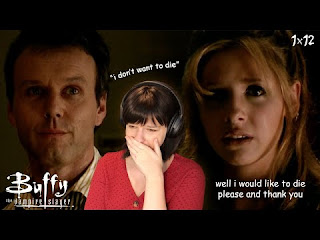
Buffy faces not only emotional and psychological problems after she returns to life, problems related to that eternal existentialist question of why am I here. She also faces economic problems given that her mother’s long illness and death has left her in financial straights (a shoutout to the broken US health care system that often leaves many in debt and with debt even if they have medical insurance). She needs to get a loan to pay her many piled up bills and get a job in order to make ends meet and to fix the broken water pipes in her basement (metaphors and allegories become more tangible and obvious in season six of the BtVS bildungsroman, in the Buffy growing up tale of season six, for obvious reasons).

Getting either a bank loan or a job proves difficult for Buffy in season six. Buffy has no collateral and her home, which she inherited from her mother Joyce, and which she tries to use as collateral to get a loan from the bank, has  already, as the bank loan officer she goes to for a loan tells her, been fully leveraged and has been losing equity for years (a shout out to the fact that Joyce’s and Buffy's home has been trashed on many occasions given that Buffy already has a job, slaying). So she can’t, like many poorer Americans, get a loan. As for getting a job, Buffy never graduated from college dropping out from UC-Sunndyale in season five in order to move home to help take care of her sister Dawn and eventually her sick mother as well so her job options are, as little sister Dawn notes in season six, pretty much limited to poor paying retail and service industry work that literally in the Buffyverse, turns many fast food workers into retail automatons. Moreover, Buffy, who is called to be a slayer—it is her vocation not her job—can’t charge those she aids for killing the monsters, demons, and vampires of Sunnydale that are out to kill them.

Fortunately, for Buffy and those, like Willow and Tara who live with her in her home and who don’t have jobs or much income either, Giles, Buffy's mentor, is there to help. He gives Buffy monies to fix the broken water pipes in her house and to take care of her other financial issues. Instead of trying to find a job immediately, however, Buffy, admittedly somewhat depressed thanks to her resurrection to the hell of ordinary life, rushes off to meet her former boyfriend Angel somewhere between Sunnydale (a low rent Santa Barbara) and Los Angeles, where Angel now resides, shirking, as Giles sees it, her more mundane financial and familial duties foisting the disciplining of her sister off on Giles in the process.

Giles, Buffy’s watcher and mentor, is concerned with Buffy’s shirking of her adult responsibilities and this concern along with his feelings that he is “standing in the way” of her growing up comes to a head, 
in “Once More With Feeling. Buffy is not the only Scooby in season six shirking her adult responsibilities. Willow is using magic to make things easier for her including making things easier for her in her relationship with her girlfriend Tara, who, after an argument, she casts a forgetting spell on. Xander and Anya are having second thoughts about their forthcoming marriage. Sister Dawn is stealing in order to get attention. All these oh grow up story and character arcs come to a head in the episode “Once More With Feeling”.

In “Once More With Feeling", a musical episode, our characters sing out, thanks to a spell cast, their deepest feelings and, in the process, they learn about some of each others deepest secrets. It the episode it is revealed that Buffy was not in hell as her friends thought but in heaven, that Willow has been manipulating Tara’s mind, that Xander and Anya have things that bug them about each other, that Giles is sensing that he is standing in the way of Buffy becoming a responsible adult, and that Dawn is feeling alone and unwanted.

What is happening in season six up to and after “Once More With Feeling” is part and parcel with what Buffy creator, show runner, writer, and director said was the broad theme of season six of the show, the need to grow up and take responsibility for your actions. All the Scoobies, save for Giles, are stuck in pre-adult overdrive, including what seem like the villains or big bad of season six at first (they actually aren’t, the inability of our Scoobies to grow up is), the trio of Jonathan, Warren, and Andrew who, after graduating from high school, decide to become supervillains just like those they emulate in the science fiction and action adventure media they devour like fanboy kids. 

It is this, this exegetical fact, the fact that Buffy season six is about growing up and taking responsibility, that many YouTube reactors including our own trio of domi e, TheLexieCrow, and Sofie Reacts, miss because they have not (and perhaps will not) engage in empirical analysis and explore what those who made Buffy say about their intentions for season six. They prefer to “approach” Buffy tabula rasa (which is, of course, impossible given the reality of socialisation), paradoxically "Tabula Rasa” is the title of the episode of Buffy that was broadcast right after “Once More With Feeling”.

All three reactors are, as their reactions to “Once More With Feeling” reveal, particularly angry with Giles who sings to a Buffy who is not paying attention and who is lost in her own little hermetic world that he feels he is standing in the way of Buffy’s life course development and needs to leave, which he does in the next episode, so she can become a responsible adult. They want him instead to continue to play the father to Buffy,  not the father who realises that some tough love is sometimes necessary to aid someone to grow up but a father who solves all problems with the wave of the money want.

It is not surprising that many “reactors” read Buffy in this way and take Buffy’s side against Giles in this episode. Buffy, after all, is the main character of the show and though many reactors identity with Giles and other of the Scoobies, many, including our trio of “reactors" also strongly identify with Buffy and take her side in crises like the ones Buffy faces in season six. One might also argue that it is not surprising that reactors take Buffy's over that of Giles because they too in a world where good and good paying jobs are fewer and fewer, where the service sector with its poor paying and poor benefit jobs is dominant, where sons and daughters sometimes have to live with their parents to make ends meet, where marriage is being delayed, and where pregnancy is delayed, where delaying growing up is kind of a functional strategy for life in the real world. 

One thus has to wonder whether many of our “reactors" are, like their fictional counterparts in Buffy the Vampire Slayer, stuck in life course neutral and consequently take the side of someone who is delaying growing up just like they are (though I suppose one can argue that engaging in the mundane and banal not so fine art of YouTube reaction video capitalism is not unlike working in the fast growing fast food industry). One has to contemplate, in other words, whether YouTube Buffy “reactors" are creating a reality in Buffy that mirrors their own in reality, something made possible if not probable by their studied ignorance of the Buffy text the creators of the show actually made and the meanings they, and particularly Joss Whedon, put into the show, along with an ignorance of the broader economic, political, cultural, demographic, and geographic aspects of the show into which the television show fits. Needless to say this studied ignorance is something very much akin to the situation that the Trio find themselves in in Buffy season six, a situation where the Trio of stuck in neutral males who are still living in the basements of their parents' homes, who don’t have jobs, who are still playing with their beloved Star Wars toys (the detritus of a mediocre adolescent franchise), discoursing on who was the best James Bond, and who seemingly can’t or don’t want to grow up.  Oh the humaninanity...


Saturday, 7 December 2024

A Critical Ethnography of Social Media: Hannah Stoddard and Latter Day Mormon Apologetics and Polemics


YouTube is a wonderful mirror into the mentalities of modern and postmodern humans. It tells us, for example, something about the ways people read television shows. It tell us something about the ways people read classic rock and roll songs. It tells us something about how contemporary Mormon apologists and polemicists interpret the history of Mormonism, the history of the United States, and the history of the world.

Recently, I have been exploring the videos Mormon “traditionalist" Hanna Stoddard and her Jospeh Smith Foundation have produced and posted on YouTube and the YouTube videos in which Stoddard appears as a guest star. These videos, to pick a few examples, condemn the works of “progressive" Mormon historians like Leonard Arrington and Richard Bushman, condemn Charles Darwin and his theory of evolution, celebrate those Mormon celebrities like Joseph Fielding Smith, Bruch McConkie, Boyd Packer, and Ezra Taft Benson who Stoddard and her fellow travellers regard as saints, and condemn modernity with its materialistic approach to history and its contextualism (history as the longue dureee product of economic, political, cultural, biological-demographic, and geographic factors).

Stoddard’s discourse has all the hallmarks of Mormon polemics and apologetics of the past, to Protestant Fundamentalist apologetics and polemics of the past, and to right wing Christian nationalist apologetics and polemics of the present. Like all apologetics since the beginning of apologetics time Stoddard’s apologetics are grounded in the assumption that “we", “us", however we and us are defined, and it is defined selectively by Stoddard, have the fullest essence of the truth. Stoddard assumes that Mormonism, her particular Mormonism, is true (she does admit that echoes of the truth can be found in other religious cultures). She believes that god exists, that the devil exists, that some people are inhabited by devils, and that there are evil witches out there in human land. She believes that the Mormon prophets are prophets of god. She believes the Mormon doctrine that America is a promised land and hence exceptional. She believes that the LDS Church is in danger of apostasy thanks to indoctrination by conspiratorial Mormon “progressives” (who are, in her mind, little better than devils and witches, Marxists and liberals) like Leonard Arrington and Richard Bushman (her apparent bete noirs along, echoing Benson, with Karl Marx, who, in an uncredited answer to what the teaching of class in the BYU Sociology Department on the Stoddards' Latter-day Answers (aka LDS Answers), refers approvingly to a book that accuses Marx of being a satanist, Charles Darwin, Sigmund Freud, John Dewey, John Maynard Keynes (all amongst Benson’s “antichrists” in “A Plea to Strengthen Our Families”, a document often cited by right wing Mormons but not apparently emphasised by the contemporary Church) and the “Darwinists" and “socialists” at contemporary BYU, the, in common LDS parlance, “Lord’s University").

Not surprisingly, these assumptions, assumptions that are grounded in Stoddard’s religious “testimony” (a Mormon term for spiritual guidance) provide the bedrock and foundation for Stoddard’s polemics. She claims that only true believers or the faithful can write quality history (faith history) not only of Mormonism but of America, Europe, the ancient Near East, and the world. Joseph Smith, Stoddard clams, could not have been a treasure hunter, someone who engaged in the occult, because the Mormon prophets said he wasn’t and those who say he was are secularists like the new Mormon historians or anti-Mormons, who the new Mormon historians draw on extensively claims Stoddard, and who can’t, as a consequence of the fact that they are anti-Mormons, be trusted. She claims the earth has only been around for around 6000 years and that Noah’s flood actually occurred globally because the Bible tells me so and god’s prophets, god’s real prophets, tell me so.

Like all apologists and polemicists Stoddard is selective. She condemns new Mormon history materialist contextualism but she is a contextualist too. She assumes, for example, that the context of the Book of Mormon is ancient Near Eastern history and ancient American prehistory and history. She is selective in that she applies the canons of critical history to what she regards as the mythhistory of the new Mormon historians but she doesn’t apply them to her faith history, an actual mythhistory since it is grounded in ideological assumptions rather than empirical evidence, something that makes her kin to Sandra Tanner, someone who also doesn’t apply the analytical strategies she applies to Mormonism to her Christian faith. She sometimes seems to conflate the critical new Mormon history with anti-Mormonism. She is selective in the evidence she uses. She, for example, far too often bases her dismissal of evidence that does not line up with her ideological assumptions because of the supposed character defects of the person from whom the evidence originates (the ad hominem strategy). She, for example, dismisses evidence about Smith on the basis that the person making the claim is someone left the Church while, at the same time, claiming that any analysis of evidence must be grounded analysis rather than assumed "analysis". She selectively dismisses evidence on the basis of it being taken down after the fact except when that evidence comes from those she regards as prophets and true religious authorities. She downplays differences among the Twelve. She ignores the fact that the LDS Church and its revelations have changed over the years. See plural marriage or polygamy and Blacks and the priesthood.  She uses inductive analysis for deductive purposes. All one has to do, Stoddard’s logic demands, is simply “verify” what god and his prophets say and bingo, you’ve got it. All of this makes Stoddard an apologist and a polemicist and only kind of an historian, one that plays in the clays of mythhistory more than real history. And this is why Stoddard is a kind of intellectual demagogue, a kind of anti-academic intellectual, and a kind of anti-intellectual intellectual since, for her, once god speaks all the thinking that needs to be done is done. That is dogma and dogmatics not history or social science.

Friday, 22 November 2024

A Critical Ethnography of Social Media: Prophets and Profits in the Mormon Social Media Universe


Social media sites like YouTube are, in a way, microcosmic examples of what theoretical quantum physics in general tells us what the universe we all live in is like. To wit, there are a host of parallel universes on YouTube and within these parallel universes one can find a number of parallel worlds.

One of the most interesting, at least to me, of these parallel universes or cultures with parallel worlds or countercultures and subcultures within them on YouTube is that related to the Church of Jesus Christ of Latter-day Saints, Mormonism. But then I have been studying Mormonism for some thirty years now.

There are a number of parallel worlds within the parallel universe that is Mormonism on YouTube. There is the parallel world of Mormon news. There is the official LDS content world which includes an ask a missionary page and the Meet the Mormons film. There is the what Mormon polygamy was and is like world, a world that ranges from the polemical, the apologetic, and the academic. There is the why I am a Mormon world. There is the why I am no longer a Mormon world. There are insider explorations of Mormon doctrine. There are critical exposes of Mormon finances and the Church’s use of their monies. There is the what are Mormon temple rituals like world. And there is the intellectual polemical and apologetic worlds related to Mormonism in general, both of which have long histories in the history of religion, particularly monotheistic our way or the highway religions, and a long pedigree in the history of Christianity. 

The Mormon polemical and apologetic world is one of the largest LDS worlds on YouTube. One can, for instance, find worlds on YouTube where some categorise Mormonism as a “fake" religion and a “fake" brand of Christianity. The bases for such a claim is grounded in the poster's perception that Mormonism is different than the religion of the poster, which these posters regard, of course, as the one true religion (ethnocentric apologetics) despite the fact that all monotheistic religions are grounded in belief and not empirical fact. See, for instance, the self proclaimed I am not a “progressive" Bible Thinker Mike Winger who, following in a long tradition in Christian polemics, condemns not only Mormonism as a “fake” variety of Christianity but also condemns Roman Catholicism as “fake” brand of Christianity, a theme that has a long history in Protestant and particularly evangelical polemics. See Capturing Christianity’s Cameron Bertuzzi, a photographer and self proclaimed Christian apologist, who, following again in a long line of Christian insider or emic polemics, condemns Mormonism and Islam as “false” religions created by “false” prophets.

Another of the parallel worlds within discussions of Mormonism on YouTube is the world populated by ex-Mormons who have converted to another sect or brand of Christianity. See, for example, the posts of Sandra Tanner, who converted to “true” Christianity thanks to her husband Jerald, the barber James Wardle, and Pauline Hancock, the founder of the more “orthodox” or mainline Mormon sect the Church of Christ (Hancock). In the wake of her de-conversion and conversion experience Sandra, along with her now deceased husband, has been arguing against (polemics) Mormonism, if in a somewhat academic way since 1964 through their Utah Lighthouse Ministry and its bookstore. See the ex-Mormon convert Ed Decker who converted to “true” Christianity—Decker was an early member of Saints Alive in Jesus, a group of ex-Mormon converts to “orthodox” Christianity—who, unlike the Tanner’s, often engages in defamations against Mormonism. See Heidi Luv, a self proclaimed “born again” Christian, demonologist, and “conspiracy theorist" who hosts the Unfiltered Rise Podcast and who has appeared as guest star on several YouTube “programmes”. Luv says that she broke away from the “Mormon cult”(a loaded ethnocentric term that in less ethnocentric scientific parlance refers to a new religious movement or a sect in tense relationships with its broader religious geography)  because of its “occult" origins. For Tanner, Decker, and Luv problems related to aspects of Mormon history eventually foregrounded for them the falsity of Mormonism. One of the curious aspects of these now “true” believing “orthodox” Christians—well not, I suppose curious from an emic point of view—is that they never apply the same empirical and historical standards to their own faiths that they do to Mormonism, their other, a religion which they remain obsessed with even after departing from it.

There are other once Mormons who remain as obsessed with their now Mormon other as they were with their Mormon us (a trait one also finds in former I believe us's who become evangelical anti-them’s or “anti-cult” crusaders) . Karl Lyman and Clarity of the Clarity Podcast, for instance, left Mormonism for other cultural, ideological, and religious reasons than did the Tanner’s Decker, and Luv. In their discussion on the Clarity Podcast Karli and Clarity note that they left the LDS because the leaders of the Church gave into governmental “tyranny" during the covid pandemic—something they compare to another federal governmental “tyranny”, prohibition—when they counselled members of the Church to get the covid vaccine shot, to wear masks, and when they shut down wards (Mormon congregations) meetings during the pandemic. Interestingly Kari and Clarity do not discuss the giving in of Mormon authorities to another possible federal government “tyranny”, the feds forcing of the Mormon elite to end polygamy. Karli and Clarity maintain that when the Mormon bureaucratic elite urged members to use masks and get the vaccine poke during the recent pandemic they capitulated to a governmental conspiracy to limit human freedom and liberty. In response, they say, they left the Church. Problematically, they miss certain historical facts. They fail to grasp that prohibition and temperance were mass movements that effectively lobbied local, state, and federal governments to end alcohol sales in the United States—prohibition, in other words, was a mass movement of citizens—and they fail to grasp that, like the birth control pill, masks, particularly the N95 mask, are, 95% effective in blocking airborne particles when worn correctly and that the covid vaccines, in all their iterations have proved to be quite effective in at least softening the effects of covid should one get it.

And then there are the ex-Mormons like John Dehlin, the excommunicated Mormon psychologist who runs the Mormon Stories podcast where a variety of historical and cultural issues related to the LDS are discussed by Mormon and cultural Mormon intellectuals, the ex-Mormon HailHeidi, many of whose posts explore the standup comedy of George Carlin and the criticism of religion of atheists Christopher Hitchens and Stephen Fry, and the ex-MormonAlyssa Grenfell. The prolific Grenfell, like HailHeidi, seems to have jettisoned her Mormon beliefs largely because of historical problems related to Mormonism (a common theme in ex-Mormon posts), and exchanged it for another meaning system or cultural system, atheism. Grenfell ranges broadly over a variety of Mormon historical, cultural, and ideological topics from dancing in Mormonism, to Mormon garments, to what is was like to go to BYU, to what it was like to go on a mission, to Mormon purity ideologies, to Mormon polygamy, and to why I left the Church. Her posts, which condemn a prophetic religion and its prophets for empirical reasons, have garnered thousands, hundreds of thousands, and even a million views on some occasion, something that, no doubt, has brought Grenfell profits.

Grenfell is one of those rare birds on YouTube. She actually does empirical historical research for her sometimes over an hour posts, good solid empirical research. Her research, however, has its limits. For example, in her discussion of Mormon purity culture she doesn’t dig deep enough and discuss how the cult of domesticity, which is not a monopoly of Mormonism (see patriarchal macho White evangelicalism, for example), has Victorian and perhaps even further back historical and prehistorical roots. In her discussion of Mormon ballroom dance culture and the prevalence of Mormon dancers on ABC’s Dancing With the Stars she fails to explore the important role dancing has played in broader aristocratic culture and in cultures in general before the advent of radio and television.

Beyond the critics of Mormonism (polemicists) there are, of course, a number of defenders of the one “true" faith of Mormonism (apologists) on YouTube. Answering LDS Critics tries to do just that. CES Letters is, like FARMS of old, an intellectual apologetics and polemical site. Thoughtful Faith discusses, sometimes with others, the Mormon Faith and often turns anyone who is critical of Mormonism for valid empirical reasons into an anti-Mormon enemy of the one true faith. The youthful and MTVish and TV commercial hip Saints Unscripted, for example, is on a mission to "present information about the gospel of Jesus Christ in genuine, compelling, and loving ways". The various hosts of Saints Unscripted do not duck and cover when it comes to addressing criticism of Mormonism. FAIR, one of today’s leading Mormon apologetic and polemical organisations, particularly after the demise of FARMS, provides self proclaimed faithful answers and informed responses, FAIR, to issues associated with Mormonism. Like Saints Unscripted FAIR does not sweep critical takes on Mormonism under the rug though they often, like Thoughtful Faith, confuse and conflate empirical criticism of the LDS with polemical criticism, a common phenomenon that one can also see in those groups and individuals who wrongly and sometimes cynically and manipulatively conflate academic analysis of Zionism and Israel with anti-Semitism and academic analysis of America with anti-Americanism. There are professional historians like Ben Spackman, who has appeared on several faithful Mormon programmes like Saints Unscripted, Keystone, and The Interpreter Foundation, who argues that Mormonism is not a form of Protestantism (which I think is accurate) and that it is more like Judaism rather than Protestant fundamentalism and evangelicalism and thus is not a sola scriptura, Bible as sole authority, brand of Christianity (which I think is accurate and which also makes it more like the liturgical brands of Christianity). Like many Christians, including evangelical Christians, before him Sparkman, in hermeneutic and homiletic mode, argues that the creation/evolution binary does not have to be an either or binary (which is accurate if not my cuppa tea in terms of intellectual engagement). One can argue, for example, for god directed evolution. Spackman also (rightly in my opinion) argues that in the 1950s, for a variety of social and cultural reasons, Mormonism was fundamentalised.

One of the major problems associated with those who interpret Mormonism, whether they are insider faith apologists and polemicists, insider critical apologists and polemicists (semi-historians and social scientists), or outsider anti-Mormon apologists and polemicists is that they all accept the false notion that Mormonism is exceptional in some way, shape, or form. The insider faith apologists and polemicists believe that the Church of Jesus Christ of Latter-day Saints is exceptionally true, the, in fact, only true Christian Church on the face of the globe. The insider critical apologists and polemicists seem to, though this may be a reflection of their fixation, in the case of ex-Mormons, on Mormonism, that Mormonism is exceptionally ridden with falsehoods. The outsider anti-Mormon polemicists and apologists believe that Mormonism, like others of its cult ilk, is exceptionally demonic. You can find all of these exceptionalists, exceptionalists that have actually been around almost since the advent of Mormonism itself on YouTube. Once again the more things change...


Thursday, 14 November 2024

A Critical Ethnography of Social Media: The Index of Banned Facebook Art


We live in an age of utter stupidity, utter idiocy, and utter moronicity. How else do you explain the election of a fascist with self-esteem issues, many related to the size of his dick, but who does not even have the mental reflexivity or capabilities to realise that he has self-esteem issues, as president of the United States? 

I was reminded of this fact once again recently when I received this rather banal message in bureaucratic American English from Facebook, another organisation headed by yet another fascist der Führer with possible self esteem and probable narcissist issues:
"It looks like you shared or sent something that shows nudity or sexual activity.
Ronald Helfrich
14 Nov 2024
https://www.prestomusic.com/.../8033275--gesualdo-the…
You shared this on your profile. This goes against our Community Standards on nudity or sexual activity”. 
What I shared or sent was a link to the Naxos Classics Gesualdo Madrigals box pictured above which I am presently listening to.

Now I realise that the age we live in is no more stupid, idiotic, or moronic than ages past. Humans have long lived in kingdoms of stupidity, idiocy, and moronicity. What is different, however, is that like term limits for politicians, limits that would simply spread the shit that is American politics around as George Carlin notes, social media sites like YouTube and Facebook spread the stupid, idiotic, and moronic shite around to a greater number of people. How else can you explain the confusion of a work of art on the Naxos Gesualdo box with pornography—painted breasts and painted arses—the morons at Facebook don’t even know because in all their wisdom they leave judgements about what is pornographic and what constitutes the violation of “community standards" to bots that are as stupid, idiotic, and moronic as they are? Nor should we forget that the scribes, Pharisees, parasites, and hypocrites at Facebook allow photographs of scantily clad women, and sometimes partially naked women, to appear hourly on their Reels feed, a feed aimed, no doubt, at the leering male “adolescent” demographic numbering in the thousands upon thousands on Facebook. But then, of course, one suspects that the high priests of Facebook adore such beefcake photos because they make monies by peddling such page three like photos on its site. And in Mammon Land money trumps everything including so-called community standards.

Like Dick van Dyke I am glad that I won’t be around to see much more of this stupid and moronic idiocy that Facebook encapsulates in its very digital bones. I may have long loved the fact that human life in absurd but even I recognise that absurdity has its limits. And Facebook's censorship of a work of art and its confusion and conflation of it as pornography is something that reaches those limits for me.

Saturday, 5 October 2024

A Critical Ethnography of Social Media: Rubbish In, Rubbish Out


You always know what you are going to find on social media. You know that you are going to find a lot of lowest common denominator nonsense about the usual suspects, for example, films, television, women (some scantily clad for the “adolescent” male gaze), politics, sports (including fabrications related to Caitlin Clark), banal and mundane sensationalist and melodramatic clickbait for fun and profit, and music. You never know, however, how low the rubbish you find on social media will go. I was reminded of this fact yet again while I was looking at books by Warren I. Cohen on Amazon, one of the lowest of lowest common denominator social media sites on the world wide web given its poor search engine, its limited and I suspect mostly bot curation of its comments page, a curation that looks for certain hot button words and phrases, and the limitations it places on actual scholarly reviews. Amazon seems to prefer “reactions” that are reflective of the widespread reality of attention deficit disorder in postmodern America and large parts of the core nation world.

I am familiar with Cohen, a specialist on American foreign policy retired from the University of Maryland Baltimore County  and author of introductory books on American foreign policy, including his excellent and aptly titled A Nation Like All Others: A Brief History of American Foreign Relations published by Columbia, his introductory work on US and USSR relations published by Cambridge University Press in its four volume history of American foreign relations series, America in the Age of Soviet Power, 1945-1991, and studies of Asian-American foreign relations, which is why I went to Amazon to see what other books he had written.

What I also found and found as interesting as the other books Cohen had written, were the comments on his book America in the Age of Soviet Power, 1945-1991. Two of the four comments—the fact that there were only four tells you a lot about the contemporary core nation world—on the book were favourable. The other two comments, however, were negative.  Of course, you are going to invariably find negative comments on almost any critical history and analysis of American foreign policy because you are inevitably going to step on the toes and draw the ire of the many faithful churchgoers of the Church of America who believe in the dogma of American exceptionalism.

One of these negative comments, that by Josh, was more “substantive” than the other, that by Sol D. Josh’s “reaction" to the book—I hesitate to call it a review since it really isn’t a review as is the case with most posts on scholarly books on Amazon—whinged about what he believed was Cohen’s New Dealism and his supposed belief that the New Deal was the best of all possible American worlds. He complains that Cohen interprets American post-WWII militarisation and the rise of its national security state as something other than a response to Soviet imperialism. He whines about Cohen's book being too much of an introductory text, something the book, in fact, is.

Sol D’s “substance” is also a statement of faith. Sol D’s faith is more clearly than that of Josh that hybrid mix of Christianity and America that has long been prominent in American culture and American life. He spends his reaction whining about Cambridge histories being the product of apologists and polemicists for “butt kissing atheist-Marxist tyrannical dictatorship”, a dictatorship, he claims, killed 200 million of its own citizens (today, of course, any self respecting empiricist would have to number many of the corporate and entrepreneurial elite, particularly in places like the Silicon Valley and Austin, amongst the tyrannical dictatorship of the mediocretariat). He ends his diatribe by stressing his devotion to his lord and saviour Jesus Christ.

Both of these comments reveal, as I noted, a faith in America, a faith some theologians would argue is a form of heresy and blasphemy. The faith of both is ultimately grounded in metaphysical and metaphysical manichean presuppositions that some humans are good guys, generally the group, clique, community, state, or nation, in this case the United States of America, that one belongs to, and that other humans are bad guys, that other whoever the goods mark themselves off against, the USSR in most of the mid-to late twentieth century, and, after the fall of the USSR, those liberals and “New Dealers” who are seen as “commies” and, paradoxically, fascists, by many and are categorised as “commies” and fascists by demagogues looking for leverage to gain political, economic, and cultural power. They are grounded, in other words, in the notion that some humans are good and some humans, them, are evil. They are grounded in the dehuhamisation of these others.

And this last—dehumanising the other—is one of the fundamental problems with these manichean politically and ideologically correct ways of seeing. Contrary to such manichean faiths humans, to varying degrees, are characterised by their better angels and their less better angels Humans, real humans, be they Hitler, Stalin, those who ordered bombs dropped on civilian targets in the name of victory, or true believers in monotheistic religious inquisitions, are, as history shows, complex and contradictory. They are neither inhuman incarnations of pure evil or cliched and stereotyped incarnations of pure goodness. Those who see the world in such manichean hues, of course, can’t admit the fact that humans, particularly those humans in positions of power (the power corrupts prover ), are the same every where and at every time for if they did they would have to admit that Cohen and other empirically grounded analysts like him are right and that both American and Soviet powers that be are neither evil incarnate of good incarnate and that humans can and do make mistakes and, of course, they can be socialised for moronic ethnocentric conformity. Cognitive dissonance, as it often does, however, in these cases, often ends up making the faith of true believers  even stronger than it was despite empirical facts to the contrary because in so many cases fiction, created reality, trumps, as it does with Trump and his ilk, real reality.

Tuesday, 10 September 2024

Musings on Writing a Book and Publishing a Book

As I have grown older—I am now retired, am sixty-nine, and will be seventy in November—one thing that has become quite clear to me is the fact that life, or more specifically a significant part of life—involves managing a never ending series of life crisis. Looking back I can see that a lot of my after I became a teenager was about managing crises: relationship crises, financial crises, and intellectual crises. All of these crises were made even more daunting by the fact that I have long been humanophobic, I have long had health problems, by the fact I lived and live in a core nation that transitioned from a modern industrial capitalist economy to a postmodern capitalist with all that entailed including deindustrialisation, globalisation, bureaucratic downsizing, and by an increase in poor paying and short lasting jobs. My England, Australia, Canada, and America was not my Dad’s England, Australia, Canada, and America

One of the many crises in my life, one that ebbed and flowed between the early 1990s and the early 2020s, involved a book I began writing on Mormon Studies in 1991 or 1992. It ebbed and flowed for a number of economic and cultural reasons including the fact that it is a book as much if not more about social  and cultural theory than it is about Mormonism, something that made my book project an even more daunting and difficult project particularly after I switched from graduate work in Anthropology and Sociology, social science disciplines with a strong emphasis on theory, to a discipline that is a social science to a few and a human science to the many and which has little interest in theory, History.

Another reason the project ebbed and flowed was technological. When I began work on my book the computer and its word processing programmes was in its infancy and had only recently replaced the typewriter, typewriter paper, and liquid paper for typewriter paper. Can you feel my pain? I initially learned computer on a Mac in the 1980s. Because I was a graduate assistant on a newsletter in Latin American Studies which was done on a PC, however, I had to learn PC and its Microsoft programmes. I would later learn the PC version of WordPerfect. I remained wedded to the PC until the early 2000s when, after a number of crises associated with PCs and particularly a Dell PC—I got an error message when I turned it on for the first time—I went back to Macs, a decision I have never regretted though it easier to do these days—now you can get Word for Macs, for instance—than it was in the early primitive days of computers. 

Doing my book at first on a PC led to a number of crises. Initially my book was typed in Microsoft Works. When Microsoft Word replaced Microsoft Works I transferred my book into Word. In the process, however, I lost every other of several hundred footnotes and parts of the text itself were sometimes made into an ugly mess. Don’t you just love it when one product of a corporation isn’t fully compatible with another product of the same corporation? To fix this problem, of course, required, the expenditure of a good deal of time, time limited by the fact that I was a graduate student and worked part-time because I needed the money. Despite the limitation of time and despite the fact that I had to use computers in a computer lab on campus since I did not own a computer, I did begin to try to reconstruct the missing footnotes.

Another crises related to the book was associated with the fact that I have never really been all that enamoured of graduate school education. I knew given my age—I started college late in life, something I am glad I did since I really wanted to go to college when I went and was serious about it—and left college because of relationship, financial, and intellectual crises related to that bureaucracy on several occasions. My ambiguous feelings about academic bureaucracies was the product of several things including the too often soap opera, Machiavellian, and limits on valid critical discourse atmosphere of post-graduate education, by my alienation from a bureaucracy where what one did was regarded as more of a job than a calling, by my alienation from the higher education stratification system, by a dramatic decline in my romanticism about academia, by the fact that I knew my chances of getting an academic job given my cultural capital was about nill given my post graduate educational background—I really didn’t want a full-time job in the academic beast anyway—and by the fact that I got a job as an acquisitions editor at a university press in 2000. All of these contributed, along with the technology issue, to me putting my book on hold in the late 1990s and the early 2000s.

After getting a job in academic publishing my intention was to make a career of publishing. However, as I have written about elsewhere, my life in publishing was cut short thanks to the economic downturn after 9/11, and thanks, I suspect, to my ideological iconoclasm, an iconoclasm that didn’t play well in the publishing corporation in which I worked any better than it did in academia, As one of the last hired I was one of the first to be let go by the press. 

Though I tried to get another job in academic publishing and had two interviews with publishers my lack of success in getting another job in publishing led me to give up the search for another publishing position. As a consequence I decided to return to teaching as an adjunct and eventually I decided to finish my doctoral degree. By 2011 I had earned my doctorate and had a published a papers on the culture war surrounding the 1969 Woodstock Festival and on the theoretical problems associated with Buffy Studies, both of which required extensive effort and both of which I remain very proud of today. Another paper I wrote on Downton Abbey was slated for publication but I pulled it out of consideration for the anthology when the editor of the collection drained, from my perspective, all the life and soul out of my prose in his edits.

During my adjuncting years I started work again on the book, mostly because the manuscript was there, when breaks from work and energy permitted. It was work I did without support from foundations, the US government, or the administrative staff at the college at which I taught, perquisites that full time faculty sometimes get. The pandemic in the early 2020s helped me get the manuscript into shape. Footnotes were reconstructed and rechecked. Text was checked and rechecked, written and rewritten, and moved from one place to another. I then started to send the manuscript around to publishers. 

Several publishers were interested in it. Mormon Studies, after all, is a money maker for academic presses particularly for those that also target faithful demographics with what amounts to polemical and apologetic work. A few sent it out for review. As peer reviews sometimes are, one was one of the oddest I ever read but then so much criticism is not about the book someone else wrote but about the book the reviewer would have written.

Finally a publisher accepted the book for publication. There were some problems, however. My health has never been good. I have had serious asthma that hospitalised me regularly before the advent of Advair and Singulair, which have allowed my asthma to be finally controlled and allowed me to lead somewhat of a “normal” life. Additionally, once I hit my fifties and sixties I have been beset by muscular-skeletal arthritis, acid reflux, increasing difficulty breathing deeply because of chest and abdomen tightness, increasing vision problems, and bowel problems, all of which complicated working on the manuscript in a number of ways. Isn’t old age wonderful?

With the manuscript approved for publication I sent it in. The publisher wanted me to change the manuscript's English into American. I did it though I found this a ridiculous demand since academics are used to reading English English as well as American English given the global nature of the academy and intellectual life. This along with the occasional idiocy that is spell check, my haste due, in part, to the college I worked at eliminating my access to Word after I retired (my reward, along with the meagre remuneration I received for twelve years of teaching 100 and 200 level classes), and my problematic eyesight—I should have increased page size—made fixing the errors in the manuscript difficult if not impossible even though I did have someone else read the manuscript as well. It is always difficult, particularly with computer manuscripts, to see the errors of one’s manuscript ways. 

My haste to finish the manuscript also meant that I did not add material on anthropological studies of Mormonism that I wanted to particularly once I gave up hope, given how physically and intellectually exhausting doing this book was, that I would or could write a follow up book on Anthropology and Mormonism. There were also other things I wish I had added to the manuscript. Speaking of manuscripts, one can acess a more cleaned up and expanded version of the book in English English in the BYU Special Collections at the BYU Library. I am quite proud of this manuscript and regard it as the authoritative version of the book.

The book has now been out for almost four years. It has not gotten much critical attention though I have gotten three royalty cheques so presumably someone or some institution is buying it which is not a bad thing I suppose though it does make for more work at tax time. This state of affairs has not been unexpected. I am not an insider-insider, an insider-outsider, or an outsider-insider in Mormon Studies. I am not a member of the Mormon History Association or any other “professional” organisation and I am retired. I really don't want to be identified as a Mormon Studies scholar anymore than I want to be identified as an academic. I am, as I was in academia, an iconoclastic outsider-outsider and I like it that way.
 

Sunday, 25 August 2024

A Critical Ethnography of Social Media: Google, the Skanky Cookie Monster

When I decided to start blogging, writing essays on various subjects in various shapes and sizes on the World Wide Web in 2011, I chose to go with Blogger instead of WordPress. Blogger, which went online in 1999 and was purchased by Google in 2003, and WordPress, which was founded in 2003, were the only two blog sites I was familiar with at the time and sad to say I chose Blogger not for political or economic reasons but for cultural reasons. I preferred its look to that of WordPress. Yes, like all humans I too can sometimes be shallow.

I still don’t know much about WordPress and how it works since I don’t use it. But I do know something about Blogger and knowledge as it sometimes does, has tarnished the aesthetic sheen and the reputation of this blog site for me.

 In the last couple of months the sheen has really began to wear off gilded Blogger for me. Google now requires, when I upload an image from my computer on to Blogger, that I allow them to use cookies, tracking cookies, in order to access and utilise information about me that they can presumably pass on (Google as Big Big Big Big Brother) and sell (Google as Big Big Big Big Corporation) to interested others. That is, after all, one of the ways that Google makes money and like many global postmodern megacorporations these days they will use every means, regardless of how small and seemingly petty, to make monies. 

And this is just one of the reasons why Google is one of the several skamky cookie monsters we sadly have to live with today. Beware of the skanky cookie monster whose ABC’s are actually dollar signs, pound signs, and Euro signs. The World According to Mammon.
 

Sunday, 18 August 2024

A Critical Ethnography of Social Media: Hochschild, Goffman, Sly and the Family Stone, and YouTube


One of the fascinating things about social media is that it verifies a lot of what social anthropologists, cultural anthropologists, sociologists, and social psychologists interested in the micro meets macro and macro meets micro of everyday life have been saying for years. Social media sites like YouTube speak volumes about the commercialisation of everyday life, about front stage and back stage, about surface acting and deep acting,  and, if in a variation of this theme, about everybody wanting to be a star.

No one has explored the commercialisation of everyday life more broadly and more intensively than Berkeley sociologist Arlie Hochschild in books like The Managed Heart and in the papers collected in her book The Commercialization of Intimate Life. In The Managed Heart Hochschild found that those working in retail in capitalist societies developed emotional strategies to successfully traverse the mine field that is the service or retail sector of the economy, the dominant sector of the capitalist economy in postmodernist core nations. Hochschild’s emotional labourers, such as the airline attendants and bill collectors she studied, match, she argues, their emotions to their job. Airline attendants develop cool and calm emotions and demeanours to assure passengers, many of whom have qualms about flying, that everything is safe and thereby assure them that everything is going to be alright and  that they will enjoy their flight experiences. Bill collectors, on the other hand, develop emotions to deflate those they are trying to get monies from in order to guilt trip them, trick them, and threaten them to pay the bills they owe. 

On YouTube, a media form that seems to have been made of the postmodernist service sector age—it is, of course—most “reactors” engage extensively in a form of emotional labour. Most “reactors", develop emotions to assure viewers that they care about what they are reacting to and plead with them or guilt trip them into liking their “reactions", subscribing to their “reactions", or going to Patreon—where many of the reaction videos to films and TV shows start life—to support their “reactions”. They engage in this emotional labour in order to get their viewers to financially support them and their “reactions” in order that they can make more “reaction" videos and thereby earn more monies, perhaps even enough money on which to make a decent living or to supplement monies they earn from other sources.

I don’t mean to imply here that some “reactors” don’t do “reactions" for something other than financial support and financial gain. Some do. Intellectual labourers like Fil from Wings of Pegasus, for instance, engages in public service digital broadcasting when he explores the role tune correction software and not live “live" performances are playing in the popular music industry and “live “ on stage these, something that says something about the cyborging of human life. Ellie Anderson, professor at Pomona College, part of the Claremont Colleges, is performing a public service by educating potential watchers of her videos about the history of philosophy and its various schools of thought. But they, those in the knowledge sector of the postmodernist economy, are, in my experience, the few, the proud, the empirical “marines” of social media just like they are in broader society.

Social media’s emotional labourers foreground the existence of what social anthropologist and sociologist Erving Goffman referred to as front space and back space. Goffman argued that all the world is indeed a stage and we, all of us on the stage that is life, are merely players on the large stage that is life. On this stage the actors of everyday life have a front stage and a back stage. They portray to those they engage in performative interactions with, some of which are ritualistic and formulaic, the image of themselves that they want their larger interactional audience to see and feel. Generally speaking, most actors develop a front stage that others, their peers, will like. They want to be adored. They also, Goffman argues, develop a back stage, a part of them that they generally want to keep hidden or try to keep hidden from those they interact with, a part of themselves they don’t always want their broader audience to know. Only a few actors, like the drummer of the Canadian band Rush, Neil Peart, reveal this back stage in a forthright way, something Peart does in his lyrics to the Rush song “Limelight” from the album Moving Pictures or the writers of Buffy the Vampire Slayer do in the sixth six of that television show when Buffy’s writers portray fanboys and fangirls as adolescents in need of growing up (not to mention the fictional character of Cordelia Chase in Buffy). But then Peart and the writers of Buffy (and Cordelia) were “cult" celebrities for whom any stigma for criticising fans for wanting to express their public devotion to him or for portraying the very fanboys and fan girls who adore Buffy as adolescents in need of growing, is unlikely to result from these reveals given the fame and the intense love and devotion fans or groupies have for Rush and for Buffy.

Many of the “reaction” videos on YouTube problematise this division between front stage and back stage. Many “reactors” try to be genuine and authentic in their reactions wanting us to believe that their front stage is their back stage and vice versa. The problem—and this is as true of real life as well—is that given that they end up heaping all manner of praise on the films, television shows, and musics they watch and listen to it is next to impossible to know whether they really mean what they say or not since viewers have no first hand face-to[face experiences with these “reactors". Only a very few, such as Rob Squad Reactions and Wilburn Music Reactions, actually say in their “reactions”, at least on occasion, that they don’t really like what their audience has requested they listen to. It is hard, in other words, to know whether they are engaged in surface acting where they really don't believe what they say and are reacting in the way they are, which is what I suspect is largely the case, for other reasons, such as financial gain, or whether they are engaging in deep acting, life’s version of method acting, where they actually do believe in what they are saying for whatever reason, something that may be as much a function of deep socialisation or peer pressure as “authenticity”. And it is hard to rise above peer pressure.  Needless to say, the confusion of front stage and backstage is evident in the live not live performance of so many post baby boom pop performers today.

Finally, social media sites like YouTube validate, in part, what Sly and the Family Stone observed many years ago, that everybody is a star. Given the impact of the mass media, mass media such as Hollywood films and television and popular music, for instance, and the apparatus that surrounds stars, many in today’s core nations seem to want to be stars. YouTube gives them that opportunity. Like the media of old, however, only a few can really attain the stardom and celebrity they seek. And only a few will be able to make a living off the “stardom" they attain on social media. And let’s not forget that for many of these celebrities celebrity may be fleeting and turn into a nightmare thanks to our gotcha gossip oriented I hate you now TMZ society. Needless to say, this state of affairs is not that different from stardom and celebrity in the past. Just ask all those silent film stars who could not make the transition to talkies and Katharine Hepburn.


Monday, 12 August 2024

A Critical Ethnography of Social Media: Reviewing "Reviews” at IMDb


For those of us that have learned over the course of our lives that human life is absurd and hence amusing, the internet and its world wide web provides us with a lot to be amused by. I had this hypothesis verified for me yet again when I visited the social media “information” site IMDb just the other day.

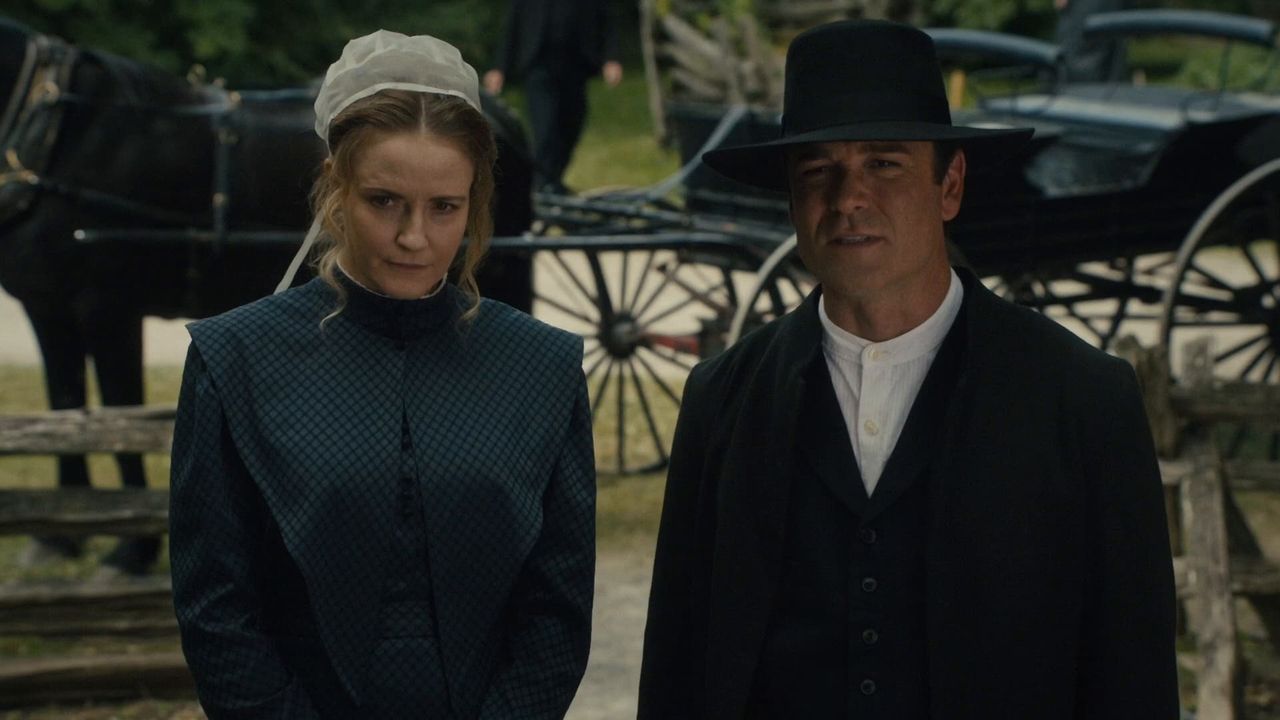
Recently, I watched an episode of the Canadian television show Murdoch Mysteries, which has run on Citytv and the CBC since 2008. The episode was entitled ‘Clean Hands” (CBC, 16:6, 17 October 2023). In that episode two of the central characters in the show, Murdoch himself played by Yannick Bison (once I came across an American “reactor” on YouTube who called him bison after the beast), and Julia, his doctor wife played by Helene Joy, infiltrate two Mennonite communities, one more “liberal” than the other, near Berlin (now Kitchener thanks to English Canadian nationalism during World War I) Ontario. Murdoch and Julia become participant spies in two Mennonite communities in order to find out who murdered a young Mennonite lad who was about to get married and who, because of his more secular ideological bent, was a circle who did not fully fit into the square pegs that were these two old order Mennonite communities. 

IMDb is a database founded in 1990 by a British computer engineer. It had its coming out party on the world wide web in 1993. It is a useful if imperfect database that contains information on films, which was its earliest focus, television shows, podcasts, home video, video games, and streaming content. I occasionally go to it to learn more about films and television shows. One of the things I am sometimes interested in which IMDb often contains information on is where films and TV programmes are shot. I wanted to ascertain where the episode of Murdoch I just watched was filmed so I went to the IMDb Murdoch “Clean Hands” page.

I was unfortunately unable able to access the information I was looking for. I did, however, find something else that interested and intrigued me even more. As I wandered around the IMDb Murdoch “Clean Hands" page I happened upon a “review" of the episode—there were five in total at the time—which I found simultaneously interesting, informative, and problematic. This “review” authored by "Steiner-Sam" entitled “Gross Misinformation of early 20th-century Ontario Mennonites” claimed that the CBC, the network that commissioned Murdoch and broadcasts it it in Canada, had done a “pitiful” job in representing Mennonite history and culture in Ontario. He claimed that Ontario Mennonites do not live in “colonies”, that they do not use matchmakers, that they do not avoid the wives of others, that they do not shun for disagreements, and that they do not lock their unwed and pregnant daughters in attics, 

There are several empirical problems with this “review”. First, the Canadian public television network CBC does not make Murdoch. The CBC commissions the show and as a consequence does have some say over the show as a result. The show is actually made by Shaftesbury Films—Rogers Sports and Media was also involved in making the show in its first five seasons before it moved to the CBC after Citytv, which is owned by Rogers, cancelled it. Shaftesbury is a private corporation founded by Christine Jenkins, who gets an executive producer credit on the show as a result, in 1987. It is Shaftesbury who hires the actors, hires the writers, and hires the craftspeople associated with the show with, of course, varying amounts of input other interested sources. By the way, Shaftesbury, is aided in their financing of the show thanks to Canadian and Ontario tax credit policies and funds from the Canadian Television Fund. 

Second, Mennonites do live in colonies. Russian Mennonites, those Mennonites who migrated to and settled in Russia as a result of persecution in Mitteleuropa, lived in colonies like Chortitza and Molotschna in the Russian Empire. Some of the members of this Old Colony Mennonite community would eventually settle in Canada, Mexico, and Paraguay after leaving Russia in the early 20th century to avoid serving in the military. Mennonites have historically been non-violent. Interestingly, many of the Old Colony Mennonites who settled in Manitoba, Saskatchewan and British Columbia including in urban areas like Winnipeg (now the city with the largest number of Mennonites globally) and Vancouver, later re-migrated to Mexico and Paraguay after receiving state promises to avoid the socialised for conformity practises of English Canadian schools, including the English Canadian British nationalist faith, and, of course, military conscription.

Third, like the term “colony”, which can mean many things including a geographical part of a colonised state under the political control of another, the original thirteen US colonies, a group of people who identify with each other while living in a foreign place, and a settlement in which people live close together—the last two definitions can clearly be used to describe separatist Old Colony Mennonites in the Prairies and separatist (colony) old order Mennonites in Ontario —the term matchmaker, someone who arranges marriages or relationships, can also take different forms. Matchmaker, for instance, can refer to a position, usually a female position, which is institutionalised and hence official in communities or it can refer a role in communities which is not officially institutionalised and which functions on an unofficial level as opposed to official level. Old Colony Mennonites, including those in Canada, like many other if not every other community across the globe, have unofficial matchmakers, unofficial matchmakers who can be recognised by the community as “official” in an unofficial way.

Fourth, Old Colony Mennonites do shun. As is the case in other old order Anabaptist groups, those who “stray” in Old Colony communities are, at least officially, initially reprimanded by a deacon. Those who still refuse to conform can be denied or “set back” from communion. This makes them outside of the fold, people who are shunned. If conformity is not forthcoming after these forms of discipline the offending party can be excommunicated.

Fifth, the episode does not portray all Mennonites as locking their unwed and pregnant daughters in attics. It portrays the hiding of an unwed and pregnant daughter, a daughter who the family hopes will  be married off in the future after she gives birth, as the response of one Mennonite family to an unwanted out of wedlock pregnancy.

Finally, let’s not forget that Murdoch Mysteries is a fictional television show that uses a host of strategies, many of them meant to manipulate the emotions of viewers such as tone, genre, drama, tragedy, comedy, satire, parody, music, and editing to manipulate viewers. Murdoch is not by any stretch of the imagination a documentary about early 20th century Old Order Mennonite life in Ontario and does not pretend to be so. It doesn’t even pretend to be a realist text. In fact, no film or TV programme, documentary or otherwise, is ever “real” or ever can be “real” making the notion that films or TV programmes can be or should be “real” an ideology that ultimately cannot be achieved in films and TV shows making the fetish of “realism” the film and television equivalent of the Holy Grail. Given this, if one wants to actually learn more about early 20th century Ontario Mennonites, one can—though most won’t, of course—take advantage of the fact that there are a number of excellent academic studies of North American and Canadian Mennonites out there in scholarly book land that can be read by those interested in Mennonite history, Mennonite society, and Mennonite culture.

IMDb is, of course, not the only social media site on the world wide web that give the reflective a strong sense that human life and its adjuncts—its political, economic, demographic, and geographic cultural ideologies or ways of perceiving—are humorous and at the same time frightening in an enlightening kind of way. There is also YouTube which, I suspect, is even more visited than IMDb, and there are also social media sites like Instagram and TikTok. What all of these social media sites say about human nature, about human gullibility, about the ideologically constructed blindness that impacts the human “race”, and about researching in a digital age that makes research easy, is a question I will leave you to answer if preferably in an empirical way.

For further empirical information on the Old Order Mennonites and Old Order Anabaptists see Harry Loewen and Steven Nolt, Through Fire and Water: An Overview of Mennonite History (Scottdale, PA and Waterloo, Ontario: Herald Press, revised edition, 2010) and Donald Kraybill and Carl Bowman, On the Backroad to Heaven: Old Order Hutterites, Mennonites, Amish, and Brethren (Baltimore, MD: Johns Hopkins University Press, 2001).


Sunday, 28 July 2024

A Critical Ethnography of Social Media: More Maps of Misreading


As I noted earlier, humans are, for cultural reasons, inherently ethnocentric. When a group creates an us, a group of insiders, whatever that insider group happens to be, they also have to create, via an equal and opposite reaction, a group of outsiders, a them.

This categorisation of some into us's and others into thems can take many forms, including a manichean, us good, them bad, form. This manichean form of identity classification and categorisation, of course, has dominated human culture for millennia and continues to dominate human culture today in alliance with a parochialism that mixes and matches human ignorance with human arrogance. 

In the brave new world of postmodernist digital media this manichean ethnocentrism is widely available for empirical viewing on a smart phone and a computer near you as I recently found out while doing participant observation research on and about social media. Needless to say social media sites like YouTube are a boon for the ethnographic observer and analyst who now doesn’t even have to leave the comfort of his or her armchair in order to travel to a not so exotic exotic culture any longer.

I recently stumbled on two possible if not probable culturally and ideologically driven maps of manichean misreading while doing ethnography on YouTube. The first was “reactor" Brooke Whipple’s “reaction" to one aspect of the the fifth season Buffy the Vampire episode “The Replacement”. In The Replacement" Xander, one of the original Scoobies or Slayerettes, is split into two halves, a suave Xander, who most “reactors” believe is not the real Xander, and a joking to hide his self-doubts Xander, the Xander who most “reactors” assume is the real Xander. At first the Gang is unaware that both Xander’s are the real Xander split into his confident and self-doubting halves by the demon Toth. Once  they realise, thanks to observation and research that both Xanders’ are real they devise a strategy to put broken Xander back together again. As they are preparing to do this Riley, Buffy’s ex-military boyfriend and graduate student in Psychology at the University of California-Sunnydale remarks, in what is clearly coded as comedy, satirical comedy, that the two Xanderses make him want to lock both of them up in a room and perform experiments on them, a reference, of course, to social scientific and particularly Behavioural Psychology twin studies. Not getting either the tone or the reference Whipple responds that of course Riley would want to do this since he is with the government.

Now, there is no doubt that states and nations have a distinctly checkered record when it comes to the treatment not only of their own citizens but of alien others as the deportations that occurred in the US in the World War II era, the lies associated with the US prosecution of the War in Vietnam including claims about North Vietnamese attacks on American ships and the massacre by American military of civilians at My Ly (one that recalls massacres of First Peoples by American troops and civilians in the 19th century), and US military experiments on pacifists with LSD make clear. However, private capitalist corporations and universities, public and private, also have a checkered past when it comes to truth telling and experimentation as well. See, for example, GM’s attempts to defame Ralph Nader for telling the truth about one of their cars and corporate experiments in Taylorism. So, the arises as to why Whipple chose to single out governmental nastiness while simultaneously ignoring corporate and academic malfeasance? Is it because Riley was in the US military? If so, why did Whipple not note what should be obvious to anyone with an empirical mind at this point, namely, the historic links between corporations, the government, and the military, public and private? Knee jerk manichean government evil, private bureaucracies good on the march? I suspect so.

The second example of potential knee jerk manicheanism in YouTube “reaction” videos I stumbled across were the many sensationalist Doctor Who is about to be cancelled “reaction” videos by “reactors” whose journalistic and scholarly credentials and expertise are questionable, to say the least.  No group of fans get more proprietary and red faced about their object of desire and devotion than Doctor Who fans, a fan clique that has been around since the mid-1960s. Doctor Who fans whinged and whined about the meta Doctor Who of the Douglas Adams years. They whinged and whined about the revival of the show in 2005 wandering if would do justice to their nostalagiased and romanticised memories of the show. They whinged and whined when David Tennant passed the torch to a new Doctor. They whinged and whined when Jodie Whittaker became the first female Doctor. They whinged and whined when Disney+ signed on to do Doctor Who with the BBC, something that required series fourteen of Doctor Who to become season one of Doctor Who again. They whinged and whined when Ncuti Gatwa became the first Black British Doctor, Doctor 15.

Recently, Doctor Who devotees (and one suspects those who have no devotion to Doctor Who but who are devoted to having their politically and ideologically correct way) have been boo hoo hoo and running around like chickens whose heads have just been chopped off prophesying that Disney+ is about to cancel Doctor Who because of its low ratings. In fact, ratings, for the nu new Who have been, as one Disney executive is quoted as saying that the ratings have been good though not stellar and Disney+ and the Beeb have just moved forward on a Doctor Who spinoff, hardly evidence that backs up “reactor” claims that the death of Who is imminent. They have also been conveniently forgetting that Doctor Who ratings have ebbed and flowed ever since the show came on the air in 1963. 

Given this empirical fact—the ebbing and flowing of the Who audience numbers—one invariably has to wonder if something else, something hidden, something below the surface something devouring from below is going on that accounts for all this whinging and whining about the most recent series of Doctor Who. Is it race, perhaps This type of whinging, of course, parallels all the whinging and whining that went on when Jodie Whittaker became the first woman to play the role of the Doctor.  If past is prologue one has to wonder whether some Doctor Who fans and some of those right wing populist ideologues who fancy themselves as warriors in a culture war for the soul of the universe (seemingly playing out their version of a pulp science fiction film in their comic book imaginations) can no more stand a Black man in the role of the Doctor than they could stand a White woman in the role of the Doctor. Manichean culture on the march? I suspect so.