Tuesday, 21 June 2011

Socialism and the Idiocies of Human Life...


You have to love an article like this (http://news.nationalpost.com/2011/06/20/what-are-the-ndp-talking-about-when-they-talk-about-socialism/). Why? Because the first sentence in this article is historically and culturally inaccurate.

According to the National Post, one of Canada's self-proclaimed national newspapers along with the Globe and Mail, socialism was once a social movement defined by its belief that the state ownership of industry and the equitable distribution of wealth were moral, political, and economic goods. Can you say fairy tale? In reality socialism has always been a social movement made up of different visions and versions of socialism. Socialisms rather than socialism, in other words. Getting empirical and historical I give you communal socialism (Owen, Fourier), Christian socialism (Rauschenbusch, Niebuhr), Scientific socialism (Marxism), and Democratic socialism (Michael Harrington, Bernie Saunders). In historical fact, socialism has always been about as sectarian as Christianity with its multitude of churches, denominations, and sects, including its 40 plus versions of Anabaptism. I have always appreciated this last fact because there have always been so few Anabaptists in the world, 1.6 million at last count, but they have created 40 different Anabaptist groups all of who think they are the one true version of Anabaptism and Christianity..

While there are problems with this National Post article on the NDP, the Canadian social democratic party that arose out of the merger between the largely rural Co-operative Commonwealth Federation and the Canadian Labour Congress, and socialism it is far superior in its historical understanding of socialism than many of the Facebook posts underneath a link to this article on Facebook. For ideologues and demagogues Leigh Patrick Sullivan and C.G. MacKay socialism "means" and "equals" failure". Not to be outdone poster Andrew Horton raises the linguistic stakes by claiming that socialism equals "epic failure". Unfortunately, but understandably Messers Sullivan, MacKay, and Horton have to ignore real history in order to make such statements. Quite clearly to anyone with historical eyes, ears, a sense of smell, and a sense of touch, Scandinavia, where socialism has dominated since the 1930s, has given us the social democratic success stories of Sweden, Norway, Denmark, and Finland, all of which, simply to focus on economics, have some of the highest standards of living in the Western World.

One of the most unfortunate forms of historical amnesia on posting boards, all generated by ideology and demagoguery rather than empirical historical analysis, by the way, is this historically bizarre equation of socialism and bureaucratisation. Historically, of course, Paternalistic bureaucracies have existed at least since the 300s of the current era if not before. I give you the Orthodox Church, the Catholic Church, and the Chinese imperial apparatus, paternalistic bureaucracies all.

Modernity, as Max Weber pointed out over almost one hundred years ago, transformed bureaucracies as efficiency, effectiveness, professionalism, merit, modern military structure and strategy, and notions of progress came to dominate the modern world. Today bureaucracies, be these political (governmental apparatus like the federal and provincial governments of Canada), economic (GE, Apple, Microsoft, Caterpillar), educational (UofT, SUNY, the University of Notre Dame), intellectual (the Cato Institute, the Heritage Foundation), religious (the Baptist Church, the United Church, Coral Ridge, the Union of Reform Judaism), journalistic (the National Post, the NY Times), etc. are all bureaucracies rent through with the ideologies of modernity (in their "meritocratic" form) and are all products of the modern world. As anyone with eyes can see "modern" "meritocratic" bureaucracies have "triumphed" and rule the modern from Vancouver to New York to Copenhagen, to Moscow, to Melbourne, to Auckland. Meritocratic bureaucracies, in other words, are as modern as capitalism, socialism, and liberalism and more than compatible with all of them.

Finally a word on the equation of Hitler and socialism that one finds in a blog by John J. Ray linked to by another Facebook poster under the aforementioned National Post article named Graham Martin (http://matiane.wordpress.com/2010/07/26/hitler-was-a-socialist/). This linkage of Nazism and socialism, of course, is not new. Conservative ideologue and demagogue Thomas Sowell made it in a editorial I happened upon several years ago, for example. It is so used and abused, in fact, that it has become a cliche. It is a curious equation even if we admit, as we historically must, that socialism is and has always been multiple.

So what is Nazism? Nazism is a fascinating bird. Historically Nazism has been seen as a type of fascism, other forms being Mussolini's fascism and Franco's fascism (love that alliteration). On one level, fascism and hence Nazism is conservative. It looks back to a golden age in the past be this Rome in Mussolini's case or German racial purity in the Nazi case. On another level, however, fascism is a product of the modern world along with liberalism (of the laissez faire and social insurance varieties), socialism (of its many flavours), and, perhaps most importantly, nationalism. Nazism is a form or ultra nationalism. It is a form of ultra nationalism (Germans as the superior race) that explains any national problems by pointing to the pollution of the fit Aryan body politic by racial and political outsiders and inferiors such as Jews, homosexuals, Jehovah's Witnesses, and socialists. And it is a form of ultra nationalism that sees this struggle between Aryans and diseased others, particularly Jews, in apocalyptic terms (the cosmic struggle between good aryans and evil others, particularly Jews and Jewish-Bolsheviks) as a struggle for control of this world. The apocalypticism here should remind us that Christianity with its apocalypticism and its anti-Semitism, was an important cultural factor in the rise of Nazism and the creation of its culture. Christian primitivism, with its hope of returning to an original order, an original golden age, to the utopian garden of Eden, and Christian apocalypticism, with its prophetic vision of a battle between good and evil for control of the world, merged in nineteenth and twentieth century Christianity (a final apocalypse followed by a return to a paradise where the lion will lie down with the lamb) and twentieth century Nazism to produce, in each case, two kinds of conservative modernism.

Nazism is not alone in its utopianism. For laissez-fair liberals it was and is the free market and the belief that free markets will spread the wealth. For socialists utopia was, remember there were and are different socialisms, the commune, the industrial anarchic paradise where one could philosophise, fish, and work all on a given day, and the cooperative, democratic, and just society. Like other modern supposedly secular movements socialisms had their own vision of a golden age in the past to which it to some extent wanted to return, for marxian socialism it was the cooperative society of the hunter-gatherers with industry.

The moral of this tale? Nazism is very different from socialism socially, culturally, and intellectually despite the fact that Nazism, socialism and liberalism (of the laissez-faire and social insurance varieties) are all, to a great extent, products of the Enlightenment. They are products, at least in part, of the Enlightenment because they are all rent through with ideas and ideals of liberty, fraternity, equality, happiness, property, justice, citizenship, etc. The problem is that these Enlightenment ideas and ideals were never consistent and were always contradictory (even for the "great" John Locke). Liberty and equality and justice simply, particularly under the impact of industrialisation and capitalism, aren't harmonisable though the various ideologies that arose out of the Enlightenment try to harmonise them or at least some of them.

Anyway, wouldn't it be nice if people used real history rather than kneejerk and often fear based ideological demagoguery to analyse things like socialism and to understand the world? Well yes but it is not part of the nurtured "nature" of most humans. That said over the years I have observed that those who describe themselves as leftists (a very different animal, historically, from liberals, by the way) have a much better grasp of history than those on the right. I think this is because those on the right (like most religious folk) tend to ground their "analysis" in myth, nationalist myths and economic myths, in particular, and use these myths to make and remake history in their own image, while most people on the left start from the historical facts and, even when they twist and manipulate this history, still remain grounded in a kernel of historical truth.

Monday, 20 June 2011

Buffy Blog: "The Zeppo"

“The Zeppo”, to paraphrase Spike from season two’s “Halloween”, is just plain fun. Written by Dan Vebber (who would go on to write for Matt Groening’s and David X. Cohen’s Futurama) and directed by James Whitmore Jr., “The Zeppo”, along with season four’s “Superstar” and season seven’s “Storyteller”, both written by Jane Espenson, can, I suppose, be seen as“postmodernist” because it, and they, are all self-aware, all seem rather off kilter, all manipulate audience expectations, and all break, to some extent, the mythical fourth wall as a result.

“The Zeppo’s” narrative, mise-en-scene, and music all reflect the off centredness of the episode. And they reflect it from the very beginning of the episode. The teaser to “The Zeppo” begins with a knock down drag out battle between the sisterhood of Jhe, an all female demon cult that eats those they triumph over and who want to bring the world to an end (apocalypse again) and is the monster of the week, and our heroes Willow, Buffy, Faith, and Giles. The off kilter quality of the episode comes into play because of the absence of Xander in this fight, an absence which gives us the viewer, or at least this viewer, a sense right away that something is a bit off, that something is a bit weird, that something is a bit strange. It’s not long before we find out what happened to Xander. About a minute or so into the teaser the Xandman, who has been thrown by one of the warriors of the Sisterhood of Jhe into a pile of rubbish rises out of a pile of rubbish. Even the mise-en-scene, in other words, marginalizes Xander.

This sense that something is off and that Xander is suddenly being marginalized from the Scooby Gang continues throughout the remainder of the teaser as our supernatural superheroes, Willow the Witch, Buffy the Vampire Slayer, Giles the Watcher, Faith the Vampire Slayer, and Angel the Vampire each, out of a concern for the unsuperhuman Xander, tell him one after the other that it is too dangerous for him to take part in the battle against the powerful and strong Sisterhood of Jhe.

This marginalization of Xander in “The Zeppo” continues throughout the length and breadth of the episode. The school bully Jack O’Toole, whose soda is knocked over by a football Xander is unable to catch during a game of catch at Sunnydale High, threatens to kick Xander’s ass. That other human in the Scooby Gang, Cordelia, who is missing in action, seems to have returned to her mean girl persona of season one and some of season two form and is in full revenge and Xander put down mode, calling him a “little nothing”, a Jimmy Olsen, the cub reporter from the Superman comics who often puts himself intentionally or unintentionally in harms way, and a Zeppo, the fourth of the Marx Brothers who starred on stage and on screen but who virtually no one remembers these days. Angel, who Xander runs into at the Bronze in act one, tells Xander to steer clear of the dangers associated with the coming apocalypse. Giles, who Xander runs into in one of Sunnydale’s cemeteries in act two as the Watcher is trying to learn more about the apocalypse by communicating with the spirit guides, leaves Xander behind with his new friends while going off to prepare for the coming apocalyptic battle. Willow, who Xander runs into outside a magic shop to which Willow has come to supplies for a protection spell later in act two, tells Xander she loves him not sure she will ever see her again. Faith kicks Xander out of her apartment after he saves her from one of the female warriors of the Sisterhood of Jhe early in act three. Buffy and Angel, who Xander goes for help later in act three, are in hyper exaggerated almost campy gothic romance and apocalyptic mode (something the music reflects) and and hence of no help to the Xandman who seems ever more isolated from them.

One of the things that is really off kilter about “The Zeppo” is the fact that we are only shown snatches of Buffy’s, Willow’s, Faith’s, Angel’s, and Giles’s struggle to keep the world from ending on what will be a very long night in Sunnydale. It is also off kilter because, as we the viewers learn very rapidly, this is not a Scooby episode. It is a Xander episode. “The Zeppo” largely centres on Xander’s character arc, an arc the other Scoobies are simply not aware of.

This Xander episode begins with Xander’s accidental involvement in spilling Jack O’Toole’s soda. The interaction between Xander and Jack, one in which Xander’s manhood is threatened by Jack and right afterwards by Cordelia (the you are a Zeppo speech I referred to earlier) underlines that “The Zeppo not only about Xander, is not only about manipulating the audience, but is a parody of macho manliness. Feeling marginalized by the Scoobies and feeling emasculated by Jack O’Toole Xander attempts to find the thing that will make him, as he says to Oz, “cool” and that will make him feel like a man.

Xander, of course, has long been concerned about his manliness. And the “thing” he comes up with to do something about it is a “thing” Buffy very appropriately refers to as a “penis metaphor”, a car, a 1957 Chevy Bel Aire, an appropriate “penis metaphor in a US in which males are obsessed with their automobiles. And while the car enables Xander to do his formulaic donut run for the supernatural Scoobies it also, after he is put down yet again by Cordy the mean, enables him to pick up a “chick”, to Cordy’s surprise.

With “chick” in tow it’s off to the Bronze for Xander and Lysette. There Xander runs into Angel, as I noted before. Unfortunately for Xander it’s also at the Bronze that the he and Lysette run into Jack again. As Xander and Lysette are leaving. Xander crashes his “penis metaphor” into Jack’s car, Jack’s stolen car it turns out. Ubermacho Jack, responds to the accident the same way he responded to the first accident Xander caused, he threatens the Xandman, this time with his knife Katie. Xander’s manhood goes once again into deflation mode. Xander manages to extricate himself from his dilemma by telling a policeman who happens upon Jack threating him that he and Jack were “’rasslin”. As a result Jack asks Xander if he wants to have some fun.

The fun Jack has in mind is raising his “boys”, his “buddies” (Bob, Dickie, and Parker), from the dead. This is why Xander is in one of Sunnydale’s cemetaries when he runs into Giles. With the “boys” raised and Lysette gone—she is freaked by Jack’s raising of the dead—Xander becomes wheel man for the “boys” who resurrected from the dead now want to have a bit of fun. The fun they choose is “bak[ing] a cake”. While the “boys” are collecting what they need to “bake a cake” from a hardware store they break into Xander runs into Willow coming out of the magic shop across the street.

Running into Willow seems to lead to a bit of self-reflection in Xander and he decides that hanging with the dead and becoming a member of the gang of the dead by becoming dead himself is not for him. So he splits in his “penis metaphor”. Running into a Faith battling for her life with one of the warriors of the Sisterhood of Jhe in act three Xander rams his “penis metaphor” into the warrior incapacitating her for the moment and allowing Faith and Xander to escape. Hungry and horny (remember that line in “Faith, Hope, and Trick” earlier in season three?) and ready to pop (wow there are so many sex metaphors in this episode) after not getting a kill Faith helps Xander get “up with people” (a reference to the late 1960s musical group that always seemed like a mainstream response to the hippie and countercultural movements of the late sixties and seventies), gets Xander, and then gets him gone.

With his virginity lost and his sense of manhood inflated as a result Xander looks at the supplies the “boys” stole in order to build a cake and discovers it is not a cake they are building but a bomb. Trying to figure out where the gang might plant a bomb Xander goes to Buffy and Angel later in act three but to no avail. As he is driving to the school to ask Giles about where the dead boys might plant a bomb he comes across them walking in the street, grabs Parker while driving, interrogates him, and gets almost all the answers he needs—the bomb is at Sunnydale High—before he decapitates Parker by driving too close to a post box. Hilarious.

Xander, now that he is knowledge guy, heads to Sunnydale High to defuse the bomb with Jack, Bob, and Dickie in close pursuit. In the chase through the high school halls Xander manages to dispatch Bob with a soda macine. Dickie is killed when trapped in a room by the Sisterhood of Jhe. All the while we see glimpses of the apocalyptic battle Buffy, Faith, Willow, Angel, and Giles are involved in during the chase. Then he traps Jack in the boiler room where the bomb lies. Xander, in a scene laced with references to Donald Siegel’s machoish Dirty Harry (1971), refuses to let Jack leave and thus forces him to defuse the bomb. On his way out the door Xander tells O’Toole that he doesn’t want to see him on campus anymore. And he won’t since Jack is eaten by Werewolf Oz as he tries to exit through another door leaving Oz feeling “oddly full” the next day. Hilarious.

In the final scene of “The Zeppo” Cordy tries once again to pull Xander’s chain. This time Xander smiles and walks away from Mean Cordelia. Xander, at least for the moment, is a new man.

Vancouver on my mind...

I suppose we all are aware by now, and the media just won't let us forget it, that after the Vancouver Canucks lost the seventh game of the National Hockey League final 4-0 to the Boston Bruins a "riot" ensued in that scenic Canadian city on the Pacific.

There is, I suppose, so much one can talk about and pontificate on when it comes to the Vancouver "riots" and similar "riots" in other Western cities where sports are almost a religious experience and the imbibing of alcohol an almost eucharistic undertaking. As for me I just love the fact that there were several rituals of contemporary Western society at play in Vancouver: the ritual worship at a sports arena, the ritual boozing, the ritual "riot" after a sporting event, the ritual condemnation of the ritual riot, the ritual self-righteous moral panic after the "riot", the ritual of if you can get you in the riot on social media like Facebook and you can become famous or infamous, the ritual praising of the sanctity of private property (can I get an amen brothers and sisters!), the ritual of blaming "anarchists" for the "violence" against private property (can I get another amen brothers and sisters!), and the ritual of media obsessing on a "moral panic" for fun and particularly for profit. It is good to know that we live in a cyclical universe and that the modern world just continues to keep on turning around and around and around like a looney (pun intended) ever punishing wheel of samsara.

Speaking of Western society and particularly the United States can there be a more banal society than one obsessed with designer dresses, smoky eye liner, moneygrubbing, silk ties, celebrity, the mimicking of the lives of the rich and famous, obsessing over sports, obsessing over ones body, verbally and physically abusing those who are different, all the while ignoring the global inequalities they have created? Bread and circuses, opiates of the masses. To paraphrase the Australian band Jet, Western society look what you've done you've made a fool of almost ever Western one (and, to top it off, most of them don't even know it).
\

Sunday, 19 June 2011

Buffy Blog: "Helpless"

Over the course of two and one half seasons of Buffy the Vampire Slayer we viewers have been introduced to a number of rituals that high schoolers typically pass through on their way to graduation in the United States, including those students we have become attached to at Sunnydale High. Previously on Buffy we have been introduced to the May Festival, the Sadie Hawkins Dance, and the ritual taking of the SAT’s, the Scholastic Aptitude Test that play important roles in whether the American high school student gets into college or not. But we have not seen any of the rituals, apart from the fact that when one Slayer dies another is called, associated with Slayerhood and Watcherness. That is until now.

“Helpless” written by David Fury, who after “Helpless became a writing fixture on the Buffy stage, and directed by James Contner, starts with a bang. The teaser ends with a dizzy and much weakened Buffy apparently about to die at the hands of a vampire. And since Joss and Company have killed off other major characters previously some of us undoubtedly think twice about what is going to happen to our Buffster. With the commercial over and with act one begun, however, we find out that the Slayer manages to survive her near death experience thanks to her quick wits. Despite the fact that Buffy manages to survive, however, there is at least one nagging questions we viewers (or at least this viewer) can’ t help but wonder about. Why is Buffy the Vampire Slayer, the killer of vampires and demons, suddenly so weak?

OK so it has been a year since season two’s “Surprise/Innocence” and its Buffy’s birthday again. Buffy has plans to go with her father on their annual pilgrimage to the ice show. After last years birthday Buffy is hoping that this year’s will be better than the last. She intends, she says, to put a moratorium on parties in her honour. Despite Buffy’s intention and hopes to put her recent birthday past behind her, however, there is something strange going on in Sunnydale yet again. Buffy, as I said, is experiencing dizziness, a loss of strength, and a decline in Slaying punning power for some reason—“Helpless’s” mystery of the week—and Giles seems rather slow if not reticent to help clear up the question of what is going on.

We don’t actually have to wait that long for “Helpless’s” first mystery to be cleared up. Giles, Giles the Watcher, is hypnotizing Buffy with a large blue vibratory stone and injecting something into her with that syringe. Why? With one mystery down a a number of other related mysteries appear on the Sunnydale scene in quick succession: Who are those Brits at the Sunnydale Arms? Why are they bricking in the windows? What are they doing with that vampire they have chained up in a box? Why are they giving him pills? Why is he in pain? What do they mean “the Slayers preparation” is almost ready?

We soon learn that the Watchers Council is in town and they are preparing for the time honoured rite of passage that has been done for centuries, the Cruciamentum, which takes place when the Slayer reaches the age of eighteen (here beginneth the episode arc of “Helpless” and here again is one of those coming of age and hero’s journey themes in Buffy the Vampre Slayer). Boy those Brits sure do like their ancient rituals don’t they? Giles, who must answer to the Watchers Council and its apparent head, Quentin Travers, however, regards the Cruciamentum as “an antiquated exercise in cruelty” though he is following orders, at least for the moment. And this is why he is injecting the Bufster with a herbal solution that makes her weak.

In the world of the Buffyverse, however, bad things tend to happen without much of a wait. Zachary Kralik (Fury named this character after his nephew), the vampire being held by the Watchers Council and who is to play a role in Buffy’s Slayer rite of passage, manages to escape part of the straight jacket that binds him and turn Blair, one of Travers’s Watcher Council assistants who is trying to give him his medicine, into a vampire. Soon they are bonding by feeding off Hobson, the other Watcher Council assistant and preparing a trap for our beloved Vampire Slayer.

Giles, however, puts, or so he thinks, a chink in Kralik’s plans when he comes to the Sunnydale Arms. Discovering what has happened our Watcher exists Sunnydale Arms stage right.

While Giles is discovering what horrors have happened at the Sunnydale Arms, Buffy has been transformed into a vulnerable Red Riding Hood, a fairy tale Vampire Kralik will reference several times in the episode before its over, by Buffy’s own Big Bad Wolf, the vampire Kralik himself, who even masquerades as Red at one point, and his henchman Blair. Fortunately for our weakened Slayer Giles happens along in his how does it keep running Citreon and saves our Buffy from the frightening Big Bad Wolf.

Back in the safety of the library Giles reveals, in an incredibly powerful and superbly acted scene, to Buffy what we viewers earlier learned in act three, he has, in Buffy’s words, been “poisoning” her causing her to momentarily loose her Slayer strength. Buffy traumatized and in tears throws the syringe that Giles has “poisoned” her with and which is lying on the table in front of her at our Watcher asking Giles how he could betray her. “How could you do this to me”, she asks. When Cordelia walks into the library Buffy asks her to take her home. With the scene ended we viewers, or at least this viewer, wonder whether Buffy can ever trust Giles again and whether their relationship and Buffy the Vampire Slayer itself will ever be the same. Drama, pain, and tragedy the things Joss and Company do and bring so well all rolled into one scene.

When Buffy arrives home our Slayer discovers that Kralik, who it turns out, has an anti-mother complex, he “ate” his own he tells Joyce, has taken Buffy’s mother hostage leaving behind for Buffy to find a photo of a kidnapped and frightened Joyce with the words “Come” finger written in the black of the Polaroid instant film photograph on the back. So it’s Buffy, but this time a weakened Buffy, to the rescue again. Buffy, in what are rapidly becoming her overalls of pain, the same overalls she wore when she thought she had killed the human Ted in season two’s “Ted” (she also wore them in “Inca Mummy Girl” where they were mistaken for Buffy’s white trash costume by Xander), gathers up her weapons and heads to the Sunnydale Arms, all unbeknownst to Giles.

Giles only learns that Buffy has entered the Cruciamentum arena when Travers arrives at the library. After telling Giles that he is too close to his Slayer Travers tells our Watcher that the Buffster has already entered the “field of [ritual] play” at the Sunnydale Arms. In classical horror and thriller fashion Kralik chases Buffy through the dark, shadowy, and tiny yet labyrinthian space of the Sunnydale Arms apartment. Kralik catches Buffy a couple of times but she is able to escape, the second time thanks to her wily theft of Kralik’s medication for his mental instability. Buffy grabs Kralik’s pain pills and drops down the laundry chute finding Joyce at the bottom. Kralik soon follows, takes the pills from Buffy, and washes them down as he has done before with a glass of water. This is not your normal glass of water, however. Buffy has poured holy water into the glass that Kralik has drunken his pills with. As Buffy watches Kralik burns up from the inside out. Just as everything seems safe and Buffy is trying, unsuccessfully to get Joyce’s ropes off, Blair arrives with Giles in tow. Giles manages to dust the vamp ending the threat for the moment.

“Helpless” ends with another brilliant scene (Buffy, in the course of seven seasons, has so many of them). With Buffy and Giles back in the library Travers tells Buffy that she has passed the Cruciamentum thanks to her “extraordinary courage and clearheadedness”, and I would add her skills at improvisation and quick wittedness. Giles, on the other hand, who has, claims Travers, a father's love for his “charge” has failed. Buffy upset that the Watcher’s Council ritual has let a monster loose that kidnapped her mother responds to Traver’s congratulations with that wonderful line and title of Nikki Stafford’s episode guide to Buffy, “Bite me”. Travers response to our beloved Slayer is patriarchal. Buffy, he says, is a “colourful girl”. For Travers and presumably the Watchers Council then Buffy, even though she has passed the Slayer coming of age ritual, is still a “girl”, their girl.

Buffy really gets hammered and betrayed by men in “Helpless” whether it’s her father, her surrogate father, Giles, or the male dominated Watcher’s Council. And while Buffy may be down but she’s nowhere near to being out. The Buffster’s snarky responses to Travers—“[b]ite me” and “[do] I get a gold star”—has some of the rebellion against patriarchy in it suggesting that Travers and the Watchers Council may have a rebel on their hands. Only time will tell.

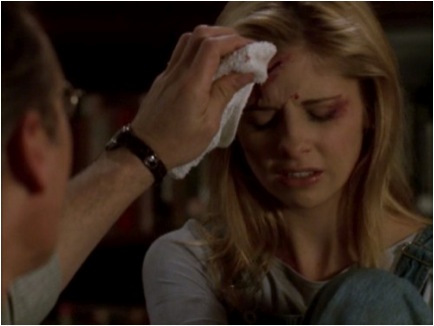
Though Giles is told by Travers not to have further contact with “the Slayer” the scene ends with Giles walking over to Buffy sitting at the table and, after Buffy gives him a white washcloth, washing out her wounds. Has Buffy, to some extent, forgiven Giles? Will they reconcile? Is the Buffster seeing Giles more and more as her surrogate father? Only Buffy time will tell.

The Cruciamentum arc isn’t the only one at play in “Helpless”. The Buffy-Angel arc makes an appearance and is still complicated—is the relationship platonic or is it, as Spike recognized earlier, a romantic relationship?—and Angel admits for the first time that he saw her before she became a Slayer (we viewers, of course, learned this in “Becoming”). The Buffy-Buffy’s Father arc, though we don’t know this yet, comes to a close in this episode when Buffy’s father, Hank, doesn’t show up for their annual daughter-father ice show outing thanks to business problems (interestingly Buffy will tell Travers that slaying is not a business in the last act of “Helpless”). With respect to the Faith arc, Faith the Vampire Slayer is once again missing in action and is on a “walkabout”, as Buffy calls it, somewhere. And then there is the Giles arc. What is Giles going to do now that he has been fired, a concept Willow can’t seem to “cruise past” at this point in season three?


Saturday, 18 June 2011

Buffy Blog: "Gingerbread"

If season two’s “Killed by Death” was the first of the great fairy tale episodes of Buffy season three’s “Gingerbread” is the second. “Hush” from season four will, as we will see, be the third.

Buffy, as I have said many times before, works on a number of levels—narrative (including the visual narrative), metaphorical, comedic, referential or intertextual, to name a few—and it is almost impossible to analyse any episode of Buffy with anything approaching the thoroughness and completeness it deserves particulary in a short essay like this. So as is generally the case in these brief musings I will focus on certain aspects of “Gingerbread”.

“Gingerbread”, written by Jane Espenson (from a story by Espenson and Thania St. John) and directed by James Whitmore, Jr., like so many episodes of Buffy, centres upon a mystery. In “Gingerbread” the mystery is who killed the little children Joyce finds on and near the merry-go-round in one of Sunnydale’s parks while she is doing Parent-Slayer night with Buffy in the teaser of the episode?

Like so many episodes of Buffy there is a monster of the week in “Gingerbread”. At first it appears that the monster of the “Gingerbread” week is a group of humans, a group of human’s practicising occult magicks. It is these humans who appear at first to have killed the kids leaving their witchy mark on the palms of their prey in the process.

As Buffy and Giles began to peel off the layers to this mystery it appears that Amy (she’s back), Michael (what is the male of witches, asks Cordy), and our Willow may be these human monsters of the week Buffy is looking for particularly after we see Amy, Michael, and Willow dressed in witch/warlock garb engaged in a spell that utilizes the mark that we saw on the palms of the dead children in the teaser.

But as is so often the case in mysteries and in Buffy’s, in particular, appearances can sometimes be deceiving. And this is where a second level of “Gingerbread kicks into gear. The “Gingerbread” of the title—Buffy’s titles almost always have an important meaning in the context of the episodes—refers to the gingerbread of the Hansel and Gretel fairy tale made famous by the Brothers Grimm, Jacob and Wilhelm, early nineteenth century collectors both of German language fairy tales. As we learn at the end of act two the real monster of the week in “Gingerbread” is Hansel and Gretel, the subjects of a fairy tale collected by the Grimm's and published in 1812.

While the Hansel and Gretel of the Grimm’s tale wondered into the woods and were imprisoned by an evil witch when they happened upon a gingerbread house the witch used to entice her young victims, the Hansel and Gretel, “Little Boy” and “Little Girl”, of “Gingerbread” are really a demon who thrives on fostering hatred and persecution and watching a community tear itself apart. They have been bringing hatred and persecution to villages and towns around the world every fifty years since 1649.

The community that the Little Boy and Little Girl are fostering hatred and persecution in this time is, of course, our Sunnydale, California. As we learn at the end of act two the Little Boy and Little Girl of “Gingerbread” are appearing to the adults of Sunnydale, Joyce Summers and Sheila Rosenberg (the first time we see Willow’s mum) included, turning them, in the course of the episode, into a vigilante mob who have the lockers of Sunnydale High students searched, have offending students at Sunnydale High disciplined when their lockers contain the stuff of the occult, have Giles’s “occult” books burned, and have the practitioners of the “occult” including Willow, Amy, and Michael, attacked

When the Scoobies discover that the Little Boy and Little Girl without parents are a demon the Scoobies morph into action mode. Xander and Oz not surprisingly head off to save Willow and discovering that she has been taken to City Hall by the mob for vigilante justice. Buffy and Giles go to the Summers hose to tell Joyce what is going on. Buffy is rendered unconscious while Giles is knocked unconscious yet again, something Cordela notes when after she repeatedly slaps Giles before he awakes (“Now let's be clear, the brain damage happened before I hit you” she remarks after Giles tells her they have to save Buffy from Hansel and Gretel). A awakened Giles and Cordelia head to City Hall in Giles’s Citroen while Cordy prepares the mixture that will reveal the Little Boy and Little Girl for the demon they are.

In the meantime the mob has tied Buffy, Willow, and Amy to the stake and set them alight to exact justice from the “bad girls” (this is not the last time we will see bad girls in season three). Amy does her “Bewitched, Bothered and Bewildered” (the season two episode) spell turning herself into a rat this time thereby escaping the fires of the vigilante mob. Buffy and Willow are not so lucky. But they have Giles and Cordy on their side who arrive and pour water on the burning pyres and break the spell cast by Hansel and Gretel revealing the Little Boy and Little Girl for the misogyny monster they are returning things to normal, well not quite. When the demon attacks Buffy the Buffster manages to break the stake she was tied to and kill the demon by using the giant stake as a weapon.

“Gingerbread” ends with Mrs. Rosenberg inflicted with the same selective memory that inflicted Joyce and many other Sunnydale residents in the past returning Willow’s home life back to normal. Well almost. Once again Willow’s mum is not taking much of an interest in her daughter though she has told Willow to invite her musician boyfriend to dinner. In the final scene Willow and Buffy are performing a spell in Willow’s house to try to “de-rat” Amy. But the spell doesn’t work and so the Buffster suggests they get Rat-Amy one of those wheel thingies.

As is so often the case with Buffy and genre—Buffy’s writers generally put a spin on the genre tales they use as clay—this episode of Buffy the Vampire Slayer puts a nice little spin on fairy tales. “Gingerbread” turns the Hansel and Gretel tale upside down turning Hansel and Gretel, who were the victims of an evil witch in the folk tale, into a misogyny demon that persecutes innocent witches. Buffy as feminist.

Turning the fairy tale upside down isn't the thing going on in “Gingerbread”. There is also the evil spirit of McCarthite witch-hunts and religious book burning and conspiracy theories about occult ritual killings hovering over “Gingerbread”, both things from America’s recent past and Buffy present. A similar spirit will show up in the Angel episode “Are You Now or Have You Ever Been” written by Tim Minear.

There is another aspect of “Gingerbread” that ties into a major theme of the series Buffy the Vampire Slayer in general that I want to talk about briefly before I end this brief musing. Since the beginning of Buffy Buffy has had an internal monologue about whether she wants to give up her “normal” life for the life of a Slayer and the responsibilities that Slayerhood entails. “Gingerbread” puts a spin on this issue and adds another layer to Buffy’s debate within herself about Slayerhood and Slayerness. In act two Joyce tells Buffy that all that she does in fighting the things that go bump in the Sunnydale night the vampires just keep on coming. Buffy, she says, does not have a plan. She simply reacts. She, in other words, can’t win.

Buffy takes what Joyce says to heart and begins to question whether what she does every night is having any effect in war against evil in Sunnydale. It is Angel who, when they run into each in the park in which the Little Boy and Little Girl have died, who gives an answer that seems to satisfy Buffy, at least for the moment (and points forward to the last several episodes of Angel). Angel tells Buffy that they can never win, that they are simply like Hans Brinker putting their finger in the leaking dyke of evil, but that fighting the good fight is inherently worth it. Angel also gives Buffy the answer to the mystery that dominates “Gingerbread”, who the monster of the week is when he mentions Little Boy’s and Little Girl’s parents.

I want to close with a brief discussion of the relationship issues that have been prominent in season three up to this point. Despite the fact that there appeared to be some Hollywood like closure to some of the relationship problems that have wound their way through series three of Buffy in “Amends” not every relationship has come to a happy or not so happy conclusion yet. Xander is oh so sensitive to accusations that he always knows where Willow is and what she is up to. Joyce and Giles continue to be uncomfortable with one another. Is there something we missed in “Band Candy”? Well, at the risk of alienating you dear unreaders, we will find out.

Buffy Blog: "Amends"

“Amends”, written and directed by Joss Whedon, is Whedon’s riff on Charles Dickens’s—Dickens is purportedly one of Whedon’s treasured authors—famous novella A Christmas Carol (1843). This episode was appropriately first broadcast on the American television network The WB around the Chrismas holidays on 15 December 1998.

If the Angel arc began with “Angel” in season one of Buffy and was extended in season two’s “Lie to Me” and “Becoming” and season three’s “Beauty and the Beasts”, then “Amends” is the latest major installment in the what is Angel’s background and what is Angel’s destiny plan. “Amends” tells us more about Angel’s background, his party boy, syphilitic, and psychologically vicious and murderous past, but it doesn’t really tell us what Angel’s “destiny” is now that he has returned from a hell dimension other than that it is something important. The TV series Angel will, of course, take off from this Angel arc in Buffy.

“Amends” is, as I mentioned earlier, Whedon’s variation on A Christmas Carol with Angel playing the role of Ebenezer Scrooge. As Scrooge was visited by the ghosts of Christmas past, present, and future Angel is visited by vivid dreams and vivid memories of his vicious past, the ever present realities of his uncertain present, an uncertain present without Buffy, and his ever present brooding about his unclear future, the what is my destiny thoughts that impact Angel seemingly at all hours of the day.

This being Buffy the fallout from the previous episodes of season three continue to impact all of our Scoobies. Buffy has left Angel. Cordelia is off for Aspen leaving Xander alone for his annual Christmas camping outing in his backyard to escape his parents alcohol infused arguments. Willow and Oz are still suffering from the fallout of the Willow and Xander relationship. The Willow-Oz relationship is about, however, to change.

Oz takes Willow back telling her he misses her. Relationship on the mend? It appears so as Willow invites Oz to her house while her parents are, as usual, away. Willow, in sexy red dress, in her living room swathed in red, the colour of seduction, and with Barry White playing on the stereo (“you’ve got Barry working for you”, says Oz; a shout out to Ally McBeal?) attempts to seduce Oz. It is Oz who pulls back saying, however, that he is not quite ready. One can’t help but think here of Oz’s other putting a hold on Willow-Oz fooling around action back in the second season episode “Surprise/Innocence”. Oz pulls back out of love for Willow. So, again, relationship on the mend? Well we will see.

It is not only the Oz-Willow relationship that is changing. The Buffy-Faith relationship seems to be changing. At Joyce’s prompting Buffy visits Faith at her Spartan lodgings inviting her to Christmas Eve dinner at the Summers home. Faith tells Buffy that she already has plans, a party to go to, but just as Joyce and Buffy are putting the finishing touches on the Christmas tree there’s a ring on the bell and Faith shows up on Buffy’s doorstep. Relationship on the mend? We will see.

Another relationship undergoing change in “Amends” is the Giles-Angel relationship. The Giles-Angel relationship, of course, is still suffering from the fallout from Angel’s murder of Giles’s love, Jenny Calendar, and Angelus’s brutal torture of Giles both in season two. Angel is, however, suffering from visions and he goes to Giles for help. In a wonderful scene at Giles’s apartment the Watcher agrees to let Angel in to his apartment but not before grabbing a crossbow and pointedly pointing it at Angel’s heart. Angel proceeds to tell Giles about his visions and his need for some clarity about his future, his “destiny”. Giles agrees to help not wanting a repeat of the Angel gone bad recklessness of season two.

And then there is the Buffy-Angel relationship. Buffy has done her best to steer clear of Angel given their feelings for each other but Buffy soon realizes that Angel is dreaming about his brutal past thanks to her “cameo” in one of his dreams. She asks Giles to help her figure out what is going on with Angel and both of them, soon joined by Xander and Willow, are researching a solution. Through their research the one and only original Scooby gang discovers that “The First”, the monster of the week, the original evil, the evil beyond sin and death, the evil even darkness fears, in the form of victims from Angel’s murderous past (including Jenny Calendar) is behind the psychological torture of Angel.

“The First” (this may, by the way, be the first appearance of “The First” but it is not the last as we, as I endlessly seem to repeat, will see) is psychologically torturing Angel to so to rid itself of Buffy (does “the First” have some long range plan here? We will see). It wants Angel to have sex with Buffy, turn once again to Angelus, and kill her. Angel decides that the only way he can escape the iron cage of his memories is to climb to the top of a hill overlooking Sunnydale and wait for the sun to come up, to commit suicide, in other words.

Buffy is not willing, however, to let this happen despite Giles’s warning to her that she may have to kill Angel, again. Buffy finds Angel argues, pleads, and even fights with him to try to get him to come in from the dangers that lie outside for vampires. Just as it looks as all seems lost, however, a miracle occurs. A snowstorm appears over and around a Sunnydale that has been boiling (thanks, by the way, to “the First” and its postulants, “the Bringers” or “the Harbingers”). A Hollywood happy ending? Has someone or something saved Angel’s life (the Powers that Be that we learn about in the series Angel?). We will, as I seem to endlessly repeat, see.

Finally, I want to give a special shout out for the music in “Amends”. Fantastic eerie score very appropriate for this episode. We even get to hear a variation of the Buffy-Angel theme as Angel is imaging himself making love to Buffy thanks, in part, due to the “The First”. I love old school film music and Buffy has it in spades. I also want to point out how much I enjoyed Buffy breaking the fourth wall, again, thanks to Oz’s dramatic gesture and his commentary on it during the third act scene between him and Willow in the Rosenberg house. And oh yes I shouldn't forget to mention how cool it was to see the Grr Argh monster in Santa cap at the end of the end credits.

Monday, 13 June 2011

Buffy Blog: "The Wish"

"The Wish" written by Marti Noxon and directed by David Greenwalt begins where the two previous episodes, "Revelations" and "Lovers Walk", left off. In the teaser Buffy, Willow, and Xander are fighting a "huge, hideous demon", well kind of fighting it for at this moment since the demon has Buffy in, what the script describes, as its "iron grip". In yet another of those your friends have your back moments in Buffy the Vampire Slayer it is Buffy's friend Willow to the rescue this time. Willow grabs a knife from Buffy's weapons bag, throws it to the Buffster who stabs the "hideous demon" killing it. In a breaking of the fourth wall moment, not the last, by the way, in "The Wish"--Larry will at one point in the episode succinctly summarise the plot of "The Wish" while Willow and Xander discuss how the name of the Slayer, Buffy, is striking fear in "nobody's heart"--the three Scoobies stand over the demon waiting for it to go poof finally realising that it won't and that they will have to bury it. Slaying and patrolling can be hard work.

With the battle over and won the events of "Revelations" and "Lovers Walk" come back to haunt our Scoobies. Buffy, Willow, and Xander commiserate together about lovers lost, at least for the moment. Willow tells Buffy and Xander that she plans to continue her groveling and begging in order to get Oz back. Xander tells Buffy and Willow that he has left fifty or sixty phone messages for Cordy but has heard nothing from her. When Willow and Xander ask Buffy how she copes with lost loves she says, in another one of those friendship is an important theme that runs through Buffy the Vampire Slayer moments, she says, "I have you guys".

Oz and Cordelia, who are noticeably absent from the battle, cope with their lovers lost in their own way. Oz, in his typically Oz way, copes stoically with Willow's betrayal by telling her, when she intentionally unintentionally runs into him at his locker, that he needs space and that her need to repeat the apologies that she has made before is more about making herself feel better than dealing with their relationship problems. So much for grovelling and begging, at least at this point.

Cordy deals with Xander's betrayal by burning photos of the Xandman, coming to school dressed like a sex bomb, trying to get back in the good graces of Harmony and the other Cordettes, and trying to make Xander jealous by fake making out in the Sunnydale High hallway with a jock. None of this works, however. Harmony is in full mean girl mode telling Cordy that she has a new stallion for Cordy to ride, Jonathan (heees's baaaak). John Lee, the jock Cordy faux makes out with, tells Cordy that he has to protect his reputation particularly since the coach has moved him to second string and that he can't be seen in public making out with "Xander Harris's castoff". It is the apparently maturing Buffy who tries to come to Cordy's aid while they are all at the Bronze separately--Willow, Buffy, and Xander together but Cordy with other friends. Buffy's attempt to talk to Cordy and tell her how important friends are in times of difficulty fails, however, thanks to a vampire attack. A vampire attacks Buffy and Cordy outside the Bronze while they are talking (this scene parallels an earlier scene in season two's opening episode "When She Was Bad" when Cordy was trying to help Buffy get over her "Joan Collins 'tude'). During Buffy's battle with the vamp Cordy gets knocked into a garbage pile and, as a result, comes out all "dumpster chic for the dumped", as Harmony remarks when she an her posse pass Buffy and Cordy while leaving the Bronze. Feeling that once again her ties to Buffy have led to disaster--Cordy remembers how she was bitten by a snake in season two's "I Only Have Eyes for You" as an earlier instance of the tendency for her to end up in danger or hurt when Buffy is around and notes that it was because of Buffy that she got involved with Xander because she made him "marginally cooler" by hanging with him--Cordy turns elsewhere for solace. It is the new girl in town who is hanging with the Cordettes, Anya, Anyanka, who comes to Cordy's rescue, or so we think.

Anya it seems has a lot in common with Cordy. They both know the difference between Prada and Payless (Cordy in the course of the episode becomes more like the Cordy of season one and early season two) and they both have had it with men. What we don't know at first, however, is that Anya is a vengeance demon, the patron demon of scorned women, and that the locket she wears gives her the power to grant scorned women like Cordelia one wish. Anyanka tries unsuccessfully to get Cordy to make the wish of a scorned woman early in act one in the halls of Sunnydale High. It isn't until the third time they meet, just after Cordy has ended up in garbage heap during Buffy's fight with a vampire outside the Bronze, that Cordy finally makes a wish--"I wish Buffy Summers had never come to Sunnydale", she says to Anya. "Done", replies Anyanka.

Cut to a commercial break. Now back to Buffy the Vampire Slayer where Cordelia finds herself, as she soon realises, in the "brave new world" of a Sunnydale without Buffy Summers. We the viewers realise both narratively and visually that the Sunnydale that Cordy is in is not the Sunnydale we know and love. Most of "The Wish" before Cordy makes her wish takes place in the SoCal sunshine of daytime Sunnydale. The only exception to this was the nighttime scene at the Bronze with its dark eruption of a vampire into the sunny world of "The Wish" up to that point, a clear foreshadowing of the darkness that is to come. The "brave new world" Cordelia now finds herself in is a bleak noirish alternative world. Buffy is no longer in Sunnydale. Willow and Xander are dead. The Sunnydale High School student population has declined. Sunnydale High has a Winter Brunch instead of an evening Winter Formal because being out after dark is no longer safe thanks to Cordelia's wish that Buffy never came to Sunnydale. It is a bleak new world in which the Master has risen from his subterranean supernatural prison turning Sunnydale after dark into the domain and realm of the vampire because Buffy was not there to stop him.

Buffy may not have come to Sunnydale in this alternative reality but Angel did. He came to await Buffy's arrival. He has been taken prisoner by the Master and has become the plaything of one of the Masters most vicious close disciples, Willow. Giles, who also came to Sunnydale presumably to prepare for the arrival of Buffy which never comes, is, along with Oz, Larry, and Nancy (who we will see later in the third season episode Earshot), part of the white hats, the good guys, who manage to save potential vampire victims, including Cordelia, from a certain and horrible death. They are not strong or organised enough, however, to take on the Master in on his home ground, the Bronze. Speaking of the Bronze it has become a vampire club host to the horrid torture of human vampire victims (Whedon has, as I noted earlier, remarked on the S&M qualities that Noxon brought to Buffy). Finally to top the horror and darkness of this episode off, the Master is about to open a "plant", a "factory", that takes that most demonic of human creations, the mass production line, and applies it to problem of satisfying the blood lust of the ever growing vampire population creating a literal consumer society in the process. Ah, the joys of capitalism.

One can, I suppose, speculate about the literary, filmic, or television sources and antecedents of "The Wish's" bleak "new world". Nikki Stafford in her excellent guide to Buffy, Bite Me, compares "The Wish" to Frank Capra's It's a Wonderful Life. And while both "The Wish" and It's a Wonderful Life imagine and visualise dark alternative worlds the alternative world of It's a Wonderful Life draws on film noir precedents with their nightscapes of rain and human depravity just as "The Wish" does.

Even if we accept that "The Wish" has been extensively influenced by Hollywood film noir there is still an interpretive problem we have to deal with. Noir has never, as far as I know, played with alternative universes. Comic books and science fiction novels, films and television programmes have, however, and Whedon, as is well known from interviews and his work in the comic book format (Astonishing X-Men, Fray, Buffy, Angel, Firefly), has been influenced by comic books. In the DC comic book universe alone there are multiple worlds with their own versions of its superheroes. Whedon, who studies film and gender studied at Wesleyan University in Connecticut, was also clearly influenced by science fiction genre films. So could the source of the alternate universe in "The Wish" be comic books, science fiction films, or both?

The problem with the comic book and science fiction film alternative world as the source of "The Wish" is twofold. First, Whedon was not the writer of "The Wish" Marti Noxon was and I can find no evidence that Noxon was the comic book or science fiction geek Whedon was (she studied theatre at UC, Santa Cruz) and she has never been involved with the Dark Horse Buffy comic books series since its inception. This is not an insurmountable problem since it is well known that Whedon often had his hand in scripts he was not the official writer of. Second, and this is the more compelling counterargument, the likely source for the alternative world darkness of the "The Wish" is told to us in the episode "The Wish" itself, Aldous Huxley's dystopian novel Brave New World (dystopian worlds are alternative worlds despite being grounded in the realities of the “real” worlds they satirise). Huxley's Brave New World is referenced by Anyanka toward the end of the episode. Finally, Huxley's Brave New World and Noxon's "The Wish" share a concern with the impact of new technologies on consumption patterns and human life.

In the meantime back in the brave new world of Buffy, "The Wish". The "exciting" "brave new world" that Cordy's wish brings forth is a brave new Sunnydale which sees Xander and Willow turned into vamps, Vamp Xander turned into a voyeur who enjoys watching Vamp Willow torture her pet "puppy" Angel (it keeps her from getting bored something that we will see afflicts the "real" Willow too), a Giles who can only watch from a cage he has been locked in by Vamp Willow and Vamp Xander while both feed on and finally kill Cordelia, a Buffy who has become a cynical loner who, as she says, doesn't "play well with others" much like Faith (the fact that Faith is missing in action is referenced early in the episode), and a Master who has become the dominant strongman and industrialist in his brave new kingdom of Sunnydale. At the end of the episode Angel, Willow, Xander, lie dead, Willow at the hands of Oz (irony?), Angel at the hands of Xander (more irony), Xander at the hands of Buffy (still more irony given the tensions in their relationship?), and Buffy at the hands of the Master (still more irony?). Just as all seems lost Giles, who has called forth Anyanka via a spell, grabs Anyanka's locket, her source of power, escapes from her clutches, and returns the world of Buffy the Vampire Slayer to what he hopes is a better world. Anyanka is returned to the point in time when Cordelia made her wish but now she can no longer grant any of the several wishes Cordelia makes. Whether this return to the world of Sunnydale we the viewers know and love will be a better one and whether this return will give us a happy Hollywood ending remains to be seen.