Sunday, 12 January 2014

The Teacher's Pet: My Teaching Life in the Academy

I have taught off and on in academia since the 1990s. While I have not found that old joke with more than a hint of seriousness that teaching would be great if it wasn't for the students entirely true over my teaching life, I have, looking back, found it to be partially true.

Before I talk about my favourite and least favourite teaching experiences, I should point out that I am not an academic. I am an intellectual. I should also note that I hate bureaucracy. One of the joys of adjuncting at colleges and universities until recently has been that adjuncts have generally not had to do those petty bureaucratic tasks that take up so much of the time of full-time tenured or full-time tenured wanna be faculty at most American colleges and universities these days. That is changing, however. One last point, while I have a doctorate in History, I am not a historian. I use history to fill out my social theoretic intellectual interests. Given this I have usually been the odd man out in most history departments in which I have taught over the years. I can live with that, however. I am not sure they can though.

Now back to the putative subject of this blog post, my teaching experiences in academia. If I had to name the best place I ever taught, Brigham Young University would be at the top of my list. I ended up at BYU somewhat by accident. In the early 1990s I became interested in Mormonism. My interest in Mormonism wasn't an interest in Mormonism per se though. I was interested in Mormonism for what it told us about the processes of identity construction and community construction in new social movements. The Y seemed, at the time at least, to be the best place for me to explore my new interest in the Church of Jesus Christ of Latter-day Saints since it was a Mormon university. So off I went to Provo. Little did I know then what I know now, that the Y takes its antiquated 1950ish style honour code with strictures on the length of men's hair and women's skirts and dresses seriously. While at the Y I taught a Social Stratification class in the new Joseph Smith Building of all places. In this class and in others I sat in on, I found BYU's students to be of two broad types, fundamentalists who thought that anything the prophet said was divine and more "liberal" Mormons who thought that the divine messages of the prophet were only those which were signed by the First Presidency. Regardless of whether BYU students were literalist or more circumscribed in their notions of prophetic revelation, I found the vast majority of BYU students I met, undergraduate and graduate, to be intellectually engaged and, respectful and appreciative of those who taught them. This should not have been a surprise to me in retrospect given the nature of Mormon culture and given that students don't go to BYU to party. They go their to get an education and to get married.

Another college at which I quite enjoyed teaching was SUNY IT. My enjoyment was due to the fact that I was fortunate enough to teach mature students, most of them mature nursing students who were taking classes to turn their associates degrees into bachelor's degree at SUNY IT. Like my students at the Y, the SUNY IT students I taught at Hudson Valley Community College in Troy, New York were intellectually engaged, weren't in school to booze and wench, and were respectful and appreciative of those who taught them. Unfortunately, in this age of higher educational cost cutting these classes are now, or so I understand, done entirely online rather than in the classroom. While there is something to be said for online classes--one can do these at anytime and in anyplace--you inevitably lose the personal relationship between teacher and students when you are teaching solely by your fingertips.

Rensselaer Polytechnic Institute would be in the middle of my list of most favourite and least favourite places in which I taught over the years. RPI, a national science oriented institute, has some great and gifted students. Given the scientific emphasis of RPI, however, RPI's students tend to major in the hard and practical I want a job in the future sciences. As such RPI students, while very intellectually capable, tend to be very narrow in their academic focus and that academic focus was rarely is on the humanities and social sciences. Add to this the fact that the liberal arts at RPI are extremely anemic--there are no humanities and social science departments at RPI unlike at MIT, Cal Tech, and Worcester Polytechnic--and you have a college that has little place for the liberal arts in its curriculum. While RPI, thanks to a new Humanities dean who wants to make a mark for herself presumably in the name of furthering her academic bureaucratic advancement career, has tried to get around the anemia in its liberal arts and its anemic funding of the liberal arts by initiating interdisciplinary classes. These interdisciplinary classes, since they are not built on the solid sand of humanities and social sciences disciplines of which RPI has none, however, seem a losing proposition to me. First, since the only background in humanities and social sciences disciplines RPI students have comes from high school courses they have taken they really do not have a solid academic disciplinary base on which to enter interdisciplinary classes. Second, what RPI's new interdisciplinary classes will do and are doing is to make Humanities and Social Science classes at RPI substantially larger than they had previously been and need to be.

If I had to choose the place I enjoyed teaching least it would have to be SUNY Albany. SUNY Albany is a weird and ugly place. SUNYA is a product of the creation and expansion of the SUNY academic system under Governor Nelson Rockefeller in the 1960s and 1970s. SUNYA's new campus was built on the outskirts of a deindustrialising and decaying Albany, a fact that gives the SUNY Albany campus a palpable suburban and commuter feel. While SUNYA, along with SUNY Buffalo, SUNY Stony Brook, and SUNY Binghamton (all three of which were built in more suburban confines) were founded as the four research centres of the SUNY system, the state monies that funded state university and college expansion in New York during the economic high times of the 1960s and early 1970s dried up in the wake of the oil crisis leaving the SUNY system and its research centres, in particular, in precarious financial positions, precarious financial positions they have been saddled with ever since. With the latest bust in the American economy SUNY Albany has had to downsize yet again and has done so by eliminating several of its liberal arts programmes. SUNYA's loss of the College of Nanoscale Science and Engineering late last year, a college which brought substantial amounts of state monies into SUNYA's coffers and which effectively subsidised SUNYA's liberal arts programmes for the few years it was part of SUNY Albany, will likely exacerbate the further decline of SUNYA as a liberal arts research university. Speaking of research universities, it should be noted that SUNYA was never in the top tier of great research university research universities in the US in the first place. Only Buffalo and Stony Brook are members of the Association of American Universities, the elite club of and for America's elite major research universities. SUNY Albany has always seemed to me more akin to the Ball State's, Kent State's, and Bowling Green's of the American second or third tier research university universe than of the first tier of the Indiana's, Berkeley's, Madison's, and Ann Arbor's.

But back to teaching at SUNY. I found the SUNYA campus, given its architecture and its suburban and commuter feel, little conducive to the intellectual life. It felt and looked more like a state bureaucracy (complete with panopticon) than an academic institution. As such there was little in the way of intellectual life on the SUNY Albany campus even on the graduate level. Since SUNYA has the reputation as a party school, an impression SUNYA's administration has tried to counter with limited success, many students came to SUNYA to booze and wench and to take business degrees so they can get a well paying job, presumably on Wall Street, after they graduate, not to take advantage of its liberal arts. I found many SUNY students to be not only non-intellectual but also unprofessional. Many did not turn assignments in on time making me wonder if they could ever hold a professional job after they leave their sheltered lives behind the walls of the ivory tower. I found many SUNY students disrespectful. I routinely observed many of them trolling around the World Wide Web, playing computer games, looking at Facebook, trawling through their cell phone messages, talking not about the class but about their personal lives, and even reading magazines in class. I found some SUNY students rude. I have, for instance, had students yell at me because they did not read the syllabus. I had SUNY students who did not know how to write an academic paper. I had SUNY students who didn't really know how to find their way around a computer. I had SUNY students who couldn't calculate 20% of 100. I had SUNY students who didn't know how to write a scholarly paper. I had SUNY students who didn't know how to discern the point of view of a non-fiction book. I had SUNY students tell me they hated television programmes they had never seen and who hated the films of directors they had never watched and who all the while expected respect for such absurd and obscene opinions. I had SUNY students who thought that a historical background was unnecessary for understanding current events and who mistook tweeter writebites for in depth journalistic excellence. I had SUNY students plagiarise including one who lifted his entire response from an article on the TV show South Park because he apparently couldn't write about a show he regularly watched in his own words. I had SUNY students who apparently didn't realise that Web search engines make finding those who are plagiarising easy. I had SUNY students who wanted to know the questions that were going to be on the exam before they took the exam. I had SUNY students who wanted me to tell them what to write about in their blog journals. I had SUNY students who forgot the password to the blogs on which they were required to put their blog assignments. I found SUNY students to be filled to the brim with that sense of entitlement attitude that seems to be so common among college age youth these days. I had SUNY students who, in a classic I am shocked, shocked Casablanca moment, condemned me for not paying attention to students who showed me by their attitudes and actions that they were not interested in my classes for paying attention to students who were interested in my classes. Well duh! And some of you wonder why I am a grumpy old cynic. Add this all up and it seems to equal the high schoolisation with its teach for the test mentality of the liberal arts college general education class.

Now don't get me wrong, there were a handful of students at SUNY who really were intellectually engaged and who were very capable. In this respect SUNY is much like other American academic institutions these days. There are only a handful of students really interested, really energised by, and really dedicated to a liberal arts education. It is, of course, to these handful of students that we teachers we aim our teaching lessons. It is these handful of students who we hope to reach through our teaching.

Needless to say the fact that I have unfortunately spent most of my teaching life in universities and colleges that aren't BYU's has meant that my teaching experiences have not been among the most joyful and stimulating experiences of my life and I need stimulating environments in order to flower. There has been joy in having benefits including health care in a bah humbug nation where millions, including significant numbers of part-time faculty members at colleges and universities, have none. There has been joy in teaching those handful of students who really care about learning and a liberal arts education. Frankly speaking, however, I have gotten a hell of a lot more joy and a hell of a lot more intellectual stimulation working at Honest Weight Food Co-op in Albany, a job which thankfully isn't a 12/7 gig for a meagre pittance of pay as adjuncting is. My kingdom for a job in a college or university full of students like those I had at BYU...

Appendix
Here is a question I got from one of my SUNY students in the past:
"Dr. Helfrich, I was looking at the syllabus again and I could not find the answer to how we are supposed to cite the information we received from each source. Since there is no format, page count, word count, I am quite confused. I am also confused on what you meant in the syllabus about writing in our blogs our comments about the discussion in class to receive participation points. Can you clarify? Thanks".
I post it here because I find questions like these so indicative of what today's student is like and how it has become a royal pain in the arse to teach. Note the need the student has for a word count. Apparently this student cannot even conceive of writing enough to answer specific questions posed to him/her without an indication of the number of words he or she must write. Note the question about format. This student appears to have forgotten the standard rules of formatting or needs to hear the standard answer about format, typed, double spaced. Note that though I said this in my syllabus, "As always in my class there is an option to speaking in class. You can put your responses on your blog in a blog post...this student doesn't seem to understand what to do" I don't know why this student needs more than this clear statement since it seems straightforward to me. It tells students that if they want to talk more about what was said in class, what they read, or what they heard they can post it on their blog. Note that the student needs guidance on how to cite properly. I assume that students are taught how to write a paper in high school, a paper with an introduction, a body, a conclusion, and proper citation, or apparently they have forgotten about how to do it. This is why I put a handy, dandy guide to writing a paper in my syllabus. By the way, I chalk all of this craziness up to the teaching for the test mentality that dominates junior high and high schools these days. This "educational strategy" does only one thing as far as I can tell. It creates a servile mentality in students in which they can't think for themselves. As such it undermines everything a liberal arts education should be about.

Saturday, 11 January 2014

Cinderella, Cinderella Where For Art Thou?: The Academic Life as Suffering

It has long been a struggle for me in the academy. I have fancied myself an intellectual since I was in junior high school where I opposed the Vietnam War and, like Kevin in The Wonder Years, helped organize an attempted walk out against the Vietnam War. It didn't work, by the way. The administration found out about it and locked us into the school putting chains on all the doors.

Once upon a time, specifically when I matriculated at college in the 1970s, I initially dreamed of becoming a teacher of Biblical Studies in a college or university somewhere in the English speaking world or if not that of becoming a rabbi, a fairy tale I gave up quite quickly because I am a sherlock, I am hardly a "people person". Eventually I came to believe, under the influence of sociology, cultural anthropology, cultural studies, and film studies, that if I could marry social theory to an emphasis on the empirical facts I could liberate students from the prison house of ideology most students were mentally incarcerated in, whether by choice or as a result of the very effective workings of mass propaganda. I, in other words, and like so many other academics of my time, burned with optimism’s flame. So off I went to graduate school first in American Studies, then in Sociology, then in Cultural Anthropology, then again in Sociology, and finally in History. Teaching in the academy, however, has shown me that my fairy tale dreams really were fairy tale illusions.

One of the things I have learned while teaching over the last twenty years is that college teaching and the work with the disabled while I was an undergraduate at Indiana University were eerily similar. When I worked with the disabled at Stone Belt in Bloomington, Indiana I was involved in the writing of objectives to be accomplished for and by my disabled clients so that they could gain greater independence. Every year we house parents and a member of the administrative bureaucracy wrote objectives we wanted to accomplish for each client so they could become more independent and eventually move into semi-independent status in a semi-independent apartment complex. While we were drawing up these objectives, however, we knew but we didn’t talk about it that it was really impossible for our clients to achieve the objectives we wrote. Despite the fact that we knew our clients could never achieve independence, however, we continued to play the game that we could make them independent not because we burned with optimism’s fame but because we had to. The state required us to write objectives every year in order to get goal number for most of these institutions, funding from the state and other sources that kept us in “business”.

Working for a living in the academy is quite similar. The state bureaucracy and those in the academy caught up in the mania for academic Taylorism with its numbers, the academic equivalent of industrial production, and quantitative outcomes, require those of us who teach general education classes (classes full timers can't or won't teach because they generally result in poor evaluations) to specify objectives that we hope to accomplish in our classes. And while I have no problem writing objectives for my classes the fact is that we can’t accomplish these objectives because most of those who take general education classes, often under duress, have little if any interest in the subject matter of the class and most of them simply don’t have the intellectual capabilities to meet the critical dimension of the objectives we draw up.

The reason for this is clear. There are simply far too many people attending liberal arts colleges these days. Those who flock to college campuses have been convinced by the argument—one that is partly true if less so as every year goes by an as larger numbers of graduates with bachelor's degrees enter the job market—made by many politicians, academic bureaucrats, and academics that if they go to college they can make lots of money after they graduate. Many, of course, come to the ivy-covered halls not to learn but to partake of that rite of young adult passage, the right to party. Most of those who come to college come, in other words, to get a job that will earn them lots of money and to party rather than to learn how to tell what is rot from what is not rot. They come to college with their heads filled with ideological beliefs which are akin to religions beliefs and which are hard if not impossible to dislodge. No amount of education as liberation will succeed against it. Over my years of teaching I have heard students say or write things which are intellectually and academically problematic and even completely intellectually and empirically invalid. Ironically it is students like these who the bureaucracy has "rate" those of us with higher degrees and immense experience who teach. This is akin to Ford hiring me to "rate" everything about their motorcars, though I have no experience or knowledge of the operation of cars in general, but because I drive one.

I am noting all of this because I find it excruciatingly painful and ultimately sapping of one's humanity to try to teach under such conditions. I am more of an intellectual than an academic. I prefer discussion and debate to standard operating teaching practise. I no longer believe in that fairy tale that education can liberate. By and large education, including higher education, produces and reproduces cogs in the ideological machine. As a result higher education no longer has meaning for me.

Additionally, the fact that I am an intellectual who doesn’t respect academic territories (and who has limited respect for the academia itself) has made it difficult for me to function in the ivory tower. My entire academic life has been one of disappointment whether it was the disappointments associated with being a student--I was disappointed by anthropology’s wholism and fetishisation of non-Western culture, sociology’s fetishisation of quantitative research, history's naïve wholism, its naïve attachment to archival research, and its anti-theory phobias--or the multitude of disappointments associated with college teaching. But what is an intellectual to do? There are few options beyond the academy these days of an intellectual and even fewer options that offer, like some academic gigs, excellent benefits. As an asthmatic and someone approaching senior citizenship I need these excellent benefits. If only I had been born in Denmark.

Friday, 10 January 2014

Honest Weight Food Coop I Hardly Know Ye

I have long been a coop kind of guy. I grew up in a family in which we were members of a rural electric coop in Indiana. When I arrived in Bloomington, Indiana for undergraduate studies in the late 1970s I joined Bloomingfoods, Bloomington's Food Coop, when it was still an institution in which all members had to work. In the 1990s I became a member of the camping store coop REI. In the 2000s I joined the Honest Weight Food Coop. Over the years I developed a healthy respect for the massive Mondragon cooperative in the Basque region of Spain. I have long believed that cooperatives were a viable and necessary democratic, real democratic, alternative and antidote to the shark tank casino capitalism that dominates and governs most of the West these days, particularly the United States.

Recently I have grown concerned about what is happening at the Honest Weight Food Cooperative. According to members I have talked to what I am concerned about goes back about five years, four years before I became heavilly involved in the coop and four years before the coop moved from its location on Central Avenue in Albany to its brand spanking new location at 100 Watervliet Avenue in Albany. All I can talk about, however, are the things the Leadership Team, the LT, and other powers that be have done, presumably with the support of the board, in the last few months that I find troubling. First there was the decision to keep the store open until 10 pm rather than 9 pm. Then there was the decision to allow chicken broth on the shelves contrary to a membership vote. The LT apparently claimed it was alright to do this since a national coop advertisement that Honest Weight no longer used had the product advertised in its pages. Then there was the decision to open a satellite café in the Empire State Plaza. Finally, there was the decision to subscribe to Sirius Radio and pipe retro music into the store over a really bad sound system. All of these occurred, to my knowledge, without any consultation with the membership of the coop.

I have been able to discuss these issues with several members of the board and the LT. They assert that such actions are fully within their purview and note again and again that we need customers, we need loyal customers, and that we need profits in the face of a Whole Foods store that will be moving into the Colonie Centre mall in spring and with which we will have to compete with and the multi-million dollar deficit that we took out in order to build the new store. Additionally, some of the LT appear to think that the satellite café at the Plaza is not a satellite store since it is, at least potentially, a short-term gig and it involves only one department of the coop, the deli. Beyond the semantics--I don't buy the notion that this is not a satellite store and neither apparently do some other members of the LT. The Albany Business Review quotes Duke Bouchard, the Coop's chief financial officer, as saying that the café at the Plaza is the Coop's "first taste running a satellite location [which] could pave the way for more expansion."

I am concerned about all of this because the membership, to my knowledge, has not been involved in any of these decisions and because these LT decisions, particularly the LT decision to establish a satellite café at the Plaza, establish a kind of HWFC common law precedent that would allow the LT and the board to take further unilateral decisions of a similar nature should it meet the same criteria that they enunciated to justify the Empire State Plaza store. I am concerned about all of this because it seems like the Coop is apparently becoming less of the alternative democracy I believed and hoped it was. Moreover, the argument that the powers that be had to act quickly and not consult the membership when it came to the satellite store boils down to an argument that members can't act and thus must not be consulted in such circumstances. This in itself is an argument against coop democracy.

Ironically, I share the LT's and board's concern with the need to establish customer loyalty and to increase profits before Whole Food's enters the Albany natural food supermarket market and I would have supported all of the above decisions of the LT and board save that of pumping music into the store--the sound system is too awful--if all of these had been brought before the membership. I have no problem supporting keeping the store open until 10 pm, no problem allowing chicken broth to be put on the shelves if it meets the HWFC guidelines, and no problem supporting the establishment of a satellite store and more satellite stores in the future. Now I am not so sure I will be voting in favour of any of these proposals should they come up for membership approval. In fact, I will probably vote against them simply to make a point about the problematic nature of the process in which these decisions were made. All these things, in my opinion, and particularly the satellite store issue, should have been brought before the membership.

Speaking of membership meeting, I think there are three things that could and should be passed by membership that could improve the functioning of the Coop. First, I think that those in the back offices should work on the store floor at least three hours a month. Second, I think that those in the back should have a starting pay that is no more than 30% of the starting pay of those who work on the store floor. Finally, I think that those doing hiring in the back should recuse themselves when their friends or acquaintances are the ones being considered for an open position. Judges recuse themselves, or should recuse themselves, in such circumstances. Classical musicians are often hired after they perform anonymously so that their skills not who they are, are of central importance. Honest Weight can and should learn from both honourable judges and the hiring strategies of the great orchestras of the world.

Monday, 6 January 2014

My Great Disappointment...

Life is full of disappointments as the Buddha recognised long ago. One of the most disappointing things I have learned during my life is that is that there is little if any intellectual culture in most contemporary American academic institutions. In my youth I imagined that colleges and universities were places where anything and everything was open to critical investigation. And at first that seemed to be the case. At Indiana University in Bloomington I found an intellectual culture amongst some of its undergraduate and graduate students who weren't caught up in the culture of partying, the culture of sports, and the culture of moneygrubbing. But then IU was basically an overgrown liberal arts research university with a large graduate school. At Ohio University I found a small community of intellectuals amidst Athens's very expansive drinking culture. At Brigham Young University I found an intellectual community focused on Mormonism. Since I was interested in Mormonism for what it revealed about social movements and community identity construction BYU and its many educationally motivated students proved to be an oasis for me. Beyond this, however, I have found intellectual life and its heart, critical thinking, almost entirely lacking in the vast majority of universities I have attended or taught. In fact, I have been far more intellectually stimulated by the cinema, by television, by books, by music, and, more recently, by the stimulating atmosphere at the Honest Weight Food Coop than by "intellectual" life in the ivory tower.

At most American colleges and universities faculty members, by and large, treat teaching positions at colleges and universities as little more than a 9 to 5 job. The vast majority of students are either uninterested in the interrogated intellectual life or are incapable of thinking outside the ideological boxes that their minds have been placed in thanks to a constant diet of fetishisations or universalisations from a variety of sources including the media. Most students, for instance, continue to use terms like "weird", "not normal", and boring as if such categorisations were descriptive rather than normative ideological social and cultural constructs, as if the intellectual revolution in cultural anthropology and deviance studies had never occurred, and as if empirical evidence was entirely irrelevant (have you read any of the Amazon reviews of the younger generation?). Needless to say teaching in such an environment despite the presence of a handful of truly excellent students who care about a liberal arts education is excruciatingly painful and, to use an uninterrogated phrase favoured by recent generations, boring.

Over time I have come to realise that a non and even anti-intellectual atmosphere is more typical and more mainstream in at many American colleges and universities than is the ever present critical investigation of life. The reason for this is simple. It is not critical thinking that America's powers that be treasure. It is conformity. Perhaps if I could just stop thinking I might too might be happy and join the ideologically lobotomised ranks of the masses who aren't disappointed, of those who believe that the uninvestigated life is the only one worth living. But I can't...

There are very few places that allow an intellectual to survive and thrive in American life today. There are a few intellectuals in the academia but the academy with its moneygrubbing lowest common denominator undergraduate masses who intellectuals have to teach and its power seeking upper echelon bureaucrats makes for a stultifying and finally deadly environment for real intellectuals. There's sport radio and television but that too is limited as the only way you can stay on the airwaves is to get ratings, to, in other words, appease the lowest common denominator seeking masses. There's PBS but on a good day that network rarely garners more than 2 million viewers for its outstanding factual and fictional shows. There's New York City but the advent of the World Wide Web has dramatically changed, not for the better I might add, and undermined the old media that once supported and provided a living to America's intellectuals. Clearly being an intellectual in contemporary America is the loneliest number.

Saturday, 21 December 2013

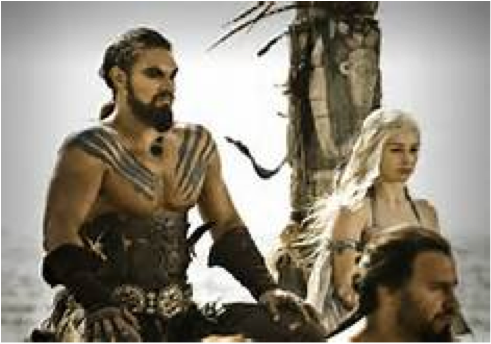
Game of Hype: Ron Watches Game of Thrones

Episode One
I am not a Christian but I have come to believe that Christmas, modern Christmas anyway, is a good thing. Christmas is worth celebrating in my opinion because this most consumer oriented of holidays--the Super Bowl, Halloween, and Mother's, Father's, and Valentine's Day are other central holidays of the American consumption ritual calendar--allows a consumer like me to purchase DVD's at Target and WalMart for a really reasonable price.

I recently made my annual Xmas pilgrimage to Target and WalMart where I picked up seasons of the HBO series Carnivale, Deadwood, Girls, Newsroom, and Game of Thrones. I recently watched Aaron Sorkin's Newsroom which I found superb if flawed. Next I started watching Game of Thrones. I found the first episode of Game of Thrones neither superb nor flawed. I found it to be, to put it bluntly and rather unacademically, crap.

Let's start with the cliches on which fantasies like Game of Thrones seems to be based. There's the retro mediaevalism. There's the manichean tale of good guys and the bad guys. There's the tale Roman and Byzantine imperial stab you in the back and throw kids off towers intrigue. There's the tale of a do anything including prostituting his sister cynical royal who wants to get his kingdom back. There's the tale of the youngish queen who is married to a fat middle aged older man but who finds a little cock action amongst the younger really bad guy set.

As I watched the first episode of Game of Thrones I couldn't but think that the show is aimed at a target demographic of literal male teens and males who have never grown out of teenhood who like their heroes good, their villains bad, their queen's beautiful and t&a naked--no dicks need apply save imaginary ones humping beautiful bare jiggly breasted and bare assed women--and who, if they are good guys, imagine themselves as Prince Valiant's who will save their beautiful queen's from a fate worse than death--in this instance, a queen married to a barbarian whose sole reason to be, like those of his ilk, seems to be boffing and killing; I fuck and kill therefore I am--or if they are bad guys who, imagine themselves those barbarians boffing beautiful bare jiggly breasted and bare assed women. The last, of course, seems to be the human condition for most homo sapiens. As for me I think I will stick with the far more intellectually satisfying and much more witty I Claudius. Colour me unimpressed, very unimpressed thus far with Game of Thrones.

Episode Two
Amidst the T&A and the appearance of "barbarian" (read Mongol?) male ass a story that is relatively interesting has begun to appear. Still it is a pity that after fifty years of reflections on females as eye candy for the male gaze we haven't gotten beyond this. One wonders whether Tamzin Merchant, who backed out of the role that Emilia Clarke plays, did so because of all the T&A women have to show in Game of Thrones.

Episode Three
The T&A continues. It appears that Emilia Clarke's "role of a lifetime", as one boosterist online magazine put it, is to show a lot of T&A for the male gaze. She also appears to be someone the female members of the audience can perhaps sympathise and empathise with. The relationship between her and her "barbarian" husband is growing more romantic by the episode and she is starting to act the role of khaleesi, barbarian queen. Meanwhile back in the "civilised" world the byzantine intrigues continue and continues to intrigue even if it is old hat for those who have a historical sense and a knowledge of genre clichés.

Episode Four
Brutal visual violence is added to the T&A. What more could a growing or a grown boy wish for?

Episode Five
I got part of the way through episode five when the DVD froze up. The DVD had numerous scuff marks on it. Needless to say HBO, I have learned again and again, has some pretty poor quality control when it comes to its DVD's.

Intermission
New and improved DVD that actually works obtained.

Episode Seven
A cock doth appear.

Episode Nine
Heads do roll.

Episode Ten
funeral pyres, forebodings of war, and dragons, oh my.

Envoi
I asked some self proclaimed fans of Game of Thrones if George R.R. Martin's work was indebted to Plantagenet history. One had no idea who the Plantagenets were. Another got defensive. Another said yes, it was in part. Game of Thrones and others in the Song of Ice and Fire series is clearly a riff on Plantagenet history likely via Shakespeare. And Martin admits it. It is a pity that fans of media get so emotionally caught up in their loves that they can't see empirical reality through the ideological mist they live their lives in.

Sunday, 24 November 2013

Happy Birthday Doctor Who...


Yesterday was the 50th birthday of Doctor Who, the celebrated British television show that premiered on the BBC on 23 November 1963 at 17:16:20. Doctor Who was the creation of a Canadian, Sydney Newman, the British producer Verity Lambert, without doubt one of the most important women in British and global television, and others. Its remit was to teach British children history and science. It went on to teach children fear, fear of the Daleks, the pepper pot shaped Naziish nemeses of the Doctor. It went on to become one of the longest running television shows beyond soap operas running from 1963 to 1989, when it was cancelled by BBC brass who hated it, only to be rebooted in 2005 by noted British writer Russell T. Davies, the writer of the original version of Queer as Folk.

I began watching Doctor Who in the 1980s thanks to PBS affiliate WMHT in Albany, New York, which ran the show on its second channel, channel 45. I continued to watch it when I moved to Utah in the 1990s thanks to PBS affiliate KUED. My first doctor was the fourth doctor, Tom Baker and I have loved him most ever since. I have a sneaking suspicion that for most of those of us who watched and watch Doctor Who our first doctor is our favourite doctor. Thanks to PBS affiliates, however, I was able to see all the episodes featuring the fourth doctor, the fifth doctor, Peter Davison, the sixth doctor, Colin Baker, and the seventh doctor Sebastian McCoy. Thanks again to PBS I was able to see all the episodes featuring the third doctor, Jon Pertwee, and many of the episodes featuring the second doctor, Patrick Troughton. Thanks to DVD's I have been able to see many episodes of the first doctor, William Hartnell.

Needless to say, I loved Doctor Who. I loved its engagement with serious issues, its discontinuity, and perhaps most of all its often sophisticated humour something that made it much more appealing to me than its very serious US TV cousin Star Trek which followed, to some extent, in Who's footsteps, and its discontinuity. As someone said online, looking for continuity is Doctor Who is a fools errand but that is one of its joys. Each doctor is different yet similar to the others. One of the most useful books on Doctor Who, in fact, is titled The Discontinuity Guide.

I was rather hesitant to watch Davies's reboot of Doctor Who. I had very fond memories of the old Who, of classic Who, and I feared that the reboot would not pay homage to the history of Doctor Who before it. I found out when I started watching the new Who that my trepidations were misplaced. Davies's Who reboot, a reboot Davies admitted was influenced by Joss Whedon's brilliant Buffy the Vampire Slayer, was, if tenuously at first, loyal to the history of Doctor Who and new technologies and great storytelling made the new Who as good and sometimes even better than the old Who. The third series Stephen Moffat episode "Blink", for instance, is as good and perhaps better than any episode of Doctor Who before it and is one of the best episodes of TV I have ever seen.

So I want to end this brief blog post by wishing one of my favourite TV shows ever a happy birthday. Happy 50th Birthday Doctor Who Long may you reign.

Tuesday, 17 September 2013

Life as Crisis Management: The IT Kiada

Yes, dear readers, it is that time again. It is time for yet another episode in my Kafkaesque and Voinavichian excursions through America's bureaucracies. This time the episode centres on my experience with one bureaucracy at the place where I work part-time, SUNY Oneonta, a liberal arts college in the beautiful Catskills of New York.

This academic year one of the departments I teach in, History, had its part-time adjunct office moved from Alumni Hall on the very south end of campus to the Milne Library where every library should be, in the centre of campus. We history adjuncts share the office with English Department adjuncts.

Before we made the move we were asked by the History Department secretary if any of us would prefer to have a Mac in the office. I am a Mac--I got a MacBook and later a MacBook Pro after two of the three laptop PC's I bought broke down within a year, specifically a Dell and a Toshiba--so I said yes. And lo and behold there was a Mac desktop computer waiting for me when I arrived at my office in Milne 309.

There was only one problem. I didn't know the password to the two entry portals of the Mac. So off I went to the History Department. They didn't know since the library IT folks set up the computers in the office. So I went to IT not once but twice. Three weeks into classes and one week after I went to the IT office in the basement of Milne I finally got a happy ending. I can now use the Mac desktop in my office at Milne. Sometimes bureaucracies do work if sometimes slowly particularly if you are, like me, a lowly adjunct.