Showing posts with label Popular Culture. Show all posts

Friday, 27 December 2024

A Critical Ethnography of Social Media: The Homiletics Horror Show


There is a striking tendency among YouTube reactors that is quite noticeable to the critical ethnographic observer. It is a tendency that is hardly new and it is a tendency that is hardly a monopoly of YouTube reactors. It has long been quite common and widespread in the human community for some time, probably, in fact, since the beginning of thinking and speaking human community time. And it is a tendency, as a consequence, that has long been present among contributors to YouTube

While a lot if not most YouTube reactors are characterised by this tendency I am going to focus on three YouTube “reactors" who are, paradoxically, also amongst, in my opinion, the better Buffy the Vampire Slayer reactors on YouTube: domi e, TheLexieCrowd, and Sofie Reacts. All three have been reacting, if sometimes fitfully to Buffy as they have other things in their YouTube barrel they are reacting to in order to generate notoriety and, as a consequence, generate monies, for years now. Of the three domi e is the only one not to have finished the series at this point.

The human tendency I am referring to relates to method, if one can assume that there is indeed some method to the YouTube “reactor" madness. Like most humans most YouTube reactors and most YouTube Buffy reactors, even the best of them, apply a faulty method of “analysis” to the text they are reacting to, in this case to the Buffy text. Instead of starting with exegesis or a close textual analysis and one that draws on what the authors of a text professed to be up to when they created it and moving on next to an exegetically grounded hermeneutics, putting, in the process, the Buffy text in its empirical economic, political, cultural, demographic, and geographic contexts, most YouTube reactors and our three YouTube reactors in particular, start with the third aspect of the method in this chain of interpretation instead of the first, homiletics. They, in other words, begin and largely end their "analysis" by inscribing their ideologies into the Buffy text sans essential exegetical and hermeneutic analysis both of which should check and balance speculative readings of any text.

One recent example of this tendency or method—beginning and ending with homiletics—is particularly apparent when one explores how all three watched and reacted to the Buffy episode “Once More With Feeling”, the seventh episode in the sixth season of Buffy the Vampire Slayer. Buffy, of course, as those who have watched the show know, died at the end of the fifth season as heroes often do during the heroes journey sketched out by Joseph Campbell (see Campbell’s book The Hero With a Thousand Faces). In the heroes journey the hero doesn’t stay dead and in Buffy’s case her friends Willow, Xander, Anya, and Tara refuse to let her die and literally resurrect her in the first episode of season six of the show.

Buffy, however, doesn’t come back right. Her friends assume she was in a hell dimension, a hell dimension similar to the one Buffy sent Angel to at the end of season three of the show. She has been instead, as she tells the vampire with a chip in his head Spike in the third episode of season six, in what she describes in her theologically naive way, heaven. So like the damaged men of Wuthering Heights, Pride and Prejudice, and even Buffy itself, Buffy is returned to what she calls hell, a real life in the real world, an ordinary life in an ordinary world (a shout out to Sartrean existentialism) that for her is literally hellish. 

Buffy faces not only emotional and psychological problems after she returns to life, problems related to that eternal existentialist question of why am I here. She also faces economic problems given that her mother’s long illness and death has left her in financial straights (a shoutout to the broken US health care system that often leaves many in debt and with debt even if they have medical insurance). She needs to get a loan to pay her many piled up bills and get a job in order to make ends meet and to fix the broken water pipes in her basement (metaphors and allegories become more tangible and obvious in season six of the BtVS bildungsroman, in the Buffy growing up tale of season six, for obvious reasons).

Getting either a bank loan or a job proves difficult for Buffy in season six. Buffy has no collateral and her home, which she inherited from her mother Joyce, and which she tries to use as collateral to get a loan from the bank, has  already, as the bank loan officer she goes to for a loan tells her, been fully leveraged and has been losing equity for years (a shout out to the fact that Joyce’s and Buffy's home has been trashed on many occasions given that Buffy already has a job, slaying). So she can’t, like many poorer Americans, get a loan. As for getting a job, Buffy never graduated from college dropping out from UC-Sunndyale in season five in order to move home to help take care of her sister Dawn and eventually her sick mother as well so her job options are, as little sister Dawn notes in season six, pretty much limited to poor paying retail and service industry work that literally in the Buffyverse, turns many fast food workers into retail automatons. Moreover, Buffy, who is called to be a slayer—it is her vocation not her job—can’t charge those she aids for killing the monsters, demons, and vampires of Sunnydale that are out to kill them.

Fortunately, for Buffy and those, like Willow and Tara who live with her in her home and who don’t have jobs or much income either, Giles, Buffy's mentor, is there to help. He gives Buffy monies to fix the broken water pipes in her house and to take care of her other financial issues. Instead of trying to find a job immediately, however, Buffy, admittedly somewhat depressed thanks to her resurrection to the hell of ordinary life, rushes off to meet her former boyfriend Angel somewhere between Sunnydale (a low rent Santa Barbara) and Los Angeles, where Angel now resides, shirking, as Giles sees it, her more mundane financial and familial duties foisting the disciplining of her sister off on Giles in the process.

Giles, Buffy’s watcher and mentor, is concerned with Buffy’s shirking of her adult responsibilities and this concern along with his feelings that he is “standing in the way” of her growing up comes to a head, 
in “Once More With Feeling. Buffy is not the only Scooby in season six shirking her adult responsibilities. Willow is using magic to make things easier for her including making things easier for her in her relationship with her girlfriend Tara, who, after an argument, she casts a forgetting spell on. Xander and Anya are having second thoughts about their forthcoming marriage. Sister Dawn is stealing in order to get attention. All these oh grow up story and character arcs come to a head in the episode “Once More With Feeling”.

In “Once More With Feeling", a musical episode, our characters sing out, thanks to a spell cast, their deepest feelings and, in the process, they learn about some of each others deepest secrets. It the episode it is revealed that Buffy was not in hell as her friends thought but in heaven, that Willow has been manipulating Tara’s mind, that Xander and Anya have things that bug them about each other, that Giles is sensing that he is standing in the way of Buffy becoming a responsible adult, and that Dawn is feeling alone and unwanted.

What is happening in season six up to and after “Once More With Feeling” is part and parcel with what Buffy creator, show runner, writer, and director said was the broad theme of season six of the show, the need to grow up and take responsibility for your actions. All the Scoobies, save for Giles, are stuck in pre-adult overdrive, including what seem like the villains or big bad of season six at first (they actually aren’t, the inability of our Scoobies to grow up is), the trio of Jonathan, Warren, and Andrew who, after graduating from high school, decide to become supervillains just like those they emulate in the science fiction and action adventure media they devour like fanboy kids. 

It is this, this exegetical fact, the fact that Buffy season six is about growing up and taking responsibility, that many YouTube reactors including our own trio of domi e, TheLexieCrow, and Sofie Reacts, miss because they have not (and perhaps will not) engage in empirical analysis and explore what those who made Buffy say about their intentions for season six. They prefer to “approach” Buffy tabula rasa (which is, of course, impossible given the reality of socialisation), paradoxically "Tabula Rasa” is the title of the episode of Buffy that was broadcast right after “Once More With Feeling”.

All three reactors are, as their reactions to “Once More With Feeling” reveal, particularly angry with Giles who sings to a Buffy who is not paying attention and who is lost in her own little hermetic world that he feels he is standing in the way of Buffy’s life course development and needs to leave, which he does in the next episode, so she can become a responsible adult. They want him instead to continue to play the father to Buffy,  not the father who realises that some tough love is sometimes necessary to aid someone to grow up but a father who solves all problems with the wave of the money want.

It is not surprising that many “reactors” read Buffy in this way and take Buffy’s side against Giles in this episode. Buffy, after all, is the main character of the show and though many reactors identity with Giles and other of the Scoobies, many, including our trio of “reactors" also strongly identify with Buffy and take her side in crises like the ones Buffy faces in season six. One might also argue that it is not surprising that reactors take Buffy's over that of Giles because they too in a world where good and good paying jobs are fewer and fewer, where the service sector with its poor paying and poor benefit jobs is dominant, where sons and daughters sometimes have to live with their parents to make ends meet, where marriage is being delayed, and where pregnancy is delayed, where delaying growing up is kind of a functional strategy for life in the real world. 

One thus has to wonder whether many of our “reactors" are, like their fictional counterparts in Buffy the Vampire Slayer, stuck in life course neutral and consequently take the side of someone who is delaying growing up just like they are (though I suppose one can argue that engaging in the mundane and banal not so fine art of YouTube reaction video capitalism is not unlike working in the fast growing fast food industry). One has to contemplate, in other words, whether YouTube Buffy “reactors" are creating a reality in Buffy that mirrors their own in reality, something made possible if not probable by their studied ignorance of the Buffy text the creators of the show actually made and the meanings they, and particularly Joss Whedon, put into the show, along with an ignorance of the broader economic, political, cultural, demographic, and geographic aspects of the show into which the television show fits. Needless to say this studied ignorance is something very much akin to the situation that the Trio find themselves in in Buffy season six, a situation where the Trio of stuck in neutral males who are still living in the basements of their parents' homes, who don’t have jobs, who are still playing with their beloved Star Wars toys (the detritus of a mediocre adolescent franchise), discoursing on who was the best James Bond, and who seemingly can’t or don’t want to grow up.  Oh the humaninanity...


Thursday, 2 May 2024

The Books of My Life: Rush, Rock Music and the Middle Class


The study of Popular Culture in American universities while present in small doses before 1960 is, like African American Studies, Latino and Latina Studies, and Women’s Studies, largely a product of the culture wars of the 1960s. Still even In the wake of that “bloody” culture war the study of popular film and eventually popular music and popular television in the university has been accepted only grudgingly in many quarters. 

The struggle to bring film, television, and popular music into the liberal arts curriculum thus has not been easy given the fact that for many intellectuals and academics in the 1950s and the 1960s the mass media, including film, pop music, and television, were seen as lowest common denominator opiates—which in some cases is true--that were of little interest to those who studied culture, meaning high culture, in the academy. By the time I went to university in the 1970s, however, film was comfortably ensconced in English, Comparative Literature Departments and even Film Programmes and Departments began to appear. Eventually, Popular Culture, if in a more practical and pragmatic key, was added into the curricular mix as those neo-liberals who ran and run the increasingly retail oriented bureaucracies known as universities and colleges discovered that there is students to be matriculated and monies to be made from the teaching of film, television, and pop music as a “profession”, even if they are all professions that, like professional sports, are not easy to break into.

As someone who came of age in the 1960s I grew to love film, popular music, and eventually television, once it, from my perspective, matured. By 1963 I had grown to love the Beatles and could barely wait for the next Beatles single or album release to appear at the record store, department store, or drug store down the street from my Dallas home. By 1967, thanks to the Beatles albums Rubber Soul. Revolver, and Sgt. Pepper’s Lonely Heart Club Band, I had increasingly come to see popular music as an art form. In this I was not alone as William Mann’s famous 1963 review of Beatles songs as art in the Times and the rise of “intelligent” rock magazines like Rolling Stone, NME, and Melody Maker make clear. By 1968 I was listening to what we would now call an alternative FM radio station in Arlington and developing a taste for progressive art rock and progressive psychedelic bands like King Crimson, the Moody Blues and later on Yes, Genesis, Van der Graaf Generator, Spirit, Kansas, Captain Beyond, and, in particular, Gentle Giant. Prog became my popular music of choice—I was already a devotee of classical music--though I continued to enjoy selectively other pop music genres in the increasingly segmented world of popular music including pop, power pop, soul, hard rock, punk, new wave, new romanticism, goth, hard rock, grunge, and even a bit of heavy metal.

Another of the bands I "got into” in those years was Rush. I first heard the Canadian rock trio in 1974 when I bought their eponymous first album. I liked it and still do. Despite this I really didn’t connect with Rush’s subsequent albums until Permanent Waves came out in 1980. I suspect this was because I was never a comic book nerd, a science fiction geek, or a fan of Ayn Rand and her cult. I was more into Hitchcock, Mark Twain, and Max Weber. Permanent Waves, however, with its, what seemed to me at the time, more progressive nature, appealed to me a lot and made me a Rush fan again. I bought every album they released afterwards save for Clockwork Angels, which I will hope to pick up at some point.

Even though I was into rock I was never an inveterate reader of rock magazines. I tended to dismiss rock "critics" because of their, what seemed to me, low level “criticism", a “criticism that seemed to me a hodgepodge of new journalistic narcissism and arrogance a la Pauline Kael blended with an inability to comprehend that beauty and value are in the eye of the beholder. What I valued was what I, for whatever cultural, economic, political, demographic, or geographic reason or reasons, liked. The fact that what I liked was not liked by most “critics” particularly at Rolling Stone, didn’t matter to me. I did not give a crap what they liked for whatever musically correct reason. I liked what I liked and that was good enough for me. After all, I was never someone to wilt before peer pressure.

When I matriculated at university I discovered that there were books on popular culture. I discovered Robin Wood’s book on Hitchcock. I discovered Dick Hebdige’s book on the mods, the punks, and subcultural style. I discovered several of Simon Frith’s many early books on popular music. I discovered John Tulloch’s and Manuel Alverado’s book on Doctor Who, a show I grew up with. I discovered the publications of the University of Birmingham’s Centre for Contemporary Cultural Studies and even thought of applying there for postgraduate work there. I was lucky I didn’t as I did not anticipate the devastation and destruction Margaret Thatcher left in her godzilla like wake. I even began to, if tentatively, write on popular culture when I wrote an essay on Punk Names for an Anthropology seminar on Names and Labels though it was not at the heart of what I studied in university.

Given all this it is not surprising that I would eventually get around to reading Canadian ethnomusicologist Chris McDonald’s Rush, Rock Music and the Middle Class: Dreaming in Middletown (Bloomington: Indiana University Press, 2009). McDonald does an excellent job of bringing together textual analysis, sociology, ethnography, and history in his analysis of Rush. For McDonald Rush and its science fiction and fantasy lyrics, its dispassionate lyrics, its musical virtuosity, its musical inventiveness and experimentation, and its emphasis on hard work and professionalism, is a middle class band whose music particularly appeals to other White middle class male nerds—like myself—including middle class musician nerds—not like myself--who too feel like outsiders in the suburbs they grew up in. McDonald also does a nice job of exploring the different cultures into which White middle class male critics—many of whom act as rock’s tastemakers for many listeners--are inscribed one of which has made Rush and its progressive rock confreres virtually the spawn of a rock and roll Satan.

I did have a few problems with McDonald’s book. McDonald seems to take the position that Canada, from where Rush hails, is either like the US or converging with it while not arguing for either position. Did the US academic publisher balk at too much Canadian content? He does not inform us where those he interviewed are from. Does he think it not matters? But does it matter? Still I found Rush, Rock Music and the Middle Class: Dreaming in Middletown an excellent analysis of Rush and its contexts and recommend it to those with an intellectual interest in popular culture. Those who respond to any scholarly work on popular culture, like the aptly named Xtreme who offers a rather typical knee jerk anti-intellectual “review" of the book and the aptly named Tom Brady, who doesn’t grasp that the formulaic claim that something is “boring" tells us little about what is being reviewed and a lot about the “reader” or “listener” doing the “review", on Amazon, one of the many brave new digital world sites that has opened its coffers up to the lowest lowest common denominator, need not apply. They, after all, appear to prefer their world unexamined so they can continue to live their lives in a world where myths and fairy tales are mistaken for reality.


Monday, 18 December 2023

A Critical Ethnography of Social Media: Isabella Balkert and the Amazon Factor


It is quite clear by now that social media have played to a lower common denominator than even the critics of television as the lowest common denominator could ever have imagined. Both Google, particularly its YouTube division, and Amazon have played a major role in this dumbing down of the already dumbed down. I was reminded of this recently when I looked up a film on Amazon, a site that used to be easy to use in order to find what one wanted but which is now one of the worst even when you put in the actual title of a book, a movie, or a CD.

I was reminded of this social media dumbing down recently after I watched the 2005 film Conversations with Other Women on the This channel. I was pleasantly surprised by the film as I had almost forgotten that once upon a time independent films with wit, intelligence, and even some cinematic innovation, i.e., art, in other words, were made in the United States, a land where most films have been made for adolescents, literal and metaphorical, since the 1970s in order to "entertain" them and increase craporate profits. Independent American cinema, of course, was put on life support thanks to the Machiavellian strategies of the oligarchic suits who run Hollywood, strategies which included the buying up of independent production companies which were subsequently downsized of eliminated, the blackmailing of cinema houses--which are also dominated by crapitalist cartels--in that tried and true crapitalist and craptorate way--if you want to show our films then--and Hollywood's success at regaining control of the means of production, distribution, and exhibition, aka synergy in postmodernist capitolese over the film industry. This, of course, made it virtually impossible for independent films to be shown in the US and Canada and even beyond if to a lesser extent in places like France after a time. By the way, this was also, and not surprisingly, the same strategy Hollywood had used to run foreign films out of the US and Canadian market (and even beyond its North American kingdom to some extent) and who used their positions of market dominance to create a ratings system blessed by Washington that ran pornography out of theatres during those same years. Hollywood, you see, has never liked competition anymore than they liked much in the way of narrative innovation. All this, by the way, made the 1948 US Supreme Court decision breaking up the Hollywood cartel something that had been thrown into the dustbin of history for by the 21st century Hollywood once again controlled production, distribution, and exhibition putting the Hollywood cartel back in place thanks largely to neoliberal free marketism, a wonderful misnomer to describe a crapitalist world dominated by vertical and horizontal (the old and more descriptively and accurate terms compared to the faddish synergy) integration and the resulting craporate monopolies and cartels, and propaganda which, whether in primary or secondary forms, socialised and socialise the post-Star Wars "kiddies" into a world in which the blue meanies include black and white films, subtitles, and repetition

But back to Conversations with Other Women: After watching the film I thought I might buy it. So, I went to Amazon to see if the film was still available on either blu ray or DVD. What drew my eye almost immediately, however, were the "reactions to the film in the dumbed down and even dumber downed Amazon "review" section . One reaction in particular drew my gaze, a reaction by Isabella Balkert apparently posted on Amazon.UK in 2007. Balkert gave the film one star compared to over 70% of reactors at the time of this post who gave the film 4 and 5 stars. She did so, she claimed, because she found the split screen technique, the interior reactions of the characters, and the flashbacks in the film, flashbacks which provided critical plot points, too difficult to follow simultaneously. I suppose these more complex art films way too difficult to follow for someone presumably brought up on movies made primarily for those with limited cultural capital and limited attention spans.

Balkert went on to condemn art films in tried and true and predictable ways. She condemned the film as pretentious, boring, and the acting awful,  Pretentious and boring, of course, are the rather boring cliches of those for whom any film that strives for art rather than "adolescent" entertainments and tells us more about the person uttering such rhetoric than it does about the film being "reacted" to. As for Balket's claims of bad acting, this is rich coming from someone who, I assume, is an amateur and who has never acted in a feature film in her life according to IMDb. This discourse, one which ignores the fact that Helena Bonham Carter has been honoured for her acting by her peers, i.e., those who work in film. She has, in fact, to note two examples of awards she has received, BAFTAs and Emmy's to her name and has been nominated for academy awards twice. Someones, in other words, find her an excellent actor as do I. The other lead in the film, Aaron Eckert, has also been praised for his acting chops by many critics, particularly for his performance in Neil LaBute's art film In the Company of Men. Needless to say, Balkert is the pretentious and boring one here given that she seems to be speaking in cliched tongues and offers no empirical evidence to substantiate her very weak godlike claims.

If I may, I would like to offer some advice to "Critic" Balkert. I would advise her to stick to the (occasionally gloriously) simplistic, formulaic, and linear films of paint by the formulaic numbers Hollywood. In fact, there is a simplified version of Conversations with Other Women which eliminates the split screen as an alternative for those traumatised by art films and their artistic complexit. There i, after all, room for flims of all types whether genre grounded, artistic, surrealistic, complex in its narrative, or even "adolescent". It is too bad Follywood doesn't recognise this any longer.

Monday, 13 November 2023

A Critical Ethnography of Social Media: The Cult of the Plastic Fantastic


Once upon a time authenticity meant authenticity in the core nation world. I, for instance, grew up in an era when more people in the West and in North America than the usual handful of bohemians and dissidents were questioning the supposed verities and nostrums of Victorianism and striving for authenticity in their questioning. Scholars have attributed this rise in scepticism and the movements undergirded by this scepticism in the post WWII world to a host of economic, political, and cultural factors including the defeat of fascism in World War II, liberal utopianism, the post-war economic boom that lasted into the 70s, the post war baby boom, the optimistic rhetoric of youthful politicians like President John F. Kennedy in the United States and Pierre Trudeau in Canada, the post war expansion of higher education and the increase in the numbers of students matriculating at universities, suburbanisation, the civil rights movement, anti-imperialisms movements such as the opposition to the French and American imperial war in Vietnam, and the sense that one could actually change the world that undergirded many of the social movements of the era.

This questioning of "traditional" verities and nostrums had an impact on a variety of things in the West including economics, politics, and culture. In popular music in the United States, for instance, it led to a revived and increasingly popular, if only in relative terms, socially conscious folk musics in places like the Village in New York City, in Los Angeles at places like the Troubadour, and in San Francisco, places that made artists like Phil Ochs, Bob Dylan, Peter, Paul, and Mary, and others into countercultural celebrities. The post-war folk movement in the US with its emphasis on authenticity and the social criticism of racism, war, and mutual assured destruction, would eventually have an impact on rock and roll bands such as the Jefferson Airplane, Love, the Byrds, and even in the Beatles as evidenced by the Dylanesque and melancholy John Lennon song "You've Got to Hide Your Love Away" on their 1965 album Help.

The US, of course, was not the only place which saw a revival of folk music performance, interest in folk musics, and notions of authenticity in the post WWII era. Folk music revivals of a somewhat different character than that in the US arose in Newfoundland and Nova Scotia, Ireland, England, and Scotland. This Canadian, Irish, English, and Scottish folk revival and its accompanying ideology of authenticity can be heard in the music of bands like Figgy Duff, Steeleye Span, and Planxty. As was the case in the US the Canadian, Irish, English, and Scottish folk music revivals also these bands had an impact on the rock and roll, something one can hear in the music of bands like Great Big Sea, the electrictrified folk of Steeleye Span and Fairport Convention, several Thin Lizzy songs including "Emerald", and in the folk influenced albums of Jethro Tull and the Strawbs.

Another genre of pop and rock music that was impacted by the folk rock revival was the singer-songwriter movement of the era, a genre that included artists like Joni Mitchell, Carol King, James Taylor, Carly Simon, Cat Stevens, and even, if briefly, Elton John, whose first four albums clearly fall outside the singer-songwriter fold, artists many listened to with great attentiveness rather that the shake your booty approach of many concert goers of today. Like the folkies and the folk rockers, pop rock's singer-songwriters placed an emphasis on authenticity. Those who privileged authenticity, or so they believed, were in a revolt, in part, against what the Jefferson Airplane called the plastic fantastic, that smiley faced happy happy joy joy organisation suburban man we are the greatest civilisation the world has ever seen were socialised or propagandised for conformity into in the years after WWII.

A lot has changed between the 1960s and today. Rock, including the singer-songwriters of the 1960s and after, isn't what it used to be. Postmodernism--economic, political, and cultural--is increasingly hegemonic in the core nation world. Selective and situational globalism is the name of the economic game in the rich parts of the globe. Californication and Disneyfornication increasingly dominate global popular culture where plastic fantastic fakeness and simulations dominate the lowest common denominator brave new digital media just as it did the old, if in a more populist way. The new digital media just spread the fakeness and commodification around more.The art cinema which was once significant in the West has been pushed to the margins. Commodification continues apace and has even broadened. Anti-intellectualism has regained its dominant hegemonic position in the wake of the counterculture particularly era in the West and even more particularly in the English settler societies.

One of the things that is or should be quite obvious to even the casual observer of social media like YouTube is how inauthentic YouTube is. Most "reactors", for instance, seem to be reality star Kardashianista wanna bes. They post images of themselves on social media which mimic fashion magazines and Hollywood red carpet poses. Most of them mrror the anti-intellectualism which has often dominated the West. They revel in their intentional ignorance of what they are reacting to whether a movie, a television show, or a song. They reflect a frowning correct puritanical culture dominated by happy faced conformist Pollyannaisms. Most YouTube reactors are clueless about how parody and satire work. In a postmodernist world core nation world, in other words, inauthenticity with its deep acting and surface acting reactors, the plastic fantastic, has become the measure of the "authentic" for so many of the post baby boom generations, the gens, who have built an online world where virtually every poster is a commodity not only for YouTube but for themselves, and where almost every potential viewer is a latter day voyeur.

YouTube and its monopolistic owner Google doesn't, of course, care about the fakeness they commodify and help sell because they make money off of the anti-intellectual tripe that dominates a social media world that is narcissistic, paranoid, conspiracy theory ridden, and amateurish (every person their own reactor regardless of their expertise). Many who post this stuff often appear to want to live out their dreams of becoming celebrities in a world where fake deep acting and cynical surface acting is the golden rule. Many, in other words, want to be a star but hardly anybody is a star in this brave new digital world of mediocrity, hubris, ignorance, and banality. And, of course, many of them also want to sell their brand. In many ways, the new digital media is nothing more than one infinite and continuous commercial dominated by that newest of human devolutionary forms, Homo Geekonomicus.

Note: It needs to be noted that many of the “reactors" on YouTube also “react” on Patreon, a monetisation site, which, according to Patreon’s capitalists, allow those using their service to create “community”.  On Patreon commodities, in the form of human reactors, are commodified and extract moneies from "patrons". Though I have not visited Patreon it is clear that many commodified “reactors” have their “patrons" vote for what they will listen to or watch and react to next and offer them “rewards” for “patronising” them via monthly financial support. The owners of Patreon, of course, take a cut (8% to 12% “commission”) from these “reactor” labourers” patron pledges. Some “reactors” sell “merchandise” to supplement their income.


Wednesday, 25 October 2023

A Critical Ethnography of Social Media: The New Labours of Herakles

I have long thought that some enterprising millennial/ GenX/GenY/GenZed/GenA, whatever, "Neo"-Klassikal scholar needs to update the twelve labours of Herakles or Hercules for the postmodernist GenMil digital age. I humbly submit that one of the "Neo" GenMil labours of Herakles, perhaps number one on the list--I know, after all that these GenMils do like their top ten or top one hundred whatever lists--should be research.

Now don't get me wrong, I know how difficult empirical and scientific research is in an age where the information of the world is at one's fingertips. After all, one has to actually type something, the labours of Herakles, for instance, into a search engine search box in order to find out something about it, something clearly much more difficult than having to get up off of a chair, keep walking to a library, or find transportation to an archive, things one had to do in those bad old so much easier days of cheesy yore. 

I suppose it is the immense difficulty of this task, of this "Neo" GenMil labour of Herakles that is research, that accounts for the fact that the vast majority of GenMil reactors to the television show Buffy the Vampire Slayer on that lower than lowest common denominator YouTube which likely accounts for why some 99% of reactors have an aversion to doing research on the show. Unfortunately, this act of slacker physics has consequences. Most reactors, for example, reactors who have little conception of how classical narrative works brought up on a steady diet of 24 to 32 page comic books and comic book movies with little plot and character development that they are, criticise season one of Buffy in that patented Monday morning quarterbacking fashion so beloved of the post-baby boom cohorts, without actually scientifically studying it and doing empirical research on it. The problem here, of course, is that if they actually did, god forbid, research on the show they would find, if they did their research properly and scientifically, a big if in the age of populist postmodernist fantasy, that the intention of those who created Buffy and ran the show during its first season was to construct a season one of the show that could be built off of in season two, should the show be renewed,  or to provide a satisfying end point for the sho if it wasn't renewed. But, of course, if these latter day Christopher Columbus's did this they might discover empirical data that might problematise their happily anti-empirical and anti-intellectual faux "opinions", "opinions" whose goal is not the empirical accuracy of the examined life but the Mammon grounded motive of profit, the god, jesus, and holy spirit all rolled into one, of the market is god and everything is a commodity life. These reactors are, you see, we want your money commodity aesthetic fetishists of the bliss inducing unexamined life.

The anti-intellectualism of the fetishised unexamined life is, of course, not new. Anti-intellectualism has been around for ages. Scholarly researchers have found it in Ancient Greece, in Ancient Rome, in the Dark Ages, in the Spain and North Africa of the Moors, in civil war England, and in British settler societies like the United States with its anti-Catholic, its anti-Mormon, its anti-Jehovah's Witnesses, its populists, and its anti-academic fundamentalist literalists, which is what most of the reactors on YouTube kind of are. After all in the same way that anti-academic fundamentalist literalists believe they don't need to do any research or any language studyin order to accurately understand the Tanakh or the Bible, GenMil reactor literalits believe they don't need to do any research in order to accurately understand Buffy the Vampire Slayer. And so it goes.
 

Monday, 2 October 2023

The Books of My Life: The Culture of Western Europe


Over the course of my intellectual life I have had a number of mentors including Max Weber, Karl Mark, Karl Mannheim, Clifford Geertz, and Victor Turner, to name just a few. Most of these mentors mentored me not in the classroom but rather through the books and journal articles they wrote and which I read. The books and journal articles I read  made me think critically about evidence, methodology, and theory, all things essential to reflect upon if one hopes to understand the human comedy, the human farce, the human drama, and the human tragedy in all its forms, something I have been trying to do for at least forty years.

Another thing my mentors taught me since they taught in a variety of academic disciplines was the importance of interdisciplinarity, something far too often lost in the specialised study of trees that has been central to academic intellectual life since the twentieth-century. I came to realise that the boundaries marking off disciplinary borders in academe and particularly in the academic social sciences, disciplines such as anthropology, sociology, economics, and psychology, were and are artificial, arbitrary, and socially constructed fetishes or reifications. Over time I came to see that the artificial intellectual borders that marked off one academic discipline from another inhibited rather than helped one understand, in an integrated way, that all human beings are economic, political, cultural, geographic, and biological-demographic animals and that by looking at humans through these ideal types we could understand human life in all of its better angel and less better angel forms. The wholistic approach to the study of humanity was something that appealed greatly to me since I quickly came to identity myself primarily as a cultural anthropologist, as someone, in other words, who saw himself as part of a discipline which, at least in North America, was grounded in the assumption that to understand humanity one needed to study human biology, human language, human society, human culture, and human prehistory. Lastly, my mentors taught me that the study of humankind must be comparative if one was to truly and fully understand humankind.

Initially, I was only limitedly interested in history, a discipline that studied humans across time. I, was of course, forced to take history classes in high school. I was, however, only limitedly stimulated by them.  When I got to college I tended to focus my attention instead on the social sciences, disciplines which were not taught in the high school I attended. Now don't get me wrong, I was interested in history but history as a methodology rather than as an academic course of reading or study. So while I was not particularly interested in history as an academic discipline I did understand that the study of human beings must not only be reflexive, comparative, and social scientific but it must also be historical. Given this I, over time, became more and more interested in history as a discipline in addition to history as a method though I would still maintain that history is more of a methodology than an academic discipline. 

Despite my limited interest in the discipline of history in my early academic years there were a few historians who had an immense impact on my subsequent intellectual development. I can still recall some forty years later, for instance, reading Keith Thomas's magisterial Religion and the Decline of Magic in Robert Janelli's class on folklore and religion at Indiana University. Its integration of theory, method, and anthropologically sensitive history had an immense impact on how I approached both theoretically and methodologically the study of humankind. Another historian who also had an immense impact on my intellectual development was George Mosse. I read Mosse's book Toward the Final Solution for a class on the Holocaust that I took with Todd Edelman who, at the time, taught at Indiana. I was gobsmacked by Mosse's exploration of the cultures that led to the Shoah in the 1930s and 1940s in Western Europe.  Both Thomas and Mosse made me see that for cultural anthropology, sociology, and social psychology to have any validity at all they all, in addition, had to be historical, must explore humankind in time as well as space, in some way, shape, or form. It was for that reason that I eventually matriculated in a history faculty in my postgraduate years, though I continued to find the discipline of history too theoretically and methodologically anemic and hence too parochial.

Though I am now retired I continue to read extensively in the social sciences and in history. Recently I read Mosse's (University of Wisconsin, Hebrew University) brilliant The Culture of Western Europe: The Nineteenth and Twentieth Centuries (Chicago: Rand McNally, second edition,  1974). As in Toward the Final Solution Mosse superbly traces, if in greater detail, the cultures and ideologies that impacted Western Europe (and the Western settler societies beyond Europe including Canada, Australia, New Zealand, and the United States) that dominated those two centuries in the The Culture of Western Europe. In the book Mosse explores what he argues is central to the cultural history of nineteenth and twentieth centuries Western Europe, namely, the separation of culture. the "real", from civilisation, the "artificial". 

Mosse's book takes readers on an excursion through the several -isms that dominated the epoch: romanticism, nationalism, racism, liberalism, conservatism, idealism, socialism, marxism, scientism or positivism, and fascism. These ideal type -isms, as they interacted with the historical dynamics of the era, argues Mosse, particularly modernity with its scientism, industrialisation, bureaucratisation, and mass society, have taken various hybridic forms, Despite taking various forms over these years, contends Mosse, all of these cultures or ideologies tended to emphasise, as Mosse makes clear, culture over civilisation. This distinction, argues Mosse, eventually led to the genocidal mania of the 1930s and 1940s, a genocide in which romanticism, with its notion of the organic real, culture, became affixed to mass racial nationalism (the culture collective blood and collective soil), mass culture, mass industrialisation, and mass modern technology. Together these led to genocide on a modern mass scale, the Holocaust.

The ideal type cultures or ideologies Mosse delineates, of course, as anyone who has been paying attention to increasing autocracy in Eastern Europe and the United States, are still with us today in the core nation West, a fact that adds an eerie been there done that quality to the historical tale Mosse tells. Though many after World War Ii, a war many thought of as a war against tyrannical fascism, argued that romantic, nationalist, and racist fascism had been tossed onto the rubbish bin of history once and for all, Mosse rightly notes in the conclusion to The Culture of Western Europe, that  the culture and ideology of fascism will never fade away. In the United States, for instance, romanticism has been integrated with nationalism and industrial capitalism to give us the most recent version of intolerant, nativist, and theocratic (my way of the highway) right wing Christian fascism. As Mosse notes, this combination of romanticism, nationalism, racism, and intolerance is a very effective meaning system, an effective meaning system that provides, particularly in times of economic, political, and cultural stress, simplistic answers to complex realities, all wrapped up in a simple minded manichean tale of us good and them evil, a manichean tale in which the "true Americans" must save America from devious liberal/Marxist/socialist/fascist enemies who are sapping America's very essence or soul.

Mosse's books, including The Culture of Western Europe, remain, in my opinion, among the most important and revelatory books published in the post-World War II era. It was a wonderful experience revisiting the work of someone I regard as one of the twentieth century's greatest historians some forty years or so after I read Toward the Final Solution in a class on the Holocaust. The Culture of Western Europe should, in my opinion, be read by anyone interested in history, particularly Western history, Western cultural history, and cultural studies. Very strongly recommended. 

There is, by the way, a third edition of The Culture of Western Europe which was published in 1988. I have not seen the third edition of the book though I am interested in taking a look at the recent University of Wisconsin Press reprint of the book, an edition which apparently restores the maps and illustrated material from the first edition of the book that had been taken out in the second. I am interested in taking a look at the new edition of the book because I have a sneaking suspicion that it may be yet another example of the dumbing down of university textbooks in the wake of the demographic revolution in American universities after the 1960s, the decline in student cultural capital, a decline so immense that one can no longer assume that all students have a basic understanding of history of Europe since the Enlightenment let alone of the Christian Bible, a book that has had an immense impact on the culture of Western society, and the ever increasing corporate businessification of universities throughout the West. If I recall correctly, I first noticed this dumbing down of university textbooks while I was preparing to teach a course on American religion. I intended to use Catherine Albanese's excellent America: Religions and Religion for the course, a book I had read in its 1998 edition. But when I compared the 1998 edition with the 2006 edition I was horrified to discover that over two hundred pages of Albanese's book had simply vanished from the book between the third and fourth editions. This cleansing of pages from the book, a cleansing I increasingly suspected was a response to the decline in student cultural capital and the retail model of education that dominates the culture of American administrators who run American research universities these days. After all American universities have become more and more like a glorified high school since the 1970s, an era that has not only seen the adoption of a retail model by the increasingly corporate capitalist administrators who dream of moving up the corporate status ladder by making their administrative mark on American colleges and universities, and an era which has been characterised by the difficulties in getting students to read even a short book of approximately 100 to 200 pages.

Monday, 3 April 2023

The Books of My Life: The Cultural Geography of the United States


I have been interested in culture for some time. It was an interest in culture, in fact, that led me to major in Religious Studies during my undergraduate years for early on in my intellectual life I realised that religion has been a central if not the central  cultural meaning system (particularly if you add in the ideology of the divine right of rulers and the ideologies associated with nationalism) in human societies across time and over space. 

This interest in culture and meaning eventually drew me, in my postgraduate years, to Cultural Anthropology, to Cultural Sociology, and to Cultural History, each of which, after all, I realised, made culture--not the high culture of literary and art historians, but the broad culture of societies--the glue that, rightly according to social scientist Emile Durkheim held societies together--central to what they studied. 

Culture has, ever since, remained central to my intellectual and scholarly life. It was at the heart of my essay in New York History on the culture war over the Woodstock Festival of 1969 and it was at the heart of my book on Mormon intellectual culture, Mormon Studies: A Critical History (Jefferson, NC: McFarland, 2021).

I don't recall exactly when I first discovered Cultural and Historical Geographer Wilbur Zelinsky's book on the culture of the United States (The Cultural Geography of the United States: A Revised Edition, Upper Saddle River, NJ: Prentice-Hall, 1993). It had to have been sometime during my undergraduate years at Indiana University in Bloomington, a university that had one of the leading undergraduate and graduate programmes in Folklore and in Ethnomusicology, both of which explored aspects of American culture. I recall picking up a used copy of the 1972 edition of the book and diving into it sometime in the late 1970s and was impressed by it for it seemed to me to be an excellent syntheses of cultural anthropology (of a complex modern society and culture), cultural history, and historical and cultural geography.

Recently, I picked up the revised edition of The Cultural Geography of the United States as I wanted to revisit Zelinsky's seminal monograph and read his more recent thoughts on the subject of the cultural geography of the United States. In the revised edition of the book Zelinsky has left the first four chapters of the monograph as they were in the 1972 edition adding only a substantial fifth chapter titled "America in Flux", a chapter that extends Zelinsky's analysis of American culture and American cultures through the postmodernist 1990s, a period which saw increasing economic, cultural, and demographic globalisation, an era that saw the extension of global forms of communication, an era that saw deindustrialisation, and an era that saw increasing fragmentation and crises of identity across the Western world.

There are a number of things I like about Zelinsky's book. Zelinsky does a excellent job of exploring the origins of American culture (English, British, European, African, Indigenous, Immigrant), the statics of American culture, the dynamics of American culture, and the complexity of American culture. He does an excellent job of exploring the concept of culture, if rather later in the book than I expected. I expected Zelinsky's general discussion of culture to be in the introduction rather than in chapter two of the monograph. He explores the debate over whether the United States had and has a civil religion, a public religion, or a common civic culture, answering, like Durkheim and Robert Bellah before him in the affirmative. He nicely explores American regional cultures, specifically the American traditional regional cultures associated with New England, the South, the Midland, the Middle West, and the Middle West. He nicely explores the issue of whether a regional culture of the American West can be delineated. He excellently explores American regional subcultures like the Mormon culture of the Mormon cultural region of Utah and parts of Idaho and Arizona, the Rio Grande subculture of the Southwest, the Southern California subculture, and the subculture of historically Baptist and Methodist parts of Texas. In the added chapter Zelinsky nicely returns to the terrain he trod earlier and brings the text up to theoretical and empirical date by reflecting on what postmodernism means for the study of the cultural geography and cultural history of the United States and what has changed and not changed about American culture in the intervening decades. I particularly appreciated his discussion of the complexities of American culture, with its subcultures, and countercultures and the many and sundry ways American culture and American cultures are expressed.

The Cultural Geography of the United States should be mandatory reading for cultural and historical geographers, cultural historians, cultural sociologists, and cultural anthropologists interested in the culture of complex societies and particularly the historical cultural geography of the United States, those interested in culture, subcultures and countercultures, cultural diffusion, and cultural innovation. All this makes Zelinsky's The Cultural Geography of the United States a model study of American  historical and cultural geography. Highly recommended.


Sunday, 6 March 2022

Musings on Manichean Mythistory...

Manichean history, a variety of mythistory and a history grounded in the notion that there is good and there is evil in history, has been around for a long time. Its origins probably lie in ancient Persia with its apocalyptic myth of the struggle between a good god and a evil god. It was incorporated into nascent Judaism during the Persian exile. It entered and became central to Christianity thanks to Paul who believed that Jesus would be returning soon, perhaps even within his lifetime, and thanks to its sometimes Zoroastrian like binary between god and the devil. 

Given the influence of Christianity on Mediterranean culture and the culture of the West, manichean mythistory has long been at the heart of Western culture and the settler societies that grew out of Western European culture thanks to Western European imperialism and colonisation. One variation of this unalloyed good versus unalloyed evil "reading" of history is the great man and evil man "theory" of history. In the twentieth century the template for the latter has, of course, been Adolf Hitler.  Ever since World War II those categorised and classified as evil by the purveyors and regurgitators of manichean mythistory have often been seen as metaphors if not embodiments or incarnations of Hitler. During the two Iraq wars, for instance, Saddam Hussein was, compared by several commentators to the Austrian, and as a result, portrayed as a madman out for world domination, a villain seemingly right out of a James Bond film. The latest iteration of Hitler and occasionally Stalin, who probably takes second place in the evil man of history twentieth and twenty-first sweepstakes and perhaps first for those who came of cultural and ideological age during the anxious and anxiety causing Cold War or who have bought into the myth that Russia stole the election for Trump, is, of course, the leader of Russia. That Putin is more Tsar than commissar is irrelevant to the demagogues and the media who purvey the manichean myth that Putin is the latest embodiment or incarnation of evil in the modern and postmodern world.

Great men, of course, have populated mythistory and the mythistory that passed for academic history for years. The American civil religion, for example, celebrates George Washington, Thomas Jefferson, and Benjamin Franklin as the founding fathers of an American nation the civil religion preaches to Americans is holy and tends to whitewash the less that righteous behaviour of these secular saints including slaveholding, Deism, and having children by their slaves. American comic books have long been populated by superheroes who seem to be the secular equivalent of the Christian saints of Roman Catholicism and Orthodox Christianity. Even Protestants, who did away with the religious saints of Roman Catholicism after the Reformation, have continued to populate their mental and material culture worlds with secular saints who are engaged in the global fight of good against evil for control of the universe. Many regard celebrities, whether from the entertainment, political, sports, or business worlds, as, thanks in part, to the media propaganda machine, secular saints. The latest to enter this pantheon of manichean grounded sainthood, thanks in part to Western propaganda and the media propaganda machine and thanks to his use of the manichean melodrama he undoubtedly learned from the media, is the president of the Ukraine. He is, after all, a former TV star.

Interestingly, the postmodern era of the late twentieth century in the core nation world has seen the rise of a less myth based history, a history that looks at reality warts and all, a history that has proven to be extremely controversial in a postmdern world characterised by a culture war between modern traditionalists and postmodernists, and the advent of media organisations that have merged traditional media sensationalism with digital gotcha culture, cultural cynicism, cultural skepticism, and cultural snark. Postmodernism with its fragmentary and diverse culture has given rise to the kind of pendulum swing Michel Foucault argued tended to occur in manichean binary cultures. It has led to a media hunger for and a mass frenzy for investigative gossip about the foibles of its secular saints, particularly its entertainment, political, and sports celebrities, which now includes those who have become celebrities thanks to the new digital media and unreal "reality" television. In the comic book world this new postmodernist culture of sensationalist gotcha cynicisim, skepticism, and snark has led to the return of the Great Depression era noirish Dark Knight vigilante and the Soviet Red Son Superman, a reflexive comic book that interrogates cultural manicheanism and its secular saints. In film it has given us films, particularly independent films in the US, that explore, in an often non-judgemental way, the dark side of human life and which often celebrate the anti-heroes or outlaws that populate its film frames. 

Despite all of this we need to remember, as Foucault notes, that while the binary may get somewhat messy in postmodern snark media like TMZ, in postmodern comic books like the Dark Night series of graphic novels, and in the contemporary postmodern American independent cinema, it still undergirds a lot of the culture of the West not only in its manichean form but also in its often manichean anti-form. Additionally, the manicheanism, melodrama, and saint making and evil making culture of propaganda surrounding the Russian and Ukrainian war should remind us once again how prevalent manichean culture with its mythistory still is in the West. Finally, it should point up to the empirically minded how effective it still is in manipulating the masses, who undoubtedly knew and still know little about the broader contexts of the Russian and Ukrainian conflict and who probably couldn't find the Ukraine on a map a few weeks before the conflict began.

But is there some truth in a manichean mythistory that divides the world between the good and the bad, the saintly and the demonic, the godly and the devilish? That issue seems to me to be more a question for theologians and social ethicists who ground their ethics and morality in some metaphical first mover or entity. What empirically oriented social scientists can say is that humans have, over the course of human history, exhibited behaviours theologians and theological ethicists would describe as good and they have exhibted characterists theologians and theological ethicists would describe as bad. Given this, it would seem more accurate for the empirically inclined to conceptualise human behaviours as lying along a continuum rather than as entirely distinct components of an either/or binary. It would thus appear to be more empirically accurate to conceptualise humans as capable of behaviours that theologians and theological ethicists would regard as both good and bad simultaneously.


Monday, 28 February 2022

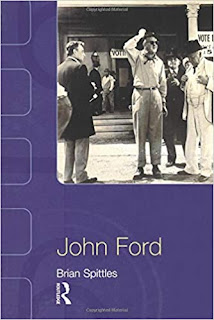
The Books of My Life: John Ford (Spittles)

Brian Spittles's John Ford (Harlow, Eng: Longman, 2002) is a good brief monographic introduction to the film career of noted American film director John Ford. Over the course of his monograph, Spittles explores Ford as auteur, Ford as a collaborator with other craftspeople and other actors including the stock company that worked with him over the years, Ford as storyteller, Ford as an artist of the film frame, Ford as a genre director, the themes in Ford's films, and the relationship between Ford the filmkaker and his broader social and cultural environment over the course of his film career.

Along the way Spittles makes a number of interesting observations. Ford, he notes, could be a bully on set pointing up the fact that many directors have, over the years, had militarisitic and authoritarian streaks much like military leaders (think George Patton) and football and basketball coaches (think Bob Knight). Spittles notes the ambiguity in Ford's representation of First Peoples, Blacks, and women over the years, something that some film critics these days too often miss or paper over in their film criticism. Spittles uses interviews with those who knew and worked with Ford and with Ford himself, primary source research, something which adds much to Spittles analysis and points up the lack of primary research in so much contemporary film criticism. Spittles nicely uses particular films Ford made over the course of his career to generalise about his film career.

Speaking of ambiguity, my response to Ford's films has, over the years, grown increasingly ambiguous. When I was younger I was simply not intellectually able to take a more critical response to Ford's films despite growing up in the more critical 1960s. This change in my approach to films and how I read them was foregrounded for me recently as I rewatched Young Mr. Lincoln, Ford's famous and critically praised 1939 film. I can't remember or recall my first response to the film. I suspect that I wanted to see the film because it was a John Ford film and John Ford was, according to critics and other directors like Orson Welles and Kurosawa Akra, one of America's and one of the world's great directors. In those auteur centred and celebrated days I tried to see as many of the films of critically regarded directors on television or at the cinema when I could. As I rewatched Young Mr. Lincoln, however, I watched it less as a film fan and more as a social scientific critic. I noted, thanks to critical work on Ford I had read over the years and thanks to my more critical gaze, Ford's limited utilisation of close-ups, Ford's use of doors as frames, Ford's mythic celebration of America, in the Young Mr. Lincoln case the myth and legend of folksy Honest Abe Lincoln, Ford's emphasis on landscape and his use of landscape as a character, though it was not as noticeable in Young Mr. Lincoln as in the films Ford shot in the aptly named Monument Valley, a landscape Ford went back to again and again over the course of his career and particularly in his westerns, and the antinomy between frontier and spreading civilisation in much of Ford's film work, in the case of Young Mr. Lincoln, the law. 

As I have grew older, gained more education, and became more critically inclined I find myself "liking" Ford's darker and more critical films such as The Grapes of Wrath (1940), The Searchers (1956), The Man Who Shot Liberty Valence (1962), and Cheyenne Autumn (1964) more than his earlier more celebratory fairy tale movies. These darker films, like the more critical sixties I grew up in and eventually imbibed and embodied, seem to me to deconstruct, to raise questions about, to undermine or at least partially critique, Ford's earlier nostalgia, his earlier celebration of American nationalism and American manifest destiny, his earlier myth making (Ford printing the legend), his earlier emphasis on and antinomy of individualism and community, something often represented in music and dance, his earlier representation of First Peoples, and his earlier less critical representation of the conquerors of the American frontier. Ford's later representation of the John Wayne character in The Searchers, who seems to be a sociopath on the rampage for much of that film, seems to me to be a more realistic representation of the White right wing "nativist" American who appears to be more common or just more obvious in the age of Trump. In all this these darker films appeal to the now more critical critic and realist that is very much a part of me these days.


Thursday, 2 April 2020

The Books of My Life: The Psychology of Joss Whedon

As the study of popular culture, popular film, and popular television became more and more prominent in the late 20th century a species of books also became more prominent in the late 20th and early 21st centuries, books exploring the relationship between academic subjects and popular culture, popular film, and popular television. In recent years we have seen, for instance, books on Star Trek and physics, the X-Files and science, and Buffy and philosophy, to note just a few. Joy Davidson's edited collection, The Psychology of Joss Whedon: An Unauthorized Exploration of Buffy, Angel, and Firefly (Dallas: Benbella, Psychology of Popular Culture series, 2007) takes readers into the realm of the biology--neuroscience--and the social science of Joss Whedon's television shows Buffy the Vampire Slayer, Angel, and Firefly.

 In her introduction to the collection Davidson argues that Whedon's television shows show us the human condition in its most glorious and in its most depraved forms. Whedon's teleision shows, Davidson maintains, explore the remotest corners of human emotions, the corners of human capriciousness, and the corners of human morality, and interrogate the meanings of human existence all the while reflecting all of these back at us, the viewers. In Davidson's collection essays by a variety of psychologists coming from a variety of different perspectives apply evolutionary psychology, terror management psychology, existential psychology, feminist psychology, personality disorder psychology, therapeutic psychology, and neuroscience to the Buffyverse, Angelverse, and Firefly verse.

The Psychology of Joss Whedon, like many other books in the television and genre, feels like a hybrid mashup thanks to its formulaic here is the psychology and here is how psychology applies to Buffy, Angel, and Firefly. This paint a television show by its what we are comparing it to or contexting it within numbers approach doesn't always make for easy reading. And while the essays do make a somewhat compelling case for the proposition that, in this instance, psychology, can profitably be applied to popular television shows like Buffy, Angel, and Firefly, so can (and have) almost any academic discipline making one wonder, given the general avoidance in the essays of historical and archival work, whether the television shows are being fitted into little psychology boxes rather than the other way around. This doesn't mean that I wasn't enlightened and that I did not enjoy several of the essays, in the Davidson collection. Editor Davidson's essay on Angel and Darla, for instance, was very enlightening and very well argued.


Monday, 1 April 2019

The Books of My Life: A Woman's View

Jeanine Basinger, in her book A Woman's View: How Hollywood Spoke to Women 1930-1960 (Hanover: NH, Wesleyan University Press, 2013) rightly, in my opinion, sees the movies Hollywood made between 1930 and the early 1960s, particularly the movies aimed at women, as, at least in part, Durkheimian. Hollywood films, in other words, show those in the audience what they should and should not do. They hold up a mirror for women that reflects back to them images of how they should act and how they shouldn’t act. They also, as Basinger notes, allow women to have their cake and eat it too, for while watching women on the big screen doing what the films ultimately tell them they should not do, women in the audience were able to experience the vicarious thrill of liberation, if only briefly, from the social and cultural norms associated with the cult of domesticity.

There is a lot to admire in Basinger’s book. Basinger takes a sociological approach to Hollywood films and to women’s films rather than the psychoanalytic approach that is far too common in contemporary academic film studies these days and all the better, in my opinion, for it. Basinger foregrounds the fact that Hollywood films aimed at women were gender tales and moral cautionary tales, similar, in their own way, to the much critically reviled Socialist realist novels and films of the 20th century. Hollywood films aimed at women, Basinger argues, showed American women in the audience that their lives should revolve around the cult of domesticity and showed them the dangers that awaited them should they not follow women’s natural path of men, marriage, and motherhood. Basinger’s analysis is grounded in a systematic and analytical analysis of hundreds if not thousands of women’s films with their recurring characters, settings, plots, dialogues, and techniques, rather than, as is far too common in contemporary academic film studies, the analysis of what are seen as classics largely in retrospect. Basinger’s study is sensitive to historical change. She argues, for example, that the cult of domesticity oriented women’s films Hollywood produced were undermined by the countercultural “revolution” and its sexual revolution.

I had a few qualms about Basinger’s analysis. Basinger admits that it is difficult to define the genre women’s films making one wonder whether Hollywood’s women’s films are best seen as a genre or as a theme or a tone. Basinger’s analysis is only limitedly quantitative raising questions about the representative nature of the case studies of women’s films she explores. Basinger’s study assumes certain things about audience reactions to Hollywood’s women’s films. Without quantitative or qualitative studies of how women in the women’s film audience actually reacted to such films, however, Basinger’s hypotheses about how the audience for women’s films reacted to the films remains, as she realises, tentative.
 

Despite these concerns I highly recommend Basinger’s book to anyone interested in gender studies, cultural studies, socialisation processes, and film studies. Unlike many of the scholarly analyses of films grounded in psychoanalytic methodologies and approaches, Basinger’s historical and cultural study of Hollywood movies is likely to prove useful to those interested in the intersections of gender, culture, films for some time.

Tuesday, 24 July 2018

Musings on the Film "Love Finds Andy Hardy"

I watched the fourth film in the Adventures of Judge Hardy's Family or the Hardy Family Pictures series, a serial of sixteen films released by MGM between 1937 and 1958, today. I didn't find Love Finds Andy Hardy (1938) to be a great film and I certainly wouldn't really want to watch it again. I did find it an interesting film, however.

1. There are a several cultural antinomies or binaries at the heart of Love Finds Andy Hardy. The first is the antinomy between small-town Carvel and big city New York City, which is mentioned but never seen in the film. It will be in a later installment in the Andy Hardy series. There is the binary between the historical past of Judge Hardy (Lewis Stone) and the historical present of Andy Hardy (Mickey Rooney). Judge Hardy's more traditional world is a world without aeroplanes, a world of covered wagons, a world where you don't buy on credit, and a world of correct speech. Andy's modern world is a world of aeroplanes, of cars, of buying on credit, of telegrams, of telephones, of ham radios, and the latest in hip popular speech. There is the antinomy between Andy's girlfriend Polly (Ann Rutherford), the Midwest every woman who is economic with her kisses, who swims with Andy, and who takes the long way home through the woods with Andy, and Beezie's (George Breakston) girlfriend, who Andy is looking after while Beezie is away, Cynthia (Lana Turner), who, as Andy says, wants to kiss all the time, who doesn't go swimming because she doesn't want to ruin her hair, and sees the long way home as an excuse to kiss some more. There is the binary between the uppitiness of Cynthia and the Midwest down homeness of small town Polly.

2.Betsy (Judy Garland) is the youngest of the three loves who find Andy Hardy. Betsy is, as she says, the in-between girl, the unglamourous girl. She is too young for Andy to take seriously as a love interest though clearly Betsy is smitten with Andy knowing about him before she even arrives in Carvel from the big city. Betsy becomes a "Cinderella" in Carvel, becomes a kind of grown up in Carvel, thanks to the grown up gown she wears to the Christmas Eve dance Andy takes her to and her acceptance by others at that dance during which she performs two songs with the band and gets to lead the grand march at the Christmas Eve dance.

3. Betsy, the in-between girl, is the girl who makes everything right for Andy by film's end. Love Finds Andy Hardy is a comedy of manners and misunderstandings. It is Betsy who sets the misunderstandings right by film's end. She convinces Cynthia that the car Andy is going to take her to the Christmas Eve dance in is a jalopy, a jalopy that is below the uppity Cynthia, so she backs out of her date to the Christmas Eve dance with Andy. Betsy reconciles Andy and Polly, at least for the moment. The question of whether anything will spark between Andy and Betsy in the future remains an open question at the end of this episode in the Andy Hardy tale. The Hardy series is a forefather and foremother of American television sitcoms.

4. Romanticism is one of the cultural themes at the heart of Love Finds Andy Hardy not to mention other Hollywood films. All three girls, Polly, Cynthia, and Betsy, really do want Andy Hardy. One of the things one imagines those young people, particularly of the female of the species, who went to see the Andy Hardy films found compelling was the romanticism of the film, a representation that fed into their own romantic fantasies in their lives.

5. Is the reference to Brigham, Canada and polygamy in Love Finds Andy Hardy a sly reference to Mormonism?

6. Though Love Finds Andy Hardy was released in June it has a Christmas theme to it and even has a kind of Christmas miracle as part of its denouement. And then there is that fascinating the Hardy clan wishes you a Merry Christmas short included on the DVD.

Thursday, 8 March 2018

“It’s Strange to See A Girl Act Like That But I Liked Them”: Recovering the Nearly Lost History of All-Female Rock Bands Before the Runaways

Rock and Roll, since its inception in the 1950s, has been and still remains to some extent, a man’s game. Males have dominated and controlled the industry since its inception. There were, of course, female acts like Lesley Gore, girl groups like the Shangri-Las, the Ronettes, and the Supremes, Brill Building songwriters like Carole King, and female fronted bands, like Jefferson Airplane, Big Brother and the Holding Company, and Frumpy, fronted respectively by Grace Slick, Janis Joplin, and Inga Rumpf. And their were bands with female members such as Anne “Honey” Lantree the drummer for the English band The Honeycombs. Thanks to the World Wide Web and especially YouTube and Wikipedia, however, it is now possible, if tentatively, to begin to recover the lost history of female rock and roll bands, the lost history of bands made up of females who played their own instruments, the lost history of female bands trying to make their way in what was a man’s world.

Despite the fact that rock and roll has been a man’s world since it began there have been all-female rock and roll bands since the 1960s. Eric Brightwell’s database of all-female rock and roll bands formed in the 1960s and the 1970s lists some 110 all-female bands founded before 1975. There was, for example, Liverpool’s Liverbirds a band founded in 1963. There was Manhattan’s Goldie and the Gingerbreads, a band formed in 1963 by singer and saxophonist Genya Zelkowitz who was later known as Genya Ravan. There was Minnesota’s and Iowa’s Continental Co-ets, a band that emerged in 1963. There was Niles, Michigan’s Tremolons, a band formed in 1963 by sisters Char Vinnedge, who played guitar, and Chris Vinnedge who played bass guitar, who later morphed into the Luv’d Ones. There was Finland’s Cimmats, a band founded in 1963. There was Detroit’s Debutantes and Pleasure Seekers, both formed in 1964, the latter by guitarist Patti Quatro. Patti’s sister Suzi, who played bass in the band, would go on to have a major solo musical career particularly in Britain and a career as an actor appearing on American the TV sitcom Happy Days. In 1969 the Pleasure Seekers morphed into Cradle. There was Indonesia’s Dara Puspite, a band which emerged in 1964. There was Singapore’s Dorothy and the Vampires, a band which was founded in 1964. There was Argentina's Las Mosquitas, a band that was formed in 1964. There were Les Filles and Cheetas both of which emerged in 1964, two of the eight all-female bands that formed in the 1960s in Denmark, which seems to have been a hot bed of all-female rock and roll band activity during that era. There was Norway’s Dandy Girls, a band founded in 1964. There was Berlin West Germany's Die Sweeties, a band that emerged in 1964. There was Sacramento, California's Id, who formed in 1964 and who later morphed into Hairem and finally She. There was Sacramento's Svelts, a band founded in 1964 and who later morphed into Wild Honey and finally Fanny. There was Tokyo’s Tokyo Happy Coats, a band formed in 1964 and who played on Fanfare in 1965 and the Ed Sullivan Show in 1966. There was Jugoslavija’s Sanjalice, a band founded in 1964. There was Boston’s Pandoras, who emerged in 1964. There was Montréal Québec's Les Beatlettes, who formed in 1964. Québec, by the way, was home to five all-female bands in the 1960s. There was Sweden’s Black Cats, who formed in 1965 and who later changed their name to the Woops. The Black Cats were among the five all-female bands that emerged in Sweden during the 1960s. There was Sydney, Australia's The Vamps a band formed by European immigrants a la The Easybeats in 1965. There was Chicago’s Daughters of Eve, a band founded in 1965. There was New Zealand’s Fair Sect, a band formed in 1965. There was Manitoba’s Feminine Touch, a band that emerged in 1965. There was California’s Freudian Slips, a band founded in 1965. There was Manhattan’s What Four, a band formed in 1966. There was Lubbock, Texas’s the Heart Beats, a band that emerged in 1966. There was Nashville, Tennessee’s Feminine Complex, who later renamed themselves the Pivots, and who formed in 1966. There was Columbus, Ohio’s Wild Things, who emerged in 1966. There was Mexico’s Las Chicas, a band founded in 1967. There was Fullerton, California's The Daisy Chain. There was the Haight’s Summer of Love Ace of Cups, a band formed in 1967. There was New Hampshire’s the Shaggs a band founded by the three Wiggin sisters in 1968. There was Orem, Utah’s the Clingers, who morphed from a girl group into a garage rock and roll band in 1969. There was Toronto’s The Curse, who formed in 1971.

In an era when singles were more important than albums--albums really didn't start to become important in certain circles until the late 1960s--several of the all-female bands of the 1960s recorded singles. Most of the singles they recorded were cover versions of songs written by others. The Liverbirds, for instance, hit the top five in Germany with a version of Bo Diddley’s “Diddley Daddy”. Goldie and the Gingerbreads, who initially signed a recording deal with Spokane Records, released a single version of Bill Haley and his Comet’s “Skinny Vinnie” with lyrics slightly altered and credited to Zelkowitz and Stan Green. In 1963 they recorded a cover version of Herman’s Hermits “Can't You Hear My Heartbeat” which reached number 25 on the UK charts, for Decca, who they signed with in 1963. The band released nine singles before breaking up in 1967. West Germany's Die Sweeties released two singles in 1964, "Morgen Will Mein Schatz Verreisen" on Bingola and “Früher Oder Später” on Polydor. The Pleasure Seekers recorded the David Leone penned single “What a Way to Die" for Detroit's Hideout Records in 1965 and the G.Fishcoff and C. Boyer penned “Light of Love" for major label Mercury Records in 1968. Les Beatlettes recorded two singles, "C'est N'est Plus Qu'un Rêve", written by Hal Stanley, Lucien Brien, and Ben Kaye, who also produced the single, in 1964, and "C'est Grace A Toi", a single released in 1968. The latter was a cover of the Supremes "You Can't Hurry Love". The What Four signed a record contract with major label Columbia where they recorded two singles including “I'm Going to Destroy That Boy” written by Ronnie Dante and Arthur Resnick in 1966. Auckland's The Fair Sect recorded the single "Kimberley" b/w "Never Again", the first written by Tom Turner, the second by Hart Randazze, for New Zealand's Zodiac Records in 1966. Chicago's Daughters of Eve, who were founded by Carl Bonafede manager to be the sister band of his Buckinghams, signed with USA Records then Spectra Records and finally Cadet Records, releasing four singles, including the James Butler penned "Social Tragedy", between 1966 and 1968. The Clingers recorded a cover version of Australia’s The Easybeats “Gonna Have a Good Time Tonight”, with slight lyric changes, that was released as a single produced by Kim Fowley and Michael Lloyd on Columbia Records with production in 1969. The Clinger’s performed the song on the Smothers Brothers Hour in 1969. Mr. Kim Fowley, by the way, would later create and manage the all-female punk band the Runaways. The Tokyo Happy Coats released two singles in the 1970s, including the Earl Hagen penned "Harlem Nocturne" and the Bob Marsano penned "Tea-A-Wanna Whistle" on King Records.

A few of the all-female bands of the 1960s did record their own compositions, something that was becoming more common and would soon become the norm in the post mid-1960s rock and roll world thanks to the Beatles. Carol Goins, lead guitarist of the Continental Co-ets, wrote "I Don't Love You No More", while all the members of the band wrote the instrumental b side, "Medley of Junk" of a single released by Milford, Iowa's International Great Lakes Records in 1965. Goins also penned the Co'ets single “Let’s Live for the Present”, a single that went unreleased until Hip Hop Records released it in 1994. Many of the Luv’d Ones songs, including “Dance Kid Dance” and “Up Down Sue”, two of the four singles the Luv’d Ones released in 1966, were written by singer, guitarist, and manager Char Vinnedge. Most of the unreleased songs of the Ace of Cups, including “Simplicity”, were written by the Cups guitarist Denise Kaufman, who was, by the way, the Mary Microgram of Merry Pranksters frame. Contemporaries were able to see and hear The Cups perform “Simplicity” thanks to the 1968 documentary on the San Francisco music scene, West Pole. The Feminine Complex's Mindy Dalton wrote their single "Run That Through Your Mind”, which was released on Athena Records in 1968. She's guitarist Nancy Ross wrote both sides of their single, "Boy Little Boy" b/w "Outta Reach", which was released on Kent Records in 1970.

Several of the 1960s all-female rock and roll bands recorded extended play discs or long playing albums. The Liverbirds recorded two albums in Hamburg, Star Club Show 4 and More of the Liverbirds, the former released by Spain's Fontana Records in 1964 and on West Germany's Star Club Records in 1965, the latter released by Star Club Records in 1966. Dara Puspita recorded three albums and 6 eps between 1966 and 1970. The Daisy Chain released the album Straight or Lame on United International Records in 1967. The album, released during the Summer of Love, consisted mostly of psychedelically tinged songs like "Love to Share", and more soul tinged songs like "Got to Get You in My Arms", mostly written by members of the band. Sanjalice recorded two eps in 1967 and one in 1968 for three different Jugoslavijan labels. Dorothy and the Vampires released an ep on Philips Records in 1968. The Feminine Complex released their album Livin' Love on Athena Records in 1969. According to Jonathan Marx, by the way, Lee Hazen, the engineer of the  Livin' Love album, claimed that studio musicians were used on all the songs on the album while others have wondered whether the The Feminine Complex existed at all. The Shaggs recorded the album Philosophy of the World, which later became a favourite, if that is the right word to use, of Frank Zappa, Dr. Demento, Kurt Cobain, and Terry Adams and Tom Ardolino of NRBQ, was released on Third World Records in 1969. All of the songs on the album were written by The Shaggs guitarist Dorothy "Dot" Wiggin. The Tokyo Happy Coats recorded two albums, one of them live, in 1970 for King Records.

Several of the all-female bands from the 1960s were novelty acts. Genya Ravan, aka Goldie Zelkowitz of Goldie and the Gingerbreads, recalled in an interview that the band was considered “freaks”, at least in America, and that many assumed that the band could not play their instruments. The Continental Co-ets and the Heart Beats competed in battle of the band contests with male groups, the Co-ets while performing live in the Midwest and the Heart Beats while performing on ABC TVs Happening ‘68’s Battle of the Bands where they performed “Time Won’t Let Me”, suggesting that musical promoters used novelty and sex to sell rock shows. The Heart Beats, by the way, beat seven other all male bands to win Happening ‘68. Then there were the novelty all-female band acts of a more overt sexual kind including the All Girl Topless Band, founded in 1967, and the Ladybirds, both of who performed topless onstage. The All Girl Topless band accompanied comedian Godfrey Cambridge’s act at the Aladdin Hotel in Las Vegas while The Ladybirds played for audiences in Las Vegas, San Francisco, and Los Angeles.

Many of these all-female bands toured at least until family, motherhood, college, chance, and breakups intervened. The Liverbirds were a staple at the Star Club, the same club the Beatles played at, in Hamburg, West Germany and appeared on the famous West German TV show Beat Club. The Star Club billed them as the female Beatles. They broke up in 1968 after a tour of Japan. Goldie and the Gingerbreads toured the US and Europe playing on the same bill as the Kinks, the Yardbirds ,and the Rolling Stones before breaking up in 1967 after losing bassist Nancy Peterman to pregnancy. The Continental Co-ets toured the American Midwest and the Canadian Plains. They broke up after members left for college or got married. Les Beatlettes broke up after drummer Mimi Jourdan and lead guitarist Claudette Faubert died in a car crash. Christine Vinnedge left the Luv’d Ones when she got pregnant. The Daughters of Eve broke up after guitarist founding members Marsha Tomal and Judy Johnson got married. San Francisco's Ace of Cups lost members to motherhood and added male members to the band before they broke up in the early 1970s.

It wasn’t until the late 1960s and 1970s that the landscape of all female rock and roll bands began to change thanks to a host of economic, political, cultural, demographic, and geographical factors including core nation economic expansion, countercultural political radicalism, civil rights movements, free speech movements, anti-war movements, and women’s rights movements. In the late 1960s and the 1970s an all female band from California named Fanny, the band Cher referred to as strange to see in the title of this paper, emerged, changing the rock and roll landscape for all-female bands and females in rock and roll bands after them. One of the things Fanny changed was the level of musicianship in all-female rock and roll bands. Fanny took musicianship in an all-female band to a level rarely if ever seen before, a level, as a matter of fact, rarely seen even in most of the all-male bands of the 1960s and early to mid 1970s.

The pop/rock band Fanny, consisting of Manila, Philippines born guitarist and singer June Millington, Manila born bassist and singer Jean Millington, drummer and singer Alice de Buhr, and keyboardist and singer Nickey Barclay, evolved out of the Svelts, a cover band founded by the Millington sisters in 1964, a band which eventually included Alice de Buhr, and the band Wild Honey, which included the Millington sisters, de Buhr, and guitarist Addie Lee.

Unlike most of the all female bands before them Fanny recorded albums on two major record labels. Fanny recorded five albums—Fanny in 1970, Charity Ball in 1971, Fanny Hill in 1972, and Mother’s Pride in 1973--all on the major label Reprise, and one, Rock and Roll Survivors, for the major label Casablanca in 1974 with two new members, Patti Quatro, who had been in the Pleasure Seekers, and Brie Brandt, born Bree Howard, who had been in the Svelts. Most of the songs on these five albums were written by Fanny. Two of the singles Fanny released between 1970 and 1974 hit the singles charts including ”Charity Ball”, written by June Millington and Alice de Buhr, which topped out at number 40 on the Billboard singles chart, and ”Butter Boy”, written by Jean Millington, which peaked at number 29 on the Billboard singles chart in 1975. These albums and singles were produced by noted producers like Richard Perry, who produced Fanny's first three albums, and Todd Rundgren, who produced the fourth. Fanny recorded their third album, Fanny Hill, at the famous Abbey Road studio in London.

Fanny, unlike the all-female bands before them, garnered a good deal of press and music press attention. There was a cover story on Fanny in Teen magazine in June of 1971. There was a review of Fanny’s second album Charity Ball in Creem magazine in November of 1971. There was an interview with Fanny in the Great Speckled Bird in November of 1971. There was an interview with Fanny in Creem magazine in its January of 1972 issue. Billboard magazine reviewed Fanny’s third album Fanny Hill in its 4 March 1972 issue. Rolling Stone’s Mike Saunders praised Fanny’s album Fanny Hill in its April of 1972 issue. There was a profile on and an interview with Fanny in the Phonograph Review in August of 1972. There was a review of Fanny’s fourth album Mother’s Pride in the New Musical Express in April of 1973 and in Melody Maker on 6 May 1973. There was an interview with Fanny in All Right in February 1973. There was an article on Fanny in the New Musical Express in June of 1973. There was an article on and interview with Fanny’s second incarnation in the New Musical Express in November of 1974. There was an interview with the second incarnation of Fanny in Gallery in 1975.

Unlike the all-female bands before them Fanny was extensively promoted by their record label, the Warner Brothers owned Reprise Records. Reprise released three radio spots for Fanny’s first album one of which played up the fact that Fanny was an all-female band that was “heavier than anybody’s sister”. A second promo told the radio listening public that Fanny was “something that they could get behind”. Reprise placed an advertisement for Fanny’s single “Charity Ball” in the 13 November 1971 issue of Billboard magazine. A fourth Reprise Records promo promoted Fanny’s fourth album, Mother’s Pride, in the German market in 1973.

Unlike most of the all-female bands that they followed Fanny made several appearances on American and European television. Fanny appeared lip-syncing to “Charity Ball” on the Sonny and Cher Comedy Hour in August of 1971. Fanny played live versions of “Charity Ball” and the Nickey Barclay written “Cat Fever” on the Dick Cavett Show in 1971. Fanny played live on the BBC’s Old Grey Whistle Test in December of 1971 performing the June and Jean Millington written “You’re the One” and Stephen Stills’s “Special Care”. Fanny played several songs ("Charity Ball", "Place in the Country", "Hey Bulldog", "Thinking of You", "Ain't that Peculiar", "Blind Alley", and "Special Care") live on German TV’s Beat Club on 23 November 1971. In November of 1972 Fanny performed the Nickey Barclay penned “Borrowed Time” and the June Millington written “Summer Song” on Beat Club. Fanny played live on the French television programme Rock en Stock along with Birtha, another all-female band, probably sometime in 1972, performing Cream’s “Badge” and the Ike Turner composition “Young and Dumb”, one of their singles. Fanny played live on the NBC live rock music programme The Midnight Special in April of 1973. A third incarnation of Fanny, with Cam Davis replacing Brie Brandt, as Fanny’s drummer, played on the Mike Douglas Show in June of 1974 and performed a cover of the Bell Notes' “I’ve Had It” on American Bandstand in August of 1974.

Fanny toured widely in the US, Canada, and Europe with record label support, and played at a number of well known venues in the US and Europe. In Los Angeles, for instance, Fanny played both the Whiskey a Go Go and the Troubadour. They played the Fillmore West and the Fillmore East in April and May of 1971, places that some have called the churches of rock and roll. They performed at Max’s Kansas City, one of New York City's most famous live music venues, in January of 1973.

In many ways Fanny was just like almost any other band, male or female, before and after it. Some of what Fanny experienced during their run was what every band experiences. There were the inevitable tensions between members of the band. Alice de Buhr told Angela Smith that there were already tensions between her and the Millington’s in the pre-Fanny Svelts. Jean Millington admitted in an interview that there were a lot of tensions in Fanny particularly between her sister June and keyboardist Nickey Barclay. Nickey Barclay said in an interview that there were tensions between her and June, tensions that arose, she believes, from their different musical backgrounds. There were tensions between the band and its manager. Nickey Barclay said in the same interview that Fanny, like many other bands before and after them, had a crooked, sly, manipulative, and narcissistic “manager from hell” and that this was the main reason she left the band. Alice de Buhr said in an interview that she left the band because her girlfriend asked her to.

In other ways, Fanny had experiences that members of male rock and roll bands probably didn’t have. Sexuality may have been a factor in tensions within Fanny. June Millington and Alice de Buhr were lesbians while Nickey Barclay was bi. Barclay talked about the impact that the perception of some that Fanny was a lesbian band on her. “It”, she said in an interview with Curve magazine “affected me badly. In fact, I'd say it significantly delayed my realization—some six years after the end of the band—that I am bi”. Sexism was a constant for Fanny during their five year run. In an interview with Gibson June Millington noted that Fanny was in the trenches given that they were an all-female band. The record industry, as members of Fanny have repeatedly remarked, did not take them seriously because of their gender. There were also tensions that arose from the attempt by Reprise record executives to sell Fanny as a novelty act. Tensions arose because record executives and producers made Fanny much popier in the studio than they were live. June Millington mentioned on the YouTube page for “Blind Alley” that this, the "Blind Alley" live performance, really captured what Fanny truly sounded like. Jean Millington mentioned in an interview in PopMatters that Fanny’s albums don’t accurately reflect what the band sounded like live and didn’t accurately represent Fanny as a band. There were tensions between Fanny and its producers. Jean Millington recalled in an interview that producers Richard Perry and Todd Rundgren kicked Fanny out of the studio during the mixing and editing of their albums. There were tensions because many listeners assumed that Fanny didn’t play their own instruments. Nickey Barclay recalled that people came to jeer at Fanny thinking it was somebody else who was playing guitar, bass, drums, and keyboards on their songs. Alice de Buhr recalled that many who came to see them live came to see them because they thought the band couldn’t play their instruments. There were tensions in how record executives tried to dress and fashion an image for Fanny Band members have spoken about how record executives posed them in provocative positions. Nickey Barclay recalled how at the beginning Fanny wore whatever they wanted but over time were pushed to dress in more “feminine” ways. Alice de Buhr remembered a photo shoot in Germany during which a photographer demanded that Fanny get on their hands and knees and look submissively into the camera all with management approval. Jean Millington recalled that Reprise wanted the band to emphasise the “T&A” in order to increase record sells and that her sister June was uncomfortable with being pushed to be a sex object. Alice de Buhr recalled that Reprise pushed them to wear skimpy outfits. Record executives reacted negatively when de Burh said she wanted to cut her very long hair. She did it anyway. Alice de Buhr, who later worked in record distribution, recalled that Fanny was a running joke among her male colleagues at the record company. The mainstream music press often wasn’t any less sexist than the record company or artist management. An article on the second incarnation of Fanny in the New Musical Express from November 1974, for example, seems to encapsulate the sexism of the time in the mainstream musical press toward female groups like Fanny with its references to the appearance of Fanny’s Jean Millington and Patti Quatro and references to the provocative clothes they wore. Band members noted that what began as jokes, the humourous suggestions that Reprise market the band with sexually suggestive slogans like “Fanny, the End of an Era” and “Get Behind Fanny”, were used to market the band by the record company. Nickey Barclay later described all of this as the equivalent of being in a “freak show” and said she was embarrassed by it all.

Ironically, as members of Fanny mentioned in their appearance on the French TV show Rock en Stock, many rock musicians were more accepting of their presence in the man’s world that was rock and roll in the 1970s than record company movers and shakers and the male dominated music press. In an interview June Millington said that the better the male performers and bands were, the less threatening Fanny was to them. Mike Jahn reviewing Fanny’s performance at the Fillmore East for the New York Times on 30 May 1971, wrote that Fanny were “extremely good” and added that if the performance Fanny put on that night had been by a male band they would have gotten a standing ovation rather than the “slight applause” they actually got from the mostly male crowd with damaged male egos that night. In an interview with Gibson June Millington spoke about how John Lennon, who had earlier dismissed the idea that girls with guitars was a good idea in reference to his fellow Liverpudlians the Liverbirds, got David Bowie’s guitarist Earl Slick to introduce him to June in New York City so they could talk guitar. Bassist Gail Ann Dorsey, who played with David Bowie and Lenny Kravitz, has spoken about how much Bowie loved Fanny, how he introduced her to Fanny, a band she had never heard of before, and how Earl Slick, one of Bowie's guitarists, who was married to Jean Millington, told her how great a bassist Jean was.

Fanny wasn't the only all-female band to emerge in the 1970s. California’s Birtha, founded in 1968 also gained a level of popularity in the 1970s. Birtha, whose music mixed heavy funk and blues, was comprised of guitarist and singer Shele Pinizzotto, bassist and singer Rosemary Butler, keyboardist and singer Sherry Hagler, and drummer and lead singer Olivia "Liver" Favela. Birtha signed with Dunhill Records in 1972 releasing two albums on the label, Birtha, produced by Gabriel Meklar who had earlier produced Steppenwolf, in 1972, and Can’t Stop the Madness in 1973. Birtha also released the single, “Free Spirit”, written by Shele Pinuzzotto, in 1972. Almost all of the songs on both albums were written or co-written by members of Birtha. Birtha got some media attention but not as much as Fanny. An anonymous reviewer, for instance, praised Birtha’s first album in Billboard magazine in September of 1972. Lorraine Alterman briefly reviewed Birtha’s first album in the New York Times in October of 1972. Freelance critic and new journalist Lester Bangs, one of many in a long line of critics who conflated personal views with critical analysis, praised Birtha’s second album in a retrospective review in 1981. Like Fanny, Birtha also appeared on European television. Birtha appeared on the BBC’s Old Grey Whistle Test, on French TVs Rock en Stock, and on Belgium TV. Fanny guitarist June Millington, by the way, in a post on a Ms. Magazine story of all-female rock and roll bands, praised Birtha and Birtha’s guitarist Shele Pinizzotto, who died in 2014.

Manhattan’s jazz fusion band Isis, consisting of singer/guitarist Carol MacDonald and drummer Ginger Bianco, of Goldie & the Gingerbread’s fame, lead guitarist Susan Ghezzi, bassist Stella Bass, saxophonist Jeanie Fineberg, trumpeter Lauren Draper, trombonist Lilly Bienenfield, and percussionist Nydia Mata, formed in Manhattan in 1972. Isis signed with Buddah Records in 1973 and released their debut album Isis, produced by noted producer “Shadow” Morton, in 1974. All of the songs on Isis, with its emphasis on horns, congas, flutes, and even the occasional lead guitar, an album critics called a mixture of funk, psychedelic, prog, and jazz. All the songs on the album, which reached the Billboard’s Top 100 Album Chart, were written by members of Isis. Two other albums with new members added to the core group of McDonald, Lewis, Feinberg, and Seeley followed, Ain't No Backin' Up Now on Buddah in 1973 and Breaking Through in 1977 on United Artists. Like Fanny Isis got a bit of media attention during their run. Glenn O’Brien, for instance, wrote an article on Isis and did an interview with the band in Rolling Stone in November of 1973. Isis was a regular fixture at the New York City Greenwich Village club Trude Heller’s and toured with Kiss, Aerosmith, the Beach Boys, and Lynyrd Skynyrd according to Angela Smith, who interviewed Ginger Bianco for her Women Drummers: A History from Rock and Jazz to Blues and Country. Like Fanny, Isis was impacted by the sexuality of two of its members. Isis’s Ginger Bianco was lesbian. Isis’s Carol MacDonald was an out lesbian, something that was reflected in Isis’s music in songs like “She Loves Me”. According to MacDonald in She’s a Rebel (p. 130), her out lesbianism was a factor in the bands lack of popular success. Others have argued that the demise of the original line-up of the band was one of the reasons for tensions in the band and between the band and its label, Buddah Records.

The progressive rock band Mother Superior formed in London in 1975. Mother Superior consisted of guitarist and vocalist Audrey Swinburne, keyboardist and vocalist Lesley Sly, drummer and vocalist Jackie Crew, and bassist and vocalist Jackie Badger. Mother Superior managed to record one album, Lady Madonna, under difficult circumstances including off-time recording sessions and a first time producer, which was released only on SMA, an obscure Polydor label in Sweden. Band members wrote five of the seven songs on the album. Mother Superior also recorded one single, “Back Track”, which was never released. Mother Superior got even less TV airtime than Fanny and Birtha. The band appeared on BBC One’s It’s Cliff and Friends, hosted by Cliff Richard, performing Stephen Still’s “Love the One You’re With” and a cover version of Chuck Berry's “Sweet Little Sixteen”, which they performed with Richard, in 1975. Mother Superior, like Fanny and Birtha, toured Europe and the US. They, like Fanny before them, were also at the receiving end of condescending and dismissive treatment by record executives. An A&R man from Sony, who came to one of Mother Superior’s gigs in London, for instance, told them that, “[t]he trouble is, I can’t see an audience for you. Girls won’t like you and they won’t want their boyfriends to like you”. Mother Superior also, like Fanny, suffered from manipulative management. Mother Superior, like Fanny, had management problems. The band's manager negotiated a contract with their record company that allowed him to sign anything on behalf of the band.

It would be nice to say that Fanny, Birtha, Isis, and Mother Superior changed attitudes toward all-female bands once and for all. They didn’t, at least not right away, however. In a review and interview with the Runaways in Classic Rock in 2003 Ian Fortnum wrote that all-female bands were “self-consciously butch” with “hairy apparitions” for names like Fanny and Birtha. Translation: the names Fanny and Birtha conjured, for Fortnum at least, images of women with unshaven armpits and legs, images that have become standards in the anti-feminist rhetorical arsenal ever since the 1970s. Fanny, by the way, claim they chose Fanny as the name of the band because it was short, feminine, and bold and reflected the female spirit. Glenn O’Brien opened his article and interview with Isis in Rolling Stone in November of 1973 by saying that “[an] all-woman rock band, one that really cooks, seems to be both a contradiction in terms and a lousy pun” and continued by writing that “there has never been a band of women which transcended the gimmick, which went beyond the queer, reverse draggery of it all and explored a musical territory that was a no man's land”. Translation: for O'Brien all female rock and rollers were as talent less simulators as drag queens.

Sadly after the 1970s and early 1980s Fanny, Birtha, Isis, and Mother Superior were, just like their 1960s predecessors, largely forgotten, so much so that some, like Elizabeth Day and Sia Michel, came to believe that Kim Fowley’s band, The Runaways, was the first all-female rock and roll band of note in the rock and roll universe. Amnesia about all-female bands before The Runaways was so complete that David Bowie had to remind Rolling Stone magazine in 1999 that "[Fanny] were one of the finest fucking rock bands of their time, in about 1973. They were extraordinary: they wrote everything, they played like motherfuckers, they were just colossal and wonderful, and nobody's ever mentioned them. They're as important as anybody else who's ever been, ever; it just wasn't their time".

Now, thanks to the digital revolution, Fanny, in particular, and Birtha, Isis, Mother Superior and several of their 1960s predecessors are finally getting their due. In 1996 Teenbeat Records re-released the Feminine Complex's Livin' Love with additional demos on CD. In 1997 See for Miles Records in the UK re-released Birtha's Birtha and Can't Stop the Madness. In 1996 Audio Archives re-released Mother Superior's album Lady Madonna, re-titled as Mother Superior, on CD. In 1999 Sundazed Records released a compilation of Luv'd Ones singles, demos, and a live recording called Truth Gotta Stand. In 1999 Big Beat Records of the UK released a CD of mostly unreleased music by Hairem and She. In 1999 RCA Records re-released the Shaggs first album Philosophy of the World. In the 2000s Ace Records and Rhino Records released anthologies of all-female rock and roll bands on CD. In 2001 Minnesota Public Radio did a segment on the Continental Co-ets. In 2003 Big Beat Records in the UK released a compilation of Ace of Cups rehearsal tapes, demos, sound stage recordings, and live recordings on CD titled It's Bad For You But Buy It!. In 2005 Sundazed Records re-released The Daisy Chain's album Straight or Lame on CD. In 2005 Fanny drummer Alice de Buhr was inducted into the Iowa Rock and Roll Music Association Hall of Fame. In 2007 Fanny was honoured by the Berklee College of Music in Boston and Rockgirl magazine with their "Women of Valor" award. In 2008 Fanny’s first four albums were r-released, with additional live tracks, alternative recordings, demos, and unreleased tracks, in a box set entitled First Time in a Long Time: The Reprise Recordings by Rhino Records. All four of Fanny’s Reprise albums were re-released by Real Gone Music with extra tracks in 2013, 2014, 2015, and 2016. In 2011 CD Baby released What a Way to Die, a compilation CD of Pleasure Seekers songs. In 2013 Goldmine magazine named the members of Fanny as among the ten women who influenced rock and roll more than people know. In 2015 the New Musical Express ranked the first Fanny album Mother’s Pride number 92 of the 100 lost albums rock lovers need to know. In 2016 Sundazed records released a compilation of Pleasure Seekers songs on vinyl called What a Way to Die. In 2017 Guitar Player magazine named Fanny guitarist June Millington as one of their 53 unsung greatest guitarists everyone should know. In 2017 PBS station KQED's programme KQED Arts did a segment on the Ace of Cups. In 2018 Fanny was honoured with the “She Rocks” award by the Women’s International Music Network. Women in all-female rock and roll bands, it appears, are finally getting the attention and recognition they deserve for the significant and important roles they have played in the history of rock and roll.

Bibliography
General:
Jacoba Atlas, “There Aren’t Many Girls in Hard Rock, But a New Day (and Attitude) Is Dawning”, Billboard, 6 November 1971, RN-20, RN-30

Claire Fallon, “A History Of All-Girl Bands And The Rock World That Tried To Keep Them Out”, Huff Post, 26 April 2017

Gillian Gear, She’s a Rebel: The History of Women in Rock and Roll, NYC: Seal Press, second edition, 2002

"Girl in a Band: Tales from the Rock ‘n’ Roll Frontline", BBC Four, 30 October 2015

Lyndsay Helfrich, "I Wanna Rock: A Critique of Gender Essentialism in Metal Music Scholarship", MA Thesis, the University of Saskatchewan, Saskatoon, Saskatchewan

Angela Smith, Women Drummers: A History from Rock and Jazz to Blues and Country, Lanham, MD: Rowman and Littlefield, 2014

Discographies:
Dicogs

On the all female bands of the sixties and seventies:
Eric Brightwell, “All-Female Bands of the 1960s”, Amoeba Music, 3 March 2015

Eric Brightwell, “All-Female Bands of the 1970s”, Amoeba Music, 4 March 2015

Cillie Retmeister, “The Sounds of the Women’s Movement - Women’s Rock Bands in Germany (1974 – 1985)”, The Finland Lectures, Helsinki, Sibelius-Akatemia, March 5, 1985 and at Jyväskylä University, musiikin laitos / Music Institute, March 14, 1985

All-Female Band CD Anthologies:
Girls with Guitars, Ace Records, 2004

Destroy that Boy, More Girls with Guitars, Ace Records, 2009

The Rebel Kind: Girls with Guitars 3, Ace Records, 2014

All-Female Bands:
Ace of Cups:
“Ace of Cups Official Website”

Les Beatlettes:
“Les groups Québécois féminîn: Les Beatlettes”, Jukebox Magazine, No. 69, 1993, p., 56

The Cake:
The Cake, who formed in New York City in 1966 and who later migrated to California, are not technically an all-female rock and roll band. The Cake were an a capella group consisting of Jeanette Jacobs, Barbara Morillo and Eleanor Barooshian, who signed a record contract with Decca and released two albums on the label. My favourite The Cake tunes, like “Rainbow Wood”, which was written by Jacobs and Morillo of The Cake, have a wonderful Left Banke and Beatles "Norwegian Wood" baroque pop flavour to them.

Chris Campion, “The Cake A Real Life Beyond the ‘Valley of the Dolls’”, Dangerous Minds, 9 September 2016

Continental Co-ets:
Mark Stell, “Remembering the Continental-Coets”, Minnesota Public Radio, 21 August 2001

The Daisy Chain:
J. Monk, "1967: The Daisy Chain Straight or Lame, Tiny Mix Tapes, 27 June 2002

Patrick, "The Daisy Chain Straight or Lame, 1967 Female Lysergic Garage Acid Psych”, johnkatmc5, 13 September 2005

Daughters of Eve:
Debi Pomeroy and Mick Patrick, “Chicago’s Daughters of Eve: The Story of an All=Girl Band”, Spectropop, n.d.

The Debutantes:
The Debutantes: An All-Girl Band From Michigan, West Mich Music Hysterical Society: An Interactive Archival Database for West Michigan Music History, n.d.

The Feminine Complex:
Jason Arkenny, "The Feminine Complex", All-Music Guide

Jonathan Marx, "Liner Notes, Livin' Love" pp. 2–6, Teenbeat Records, 1996

Goldie and the Gingerbreads:
“Goldie and the Gingerbreads Official Website”,

Dana Spiardi, “Goldie and the Gingerbreads: Rock’s First All-Female Guitar Band”, Hip Quotient, 18 April 2014

Gary James, “Interview with Genya Ravan (aka Goldie Zefkowitz)”, Classic Bands, n.d.

Heart Beats:
"The Heartbeats Story"”, n.d.

Timothy Horgan, “The Heart Beats: An Extremely Unofficial Fan Page”, 23 April 2002

Luv’d Ones:
Emilie Friedlander, "1966: The Luv’d Ones - Truth Gotta Stand, Tiny Mix Tapes, 23 October 2008

Jessica, “Char Vinnedge and the Luv’d Ones”, The Flower and the Vine, 19 July 2013

Bess Korey, “The Secret History of Women in Rock: Charlotte and Christine Vinnedge of the Luv’d Ones”, Bitch, April 2009

Steve Seymour, “Ace Girl Band Made U.P. Stops”, Rock and Roll Graffiti, 26 November 2008

Sini Timonen, “Girls in the Garage: The Case of Char Vinnedge and the Luv’d Ones”, The Girls Are, 29, November 2009

Pleasure Seekers:
Pleasure Seekers: 1964-1966, QuatroRock: Official Site of the Quatro Sisters Music

Hairem/She:
Richie Unterberger, “She”, Pychedelicized and Mile High Music, n.d.

The Shaggs:
Susan Orlean, “Meet the Shaggs”, New Yorker, 27 September 1999

The Vamps:
Michael Organ, “The Vamps--Australia's First Female Rock Group”, VampsOz Blogspot

Fanny, Birtha, Isis, and Mother Superior:
Fanny:
“Fanny Rocks, Fanny’s Official Website”

“Fanny Portal”

June Millington, “You Never Heard of Fanny?”, Ms. Magazine blog, 26 May 2011

Secondary Sources on Fanny:
Jamie Anderson, “When Fanny Rocked”, AfterEllen, 30 June 2008

Jason Ankeny, “Fanny”, Billboard, n.d.

Geoff Barton, “Fanny: The Untold Story of the Original Queens of Noise”, TeamRock 4 September 2015

Sophie Chernin, “Meet June Millington: The First Badass Lady Rocker”, Ms. Magazine, 25 January 2016

Eric Danton, “Fanny Lives: Inside the Return of the Pioneering All-Female Rock Band”, Rolling Stone, 16 March 2018

C. Degenarro, “Fanny: An Unlikely Candidate for Rock and Roll Obscurity”, Aquarium Drunkard, 1 June 2015

Richard Metzger, “Fanny: the Great Lost Female Group from the 1970s”, Dangerous Minds, 1 August 2012

Sally O’Rourke, “Album: Fanny “Fanny Hill”, Rebeat, 29 July 2015

Ann Powers, “You've Got A Home: June Millington's Lifelong Journey In Rock” , National Public Radio, 19 November 2015

Lilian Roxon on Fanny, 1971

Toine van Poorten, “Back to the Past (29): Fanny”, Metal Maidens, 2001

Interviews with Fanny:
Jamie Anderson, “Kicking it with Fanny: The Women of the Groundbreaking All-Female ’70s Band Take us Backstage and Back in Time”, Curve, 6 June 2010

Nicole Blizzard, “Changing Horses in Mid-Stream”, Technodyke, n. d.

Eric Danton, “How Discrimination Kept Fanny From Being Recognized as Rock Pioneers”, Pitchfork, 11 November 2015

Jim Farber, “Fanny: Behind the Reunion of of a Groundbreaking All-Female Rock Band”, the Guardian, 1 March 2018

Russell Hall, “Rock’s First All Female Band”, Gibson, 20 March 2013

Eric Danton, “How Discrimination Kept Fanny From Being Recognized as Rock Pioneers”, Pitchfork, 11 November 2015

Gary James, “Interview with Jean Millington”, Classic Bands, 2016

“Jean Millington for Women of Rock Oral History Project”

Lyndsey Parker, “The Lost Story of Female Rock Pioneers Fanny: 'Society Was Not Ready to Accept Us'”, Yahoo Music, 28 February 2018

Christian John Wikane “Jean Millington: An Interview With a Rock and Roll Survivor”, Pop Matters, 26 February 2009

Fanny Live:
Fanny doing “Charity Ball”, live in Cleveland, recorded in April of 1972

Fanny live on the West German music programme Beat Club

Fanny Autobiography:
June Millington, Land of a Thousand Bridges: Island Girl in a Rock and Roll World, Goshen: MA: Institute of Musical Arts, 2015

Contemporary Writing on Fanny:
Mike Jahn, ,“Fanny, a Four‐Girl Rock Group, Poses a Challenge to Male Ego”, New York Times, p. 39, 30 May 1971

Ian Dove, “Fanny Proves Role of Women in Rock is Not in the Kitchen”, New York Times, p. 24, NY Edition, 29 January 1973

John Ingham, “Unnnghhh! Grunt, slurp…” New Musical Express, November 1974

Mike Saunders, “Slaughter on Tenth Avenue: Cryptic Tales of America’s Fanny”, Phonograph Record Magazine, August 1972, pp. 4, 14, and 25

June Millington and the Institute of Musical Arts:
Millington and her partner, Ann Hackler, have run the Institute for the Musical Arts, which was founded California and which is now in Western Massachusetts, since 1986. The institute runs summer programmes for young women including a rock and roll camp for girls, and workshops on vocal and instrumental instruction, album production and recording techniques, lyric and music composition, and booking, promotion, and entertainment law.

Tom Sturm, “Millington Smoreship”, Valley Advocate, 18 August 2011

”June and Jean Millington's (of Fanny) Play Like a Girl band camp with a brief bio of the two”, YouTube

Birtha:
“Birtha Rocks, Birtha’s Official Website”

Isis:
“Artist Biography: Isis” Classic Music Vault, n.d.

John S. Wilson, “Isis Plays Gutsy Rock and Roll”, New York Times, 19 November 1973

Mother Superior:
“Mother Superior, Official Website”

“Mother Superior - Mother Superior (1975 uk, classy wise prog rock)”, Plain and Simple, 6 September 2014

Research and Writing: October 2017 to March 2018
Published: International Women's Day, 8 March 2018
I want to thank all of those mostly non-professional historians working in the field of all-female rock and roll bands whose work I have drawn extensively on in this paper. Any inaccuracies are my own.